On this page
You pull back the end ball of a Newton's cradle, let go, and one ball leaps off the far end. Not two balls at half speed, not four balls creeping forward. The reason is two conservation laws working together, and you can prove it in four lines.
Why does only one ball swing out of Newton's cradle?
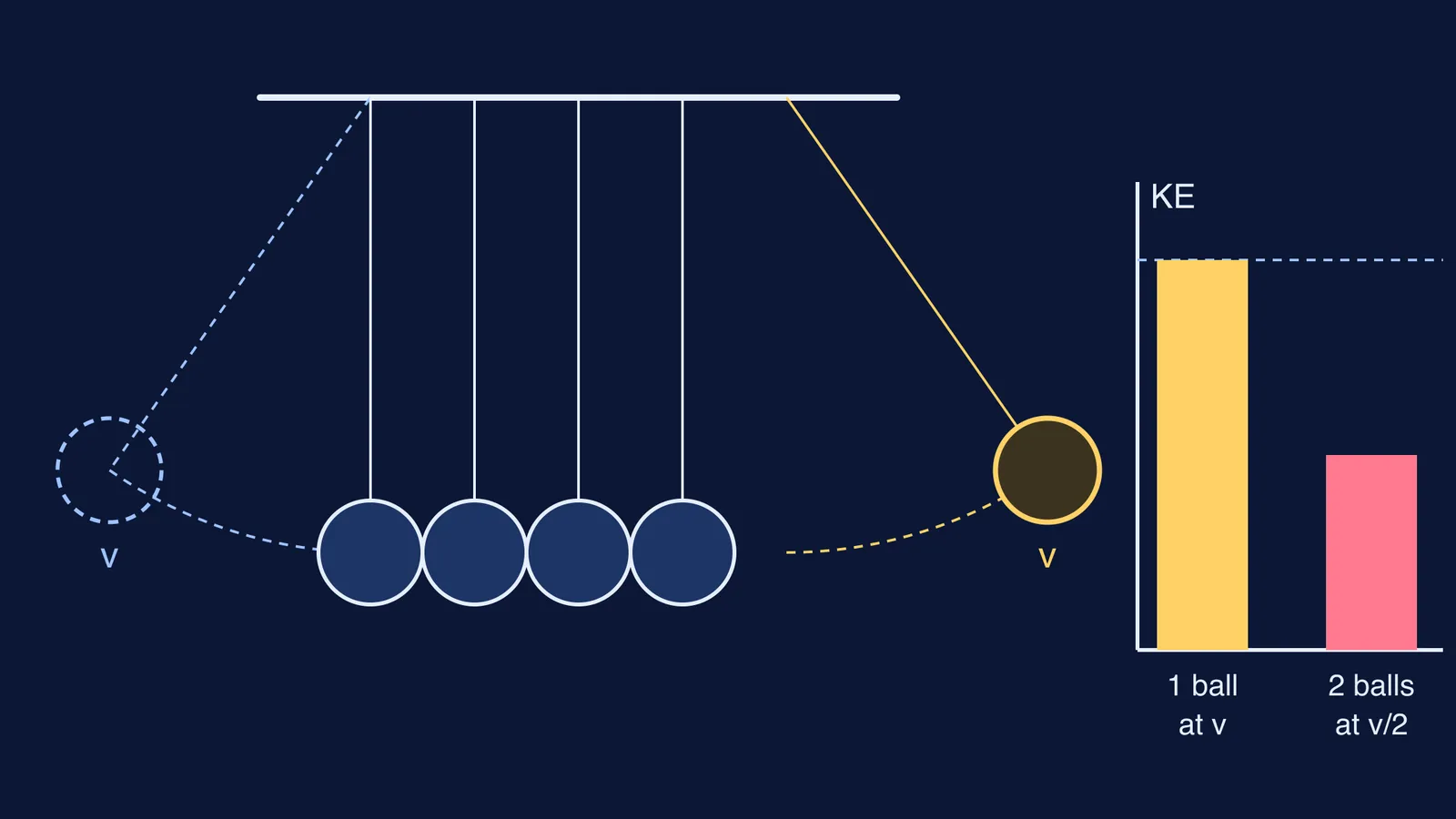
Because the collision has to conserve two things at once. Steel balls collide almost elastically, so the outcome must keep both the total momentum and the total kinetic energy the same as before the hit. The LibreTexts physics text on Newton's cradle makes this exact argument: one ball leaving at speed v carries the incoming energy mv²/2, while two balls leaving at v/2 would carry only mv²/4.
Momentum on its own cannot decide. One ball at v, two balls at v/2 and four balls at v/4 all carry the same momentum, mv. Kinetic energy is the second filter, and only one option passes it.
Can two balls come out at half speed instead?
Test it the way you would on a JEE paper. Let every ball have mass m, and let the incoming ball arrive at speed v.
Before the hit: momentum is mv and kinetic energy is ½mv².
Suppose n balls leave together at the same speed u. Momentum gives nmu = mv, so u = v/n.
Kinetic energy after the hit is n × ½m(v/n)², which simplifies to ½mv²/n.
That equals ½mv² only when n = 1.
For n = 2, the energy after is exactly half of what went in. The other half would have to disappear as heat and sound, which an elastic collision does not allow. So the two-ball outcome fails, as does every n above one.
That result is the equal-mass exchange you meet in every collisions chapter. Our post on a pendulum bob hitting an identical bob works the same exchange with numbers, and the limiting cases of elastic collisions by mass ratio shows what changes when the masses differ.
Is the textbook explanation the whole story?
Not quite. The 2004 paper Rocking Newton's cradle, by Stefan Hutzler and colleagues at Trinity College Dublin, points out that a cradle of N balls has N unknown velocities, while the conservation laws give only two equations. The proof above gets around this by assuming that the balls that move all leave at one shared speed while the rest stay still.
The same paper notes that the question is old. In 1662, papers on the cradle's physics reached the Royal Society from John Wallis, Christopher Wren and Christiaan Huygens, and Huygens pointed out that an explanation needed conservation of both momentum and the quantity we now call kinetic energy.
Real balls squash slightly where they touch. The Hutzler paper reports that simulations of a five-ball cradle by Herrmann and Seitz (1982) found balls 4 and 5 both moving forward after the first collision, with ball 4 carrying about 12% of the initial momentum. Hutzler's team also found, in experiments and simulations, that after many collisions all the balls swing together with shrinking amplitude, an effect they trace to energy lost in each impact.
So one ball out is the ideal-collision answer, and it is close to what you see in the first few swings.
How do you write this in an exam answer?
When a question asks "why not two balls?" or hands you a collision outcome to check, run this checklist:
Write momentum before and after.
Write kinetic energy before and after, and state whether the collision is elastic.
Test the suggested outcome against both equations, not just one.
If it passes momentum but fails energy, say how much energy goes missing, like the half in the two-ball case.
For equal masses in a head-on elastic hit, state the exchange: the striker stops and the target leaves with its speed.
A two-line answer that covers it: "Two balls at v/2 conserve momentum but carry only half the initial kinetic energy. An elastic collision cannot lose energy, so one ball leaves at v."
If you keep reaching the right equations but slipping on the method, the Fermi Problem Library has worked collision problems with a step-by-step solver that explains the reasoning rather than printing an answer.
What happens if you pull back two balls?
Run the same algebra. Two balls arriving at v bring momentum 2mv and kinetic energy mv². If n balls leave at speed u, then nu = 2v and nu² = 2v², which gives u = v and n = 2. Two in, two out.
Make the prediction before you watch it. Our post on predicting Newton's cradle outcomes with a simulation walks through guess-then-check, and the Fermi Simulation Lab has interactive simulations for ideas that are easier to see than to read.