

On this page
A Newton's cradle looks like a toy, but it is one of the cleanest tests of two conservation laws you meet in Class 11. Make three predictions before you read the explanation.
What happens when you lift one, two or three balls?
Take a five-ball cradle. Write down your answer to each question before you try it or watch a video.
You lift one ball and let go. How many balls swing out the far side?
You lift two balls together. Could one ball fly out at twice the speed instead of two?
You lift three balls. What does the middle ball of the five do?
The usual results: one in, one out; two in, two out; three in, three out. The third case is the surprising one: the middle ball belongs to both the incoming and the outgoing group, so it never sits still.
Why does a Newton's cradle swing out the same number of balls?
Two laws hold in every collision of the cradle, if we treat the steel balls as perfectly elastic. Total momentum (mass times velocity) is the same before and after. Total kinetic energy (half of mass times speed squared) is also the same before and after.
Each law alone allows many outcomes. Only one simple outcome satisfies both, and Class 11 algebra is enough to check it.
Can momentum and energy prove it? A worked check
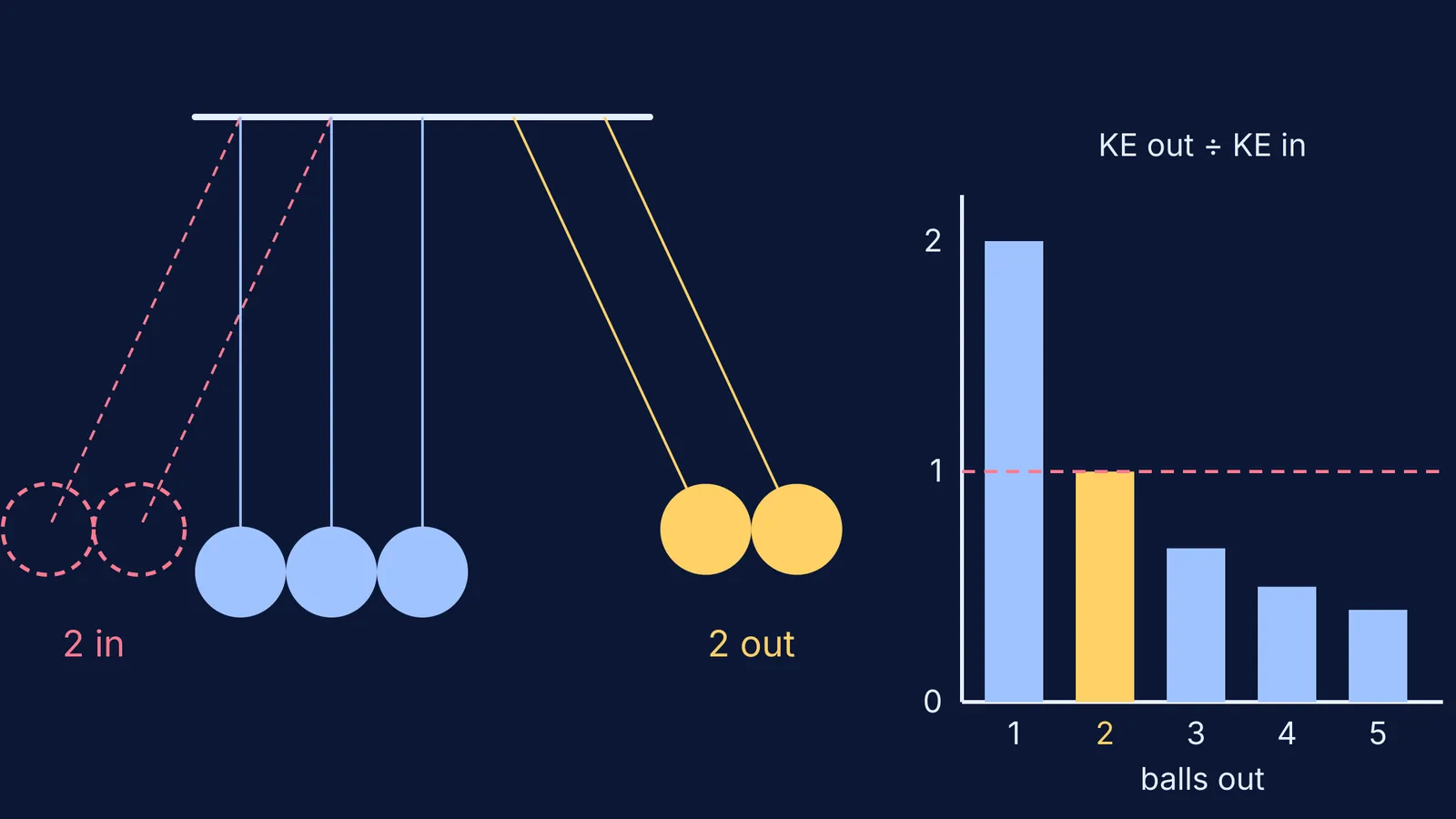
Say each ball has mass m. You lift two balls and they arrive at speed v. Going in, the momentum is 2mv and the kinetic energy is ½ × 2m × v², which is mv².
Now test the outcomes.
One ball out. To carry momentum 2mv, it must move at 2v. Its energy is ½ × m × (2v)², which is 2mv². That is twice what came in, so it is impossible.
Three balls out. To carry momentum 2mv, each moves at 2v/3. Their energy is ½ × 3m × (4v²/9), which is about 0.67mv². A third of the energy vanished, which an elastic collision does not allow.
Two balls out. Each moves at v. Momentum 2mv, energy mv². Both match.
The general version is short. Let k balls come in at speed v and n balls go out at speed u. Momentum gives nu = kv. Energy gives nu² = kv². Divide the second by the first and you get u = v, and then n = k. The diagram above plots this check for two lifted balls.
For more practice, see when to use energy conservation instead of Newton's laws.
Is the textbook story the whole truth?
Not quite. In 1981, the physicists F. Herrmann and P. Schmälzle showed that conservation of energy and momentum alone are not sufficient to explain the cradle (American Journal of Physics, 1981). One way to see the gap is counting: five balls have five unknown velocities, but conservation gives only two equations. The algebra above quietly assumed that the outgoing balls share one speed and the rest stay still. Their extra condition is that the chain of balls must carry the energy pulse without dispersion, meaning without spreading it out.
Real balls are slightly squashy, so the pulse does spread a little. A 2004 study by Stefan Hutzler and colleagues at Trinity College Dublin simulated a five-ball cradle and compared it with experiments (Rocking Newton's cradle, American Journal of Physics). They found that the first collision breaks up the line, so every ball moves a little, and that energy losses in the impacts eventually make all the balls swing together. The same paper reports that in an earlier five-ball simulation by Herrmann and Seitz, the second-to-last ball carried about 12% of the incoming ball's momentum. A detailed study of a line of balls hit at one end found the same kind of break-up (Hinch and Saint-Jean, Proceedings of the Royal Society A, 1999).
So the textbook answer is a very good approximation, not an exact law. Our post on the limits of physics simulations explains why a simplified model can still teach the right idea.
How to test your predictions
Use a real cradle, a slow-motion phone video or a simulation.
Predict and write it down. Number of balls out, and roughly how high they rise.
Run the case. Watch the far end, then watch the middle balls.
Check with the two equations. If the result matched, say which outcome each law ruled out.
Look for the small mismatch. After many swings, do the balls start moving together? That is the energy loss the 2004 study described.
See that contrast with our guide to testing elastic and inelastic collisions in a simulation. The Fermi Simulation Lab has interactive simulations for ideas that are easier to see than to read, and Fermi's AI tutor can decide whether to explain, ask or show, running the simulation and checking your understanding as it goes.


