

On this page
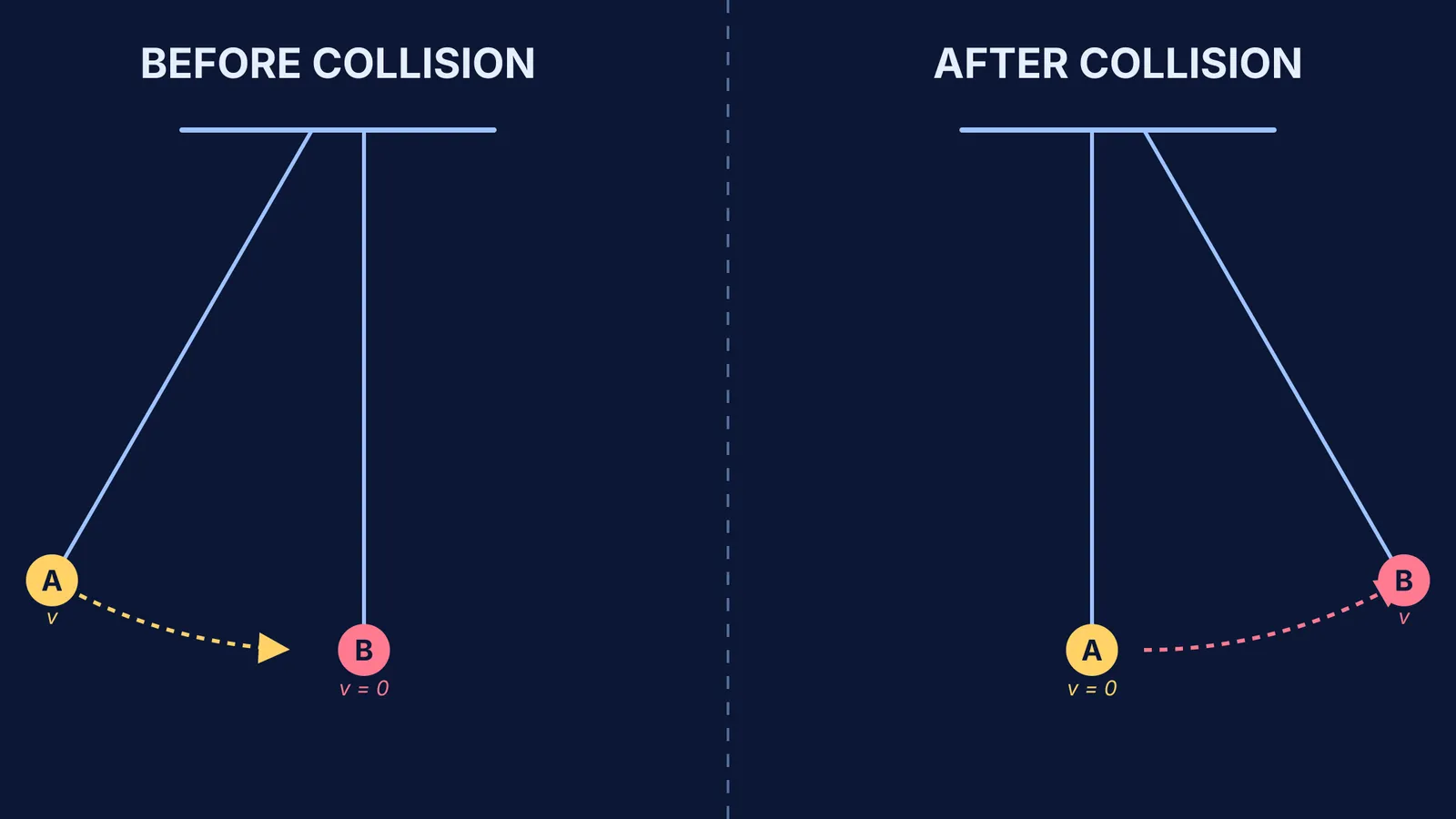
You lift a pendulum bob (Bob A) to a height h and let it go. At the very bottom of its swing, when it is moving fastest, it crashes into a second, identical pendulum bob (Bob B) hanging at rest. If the collision is perfectly elastic, what happens next?
The result is surprisingly clean: Bob A stops dead in its tracks at the point of impact, and Bob B instantly shoots forward, eventually swinging up to the exact same height h.
Why does the first bob stop?
To find out what happens after any collision, physicists use two strict accounting rules. First, the total momentum of the system must remain exactly the same. Momentum depends on mass and velocity, tracking the overall forward drive of the system. Second, because the collision is perfectly elastic, no kinetic energy can be lost to heat, sound, or deformation. Kinetic energy depends on mass and the square of the velocity, imposing a second, stricter limit on the outcome.
According to OpenStax University Physics, when you set up the equations for Collisions and momentum: elastic, inelastic and restitution with two objects of equal mass, the mass variables cancel out completely. The math leaves only one valid solution where one object was initially at rest: the objects must perfectly swap their velocities. The equations forbid any scenario where the first bob retains even a fraction of its forward speed without breaking one of the two accounting rules.
Since Bob B was stationary (v = 0) before impact, Bob A must take on that velocity and stop completely. Bob B takes Bob A's velocity and moves forward.
How high does the second bob go?
Because Bob B takes all of Bob A's kinetic energy at the bottom of the swing, it begins its upward arc with exactly the same speed Bob A had just before the crash.
As Bob B swings upward, gravity slows it down, converting that kinetic energy back into gravitational potential energy. Since both bobs have the same mass, Energy changes in a swinging pendulum: PE, KE and speed dictate that Bob B will run out of speed at exactly the height h from which Bob A was originally released.
What if two bobs moved at half speed?
A common intuition—and a frequent trap in physics exams—is to assume the striking bob pushes the stationary bob along, and they both swing upward together.
If Bob A and Bob B stuck together and moved at half the speed (v/2), the total momentum would indeed be conserved. However, the kinetic energy would not be. The kinetic energy of a mass 2m moving at speed v/2 is only half of the original kinetic energy (K = ½(2m)(v/2)² = ¼mv²). According to HyperPhysics, this massive loss of energy means the collision would be completely inelastic, not elastic.
Reading the physics before grinding the algebra
Exam problems often try to hide this simple velocity swap inside complex setups, pushing you to write out long, error-prone quadratic equations for momentum and energy.
If you find yourself stuck solving quadratic equations when the masses are identical, the Fermi Problem Library will flag the mathematical heavy lifting. The AI tutor steps in to point out the symmetry shortcut, helping you learn to recognize these physical constraints instantly rather than grinding through the algebra from scratch.


