

On this page
A pendulum swinging back and forth is a classic demonstration of the law of conservation of energy. If you pull the bob back and let it go, it continuously trades height for speed. But what exactly happens to its kinetic and potential energy during the swing, and how can you calculate its velocity?
Where do kinetic and potential energy peak during a swing?
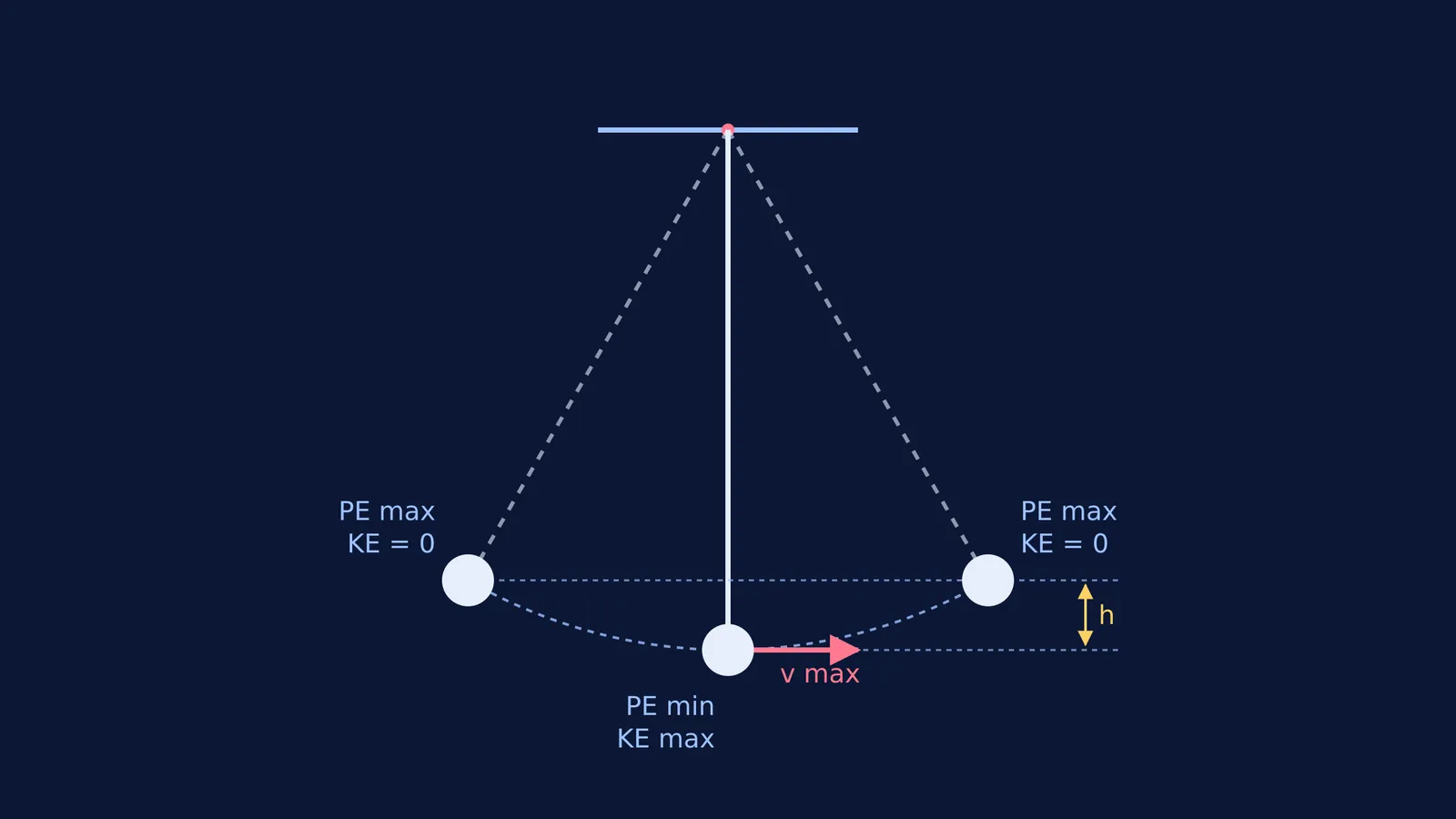
In an ideal system with no friction, the pendulum's total mechanical energy—the sum of its gravitational potential energy (PE) and kinetic energy (KE)—remains constant (HyperPhysics). As the pendulum moves, energy shifts from one form to the other:
At the highest point (the ends of the swing): The bob stops momentarily before reversing direction. Here, its speed is zero, meaning its kinetic energy is zero. Its height is at a maximum, so its potential energy is at its peak (PE = mgh).
At the lowest point (the equilibrium position): The bob has fallen as far as the string allows, meaning its potential energy is at its minimum (often defined as zero). All the potential energy has been converted into kinetic energy, giving the bob its maximum speed (KE = ½mv²).
In between: As the bob falls, it loses height and gains speed (PE turns into KE). As it swings back up, it loses speed and gains height (KE turns back into PE).
If you need to review these energy exchanges, the Fermi Concept Library has a lesson for every concept in physics.
How do you find the speed at the bottom from the release height?
Because mechanical energy is conserved, the potential energy the bob has at the top of its swing is exactly equal to the kinetic energy it has at the bottom (HyperPhysics). We can use this to find its maximum velocity.
At the highest point, total energy equals mgh. At the lowest point, total energy equals ½mv².
Setting them equal gives mgh = ½mv².
Notice that the mass (m) cancels out on both sides, leaving gh = ½v².
Solving for velocity (v) gives v = √(2gh).
This means the speed of the pendulum at its lowest point depends only on the acceleration due to gravity (g) and the vertical height (h) from which it was dropped. The mass of the bob does not matter at all.
If you often make mistakes when setting up these energy equations or dealing with forces at an angle, such as string tension in a simple pendulum, the Fermi Problem Library provides worked problems with a step-by-step solver that explains the reasoning rather than printing an answer.
Why does a swinging pendulum slowly die down?
In physics problems, we usually pretend the pendulum swings in a vacuum with a frictionless pivot. In that ideal case, it would swing back and forth to the exact same height forever.
In the real world, a pendulum's swing gradually decays—a process known as damping. This happens because the system is not perfectly isolated:
Air resistance (drag): As the bob moves through the air, it collides with air molecules, doing work to push them aside.
Friction at the pivot: The point where the string or rod attaches to the support experiences mechanical friction as it rubs back and forth.
Together, these non-conservative forces slowly bleed mechanical energy out of the pendulum, converting it into thermal energy (heat). Because the total mechanical energy decreases with each swing, the maximum height the bob can reach drops steadily until the pendulum comes to a complete stop at the equilibrium position. The period of the swing, however, remains remarkably constant even as the amplitude shrinks, which is why pendulums are so useful in clocks (you can read more about how the period of a seconds pendulum changes).
For students solving mechanics problems, remembering that PE + KE remains constant is the key to solving everything from pendulums to rollercoasters.


