On this page
Two coils wound one inside the other are the standard Class 12 and JEE picture of mutual induction. Change the current in one, and an emf appears in the other. How strongly they are linked is one number, the mutual inductance M. Below we derive it two ways, show why they must agree, and work a full numerical.
What is mutual inductance?
The mutual inductance of coil 2 with respect to coil 1 is the flux through all N2 turns of coil 2, produced by the current in coil 1, divided by that current: M21 = N2Φ21/I1, as defined in OpenStax University Physics Volume 2.
Its SI unit is the henry, and 1 H = 1 V·s/A (OpenStax). In practice it tells you the emf you get in one coil per unit rate of change of current in the other: emf2 = −M dI1/dt. If you want to see that emf show up only while the current is changing, our post on the galvanometer kick in mutual induction walks through it.
How do you derive M for two long coaxial solenoids?
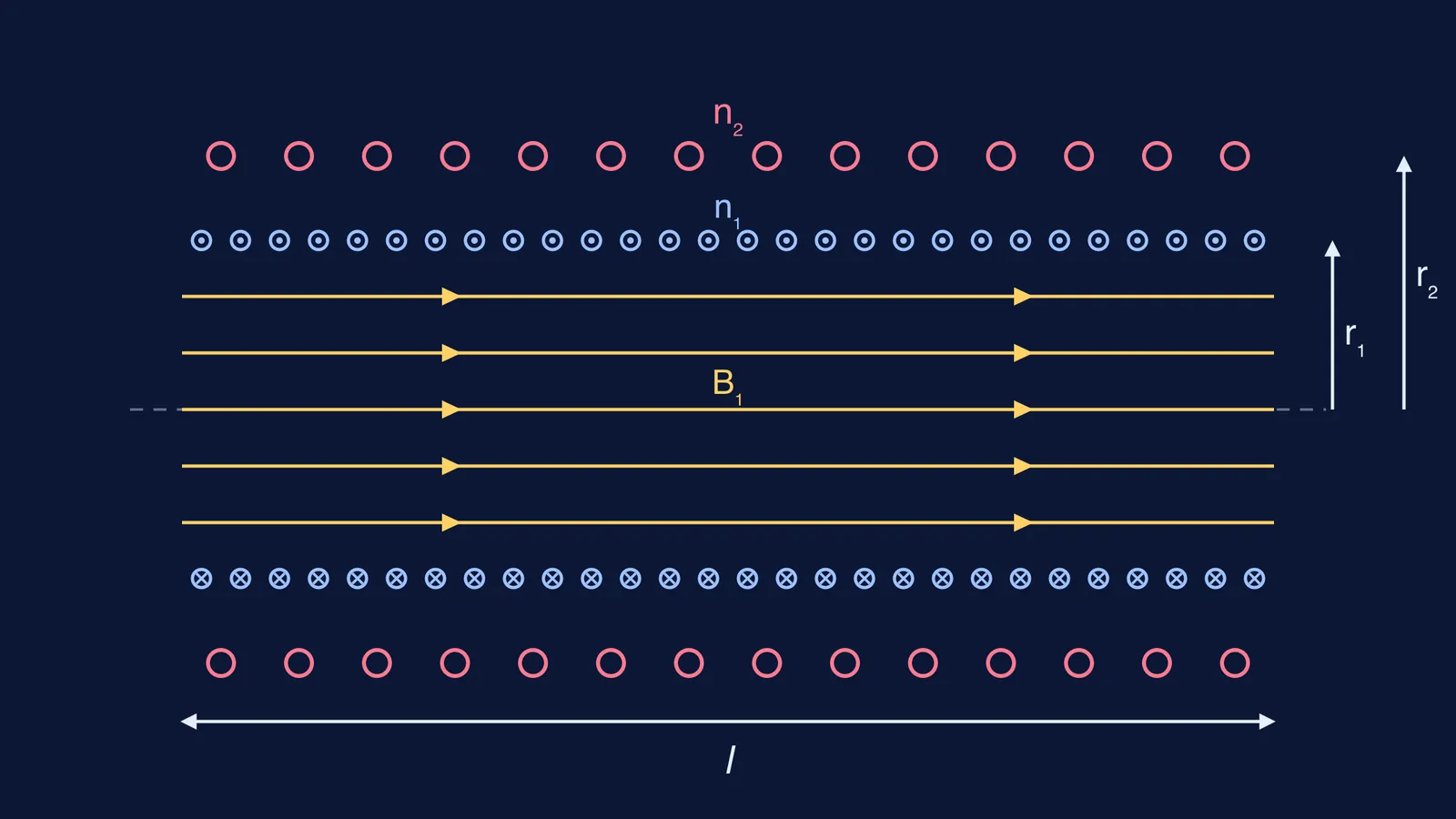
Take an inner solenoid S1 of radius r1 with n1 turns per metre, and an outer solenoid S2 of radius r2 with n2 turns per metre. Both have length l, and l is much larger than r2, so end effects can be ignored. This is the same long-solenoid assumption used in the self-inductance of a long solenoid.
Route 1: current in the outer coil.
Pass current I2 through S2. Inside it the field is uniform: B2 = μ0n2I2 (here is why the field inside a long solenoid is uniform).
Each turn of S1 encloses area πr1², so the flux through one turn is B2πr1².
S1 has n1l turns, so the total flux linkage is N1Φ1 = (n1l)(μ0n2I2)(πr1²).
Divide by I2: M12 = μ0n1n2πr1²l.
Route 2: current in the inner coil.
Pass current I1 through S1. Now B1 = μ0n1I1, but only inside S1. In the gap between r1 and r2 the field of a long solenoid is close to zero.
Each turn of S2 has area πr2², but field passes through only the inner πr1² of it. So the flux through one turn is B1πr1², not B1πr2².
S2 has n2l turns, so N2Φ2 = (n2l)(μ0n1I1)(πr1²).
Divide by I1: M21 = μ0n1n2πr1²l.
Both routes agree. Neville Harnew's Oxford lecture notes on self and mutual inductance do both calculations for a shorter coil inside a longer one, neglect stray fields, and reach M12 = M21.
Why is M12 equal to M21?
The coaxial case is a check, not a proof. The general reason is Neumann's formula, which writes the mutual inductance of two loops as μ0/4π times a double line integral of dl1·dl2 divided by the distance between the two elements (Wikipedia: Inductance). Swapping the two loops leaves that integral unchanged, so M12 = M21 for any shape.
The same article gives a second argument from energy: the stored magnetic energy is a single function of the currents, and the integrability condition on it requires Lmn = Lnm (Wikipedia: Inductance). The practical result: put the current in whichever coil makes the flux easier to find. For coaxial solenoids, that is the outer coil.
How do you calculate M in a numerical?
An inner solenoid has radius 2.0 cm and 1000 turns; an outer solenoid has radius 3.0 cm and 500 turns. Both are 50 cm long. Find M, and the emf in the outer coil when the inner current rises at 50 A/s.
Use μ0 = 1.25663706127 × 10⁻⁶ N A⁻², the CODATA 2022 value from NIST.
Turns per metre: n1 = 1000/0.50 = 2000 m⁻¹, n2 = 500/0.50 = 1000 m⁻¹.
Inner area: πr1² = π(0.020)² = 1.257 × 10⁻³ m².
M = μ0n1n2πr1²l = (1.2566 × 10⁻⁶)(2000)(1000)(1.257 × 10⁻³)(0.50) = 1.58 × 10⁻³ H, or about 1.58 mH.
emf in the outer coil: M × dI1/dt = (1.58 × 10⁻³)(50) = 0.079 V, or 79 mV.
If you had used r2 by mistake, you would get 3.55 mH, which is (3/2)² = 2.25 times too large. That factor is the ratio of the two areas.
The coupling coefficient is k = M/√(L1L2) and lies between 0 and 1 (Wikipedia: Inductance). Here L1 = μ0n1²πr1²l = 3.16 mH and L2 = μ0n2²πr2²l = 1.78 mH, so k = 1.58/√(3.16 × 1.78) = 0.67. Do the algebra and the n's cancel: for equal-length coaxial solenoids, k = r1/r2 = 2/3.
If your answer keeps coming out too big by the ratio of the areas, try similar questions in the Fermi Problem Library, where the step-by-step solver explains the reasoning rather than printing an answer. If the flux picture itself is fuzzy, the Fermi Concept Library gives each physics concept its own lesson and its place in the map.