

On this page
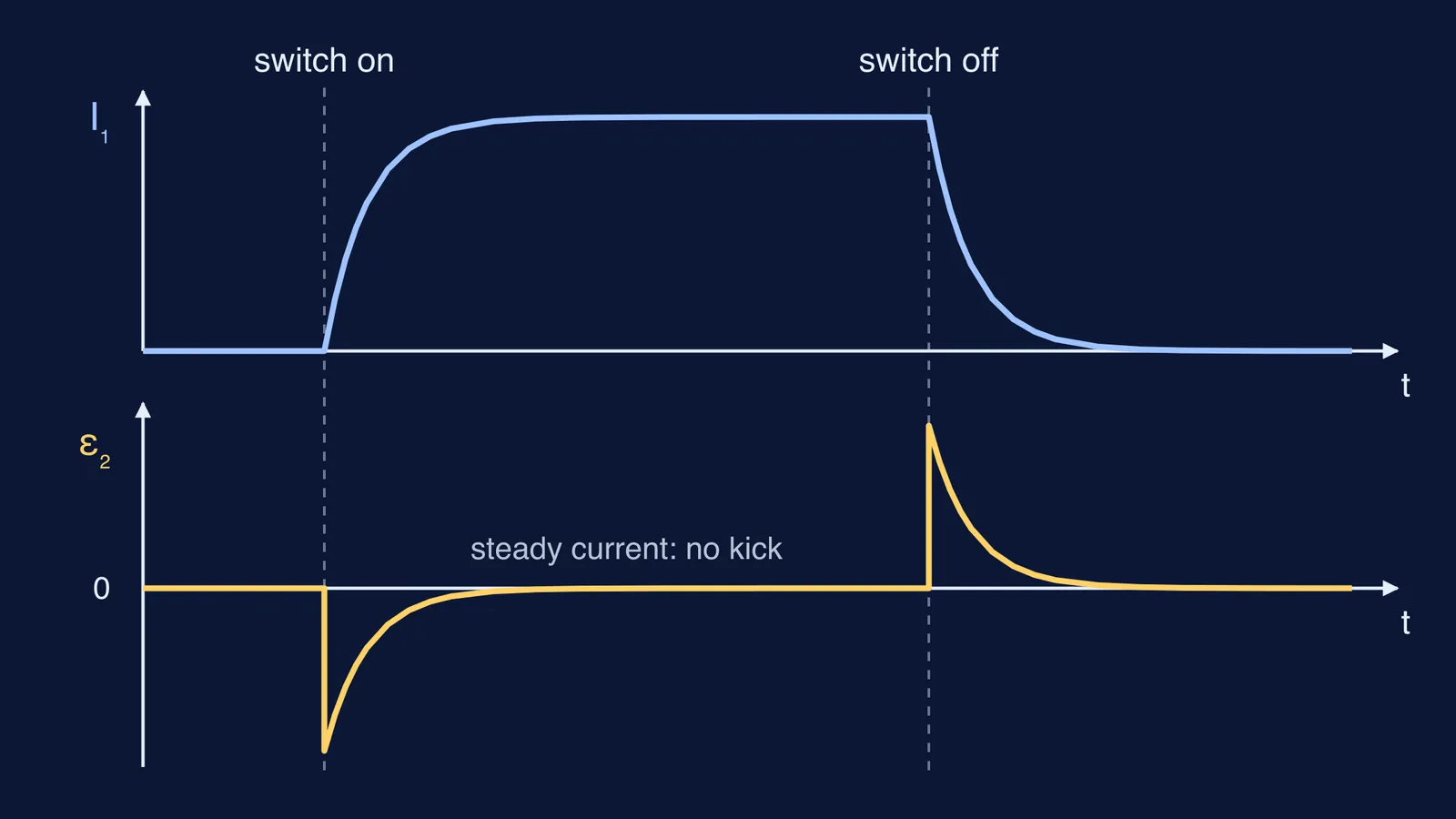
Press the key and the galvanometer on the other coil jumps, then settles to zero. Hold it: nothing. Release it: the needle jumps the other way. That is mutual induction in its simplest form, and it turns up in board practicals and JEE questions alike.
Why does the galvanometer deflect only when the switch is pressed or released?
An induced emf depends on how fast magnetic flux changes, not on how much flux there is. Faraday's law states that the induced emf is the negative rate of change of magnetic flux, ε = −dΦ/dt (OpenStax University Physics, Faraday's law).
The battery coil is the primary; the galvanometer coil, sitting in its field, is the secondary. Mutual inductance M links the two: the emf in coil 2 is ε₂ = −M dI₁/dt, and M depends only on the shapes and relative positions of the coils, not on the currents (OpenStax, mutual inductance).
So the experiment has three phases:
Switch on: I₁ climbs from zero in a fraction of a second, so dI₁/dt is large and the needle kicks.
Key held: I₁ is constant, so ε₂ = 0, however strong the current.
Switch off: I₁ falls to zero. dI₁/dt has the opposite sign, so the kick reverses.
What did Faraday actually see in 1831?
Michael Faraday's first series of Experimental Researches in Electricity was read to the Royal Society on 24 November 1831 and published in the Philosophical Transactions (DOI 10.1098/rstl.1832.0006). With two copper helices interleaved on a block of wood, he wrote: “When the contact was made, there was a sudden and very slight effect at the galvanometer, and there was also a similar slight effect when the contact with the battery was broken” (text of the paper). He added that the deflection on making contact “was always in one direction” and the one on breaking it “was in the other direction”.
With the coils wound on a welded iron ring, the effect was far stronger, even with a smaller battery. While contact continued, “the needle soon came to rest in its natural position”, and on breaking contact it was “powerfully deflected, but in the contrary direction to that induced in the first instance” (same source). Iron greatly increases the flux each ampere produces, which is why lab versions often put a soft-iron core in the coils.
Which way does the needle kick at switch-on and switch-off?
Lenz's law fixes the direction: the induced emf drives current that opposes the change in flux causing it (OpenStax, Lenz's law). Picture two coils on the same axis, wound the same way.
Switch on: flux through the secondary grows, so the secondary current circulates opposite to the primary current.
Key held: no change in flux, no current.
Switch off: the flux shrinks, so the secondary current circulates the same way the primary current did.
Faraday saw the same: the induced current ran opposite to the battery current at making contact, and with it at breaking. For more practice, work through finding the induced current direction with Faraday's and Lenz's laws.
Worked example: how big is each kick?
Take illustrative numbers, not data from a real experiment: M = 5 mH, the primary current rises from 0 to 2 A in 10 ms, and the secondary circuit (coil plus galvanometer) has 50 Ω resistance.
Average emf at switch-on: ε₂ = M ΔI₁/Δt = 0.005 × 2 / 0.010 = 1 V.
Average induced current: 1 V / 50 Ω = 20 mA, lasting about 10 ms.
Charge through the galvanometer: Q = M ΔI₁ / R = 0.005 × 2 / 50 = 0.0002 C, or 0.2 mC.
Switch-off: say the current falls to 0 in 1 ms. The average emf is 10 V, but the charge is still 0.2 mC, flowing the other way.
Tall and short or low and long, the pulse carries the same charge. See why the charge through a coil does not depend on how fast the flux changes. If a question asks for charge, use Q = MΔI/R and ignore the time.
What makes the kick bigger or smaller?
Bigger change in primary current: bigger kick.
Larger M: more turns, coils closer together, on the same axis, or an iron core.
Faster switching: larger emf, shorter pulse, same charge.
Sliding a rheostat instead of switching: a smaller, slower deflection while the slider moves, in the switch-on direction if the current rises and the switch-off direction if it falls.
Alternating current in the primary: the current never stops changing, so an emf is induced all the time, the principle of a transformer. To go further, read self and mutual inductance: energy in an inductor and LR growth.
If you keep getting the sign wrong, the Fermi Problem Library has worked problems with a step-by-step solver that explains the reasoning rather than printing an answer, so you can see where the direction flipped. If flux itself is the shaky part, the Fermi Concept Library gives each concept its own lesson.
Next time you see that needle twitch, ask one question: what is changing right now?


