On this page
Throw a die 10 times. How many sixes are you most likely to get? The mean, np = 10/6, is no help, because you cannot roll 1.67 sixes. The question asks for the mode: the value of r with the largest P(X = r). One short test finds it for any n and p, and tells you when the answer is two numbers.
What is the most probable number of successes in a binomial distribution?
For X ~ B(n, p), the probability of exactly r successes is P(r) = nCr p^r q^(n − r), where q = 1 − p.
For 0 < p < 1, the mode of a binomial distribution is usually the floor of (n + 1)p, the largest whole number not bigger than (n + 1)p (Binomial distribution, Wikipedia).
When m = (n + 1)p is a whole number between 1 and n, there are two consecutive modes, m − 1 and m, with exactly equal probability (Kyle Siegrist, Random: The Binomial Distribution).
Two edge cases complete the picture. If p = 0 the mode is 0, and if p = 1 the mode is n, as the Wikipedia article above notes.
How does the ratio P(r + 1)/P(r) find the mode?
You do not need to compute every probability. Compare each term with the one after it. Most of the powers cancel:
Write the ratio: P(r + 1)/P(r) = [nC(r + 1) / nCr] × p/q.
Use nC(r + 1) / nCr = (n − r)/(r + 1), so P(r + 1)/P(r) = (n − r)p / ((r + 1)q).
The probabilities climb while this ratio is bigger than 1, that is while (n − r)p > (r + 1)(1 − p).
Expand and cancel the rp terms: np + p > r + 1, so the probabilities climb while r + 1 < (n + 1)p.
The ratio equals exactly 1 only when r + 1 = (n + 1)p, which can happen only if (n + 1)p is a whole number.
So the probabilities rise, peak and fall; Siegrist's text proves the same result by comparing f(k) with f(k − 1) (Random: The Binomial Distribution). The peak is the floor of (n + 1)p.
Worked case 1: what if (n + 1)p is not a whole number?
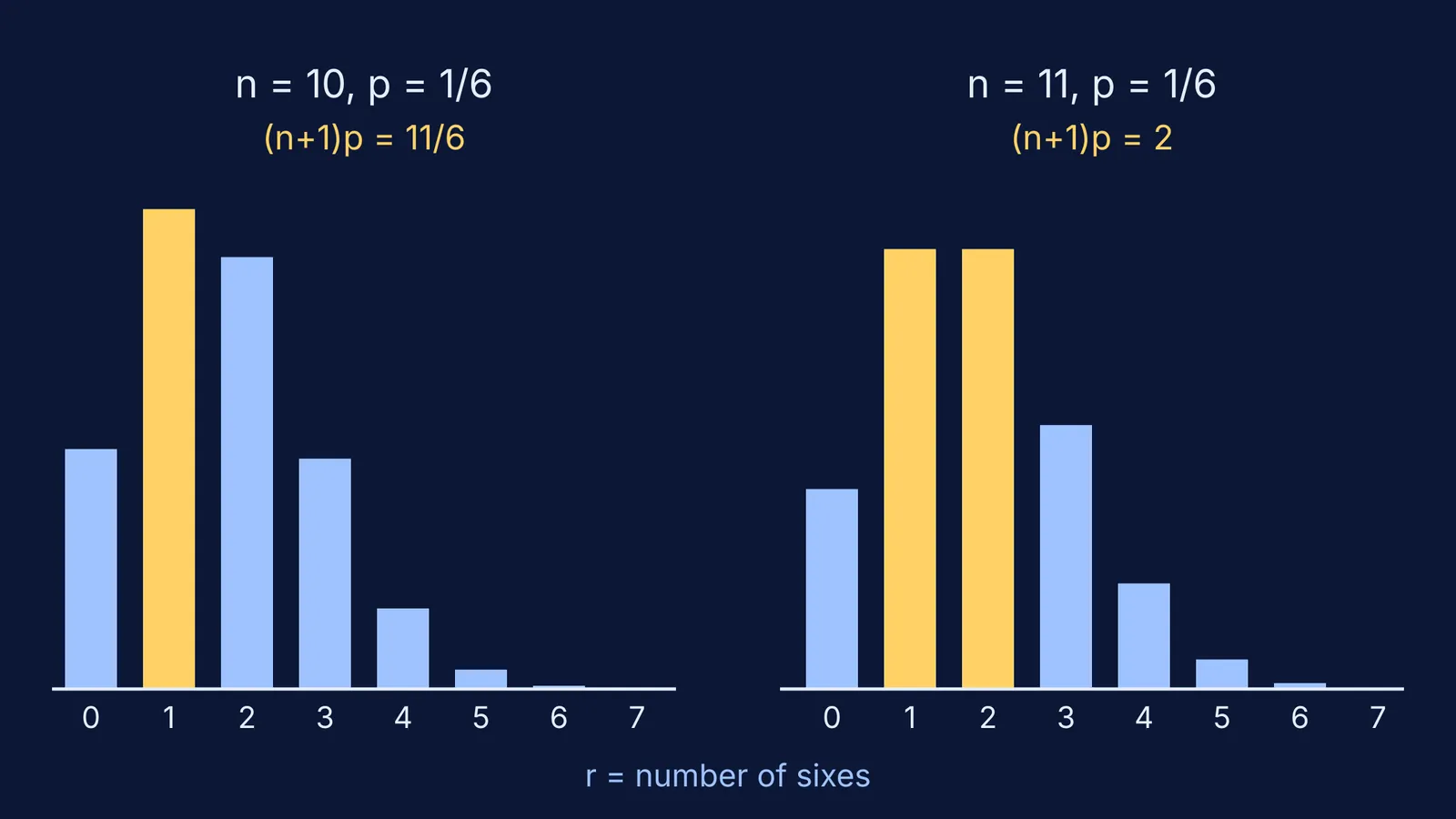
A fair die is thrown 10 times, and a six counts as a success. So n = 10, p = 1/6, q = 5/6. Here (n + 1)p = 11/6 ≈ 1.83, so the rule from the Siegrist text predicts a single mode at 1.
Check it with the ratio. Here P(r + 1)/P(r) = (10 − r)(1/6) / ((r + 1)(5/6)) = (10 − r) / (5(r + 1)).
r = 0: ratio = 10/5 = 2, so P(1) is twice P(0). Still climbing.
r = 1: ratio = 9/10, which is less than 1, so P(2) is smaller than P(1). The climb has stopped.
The actual values agree: P(0) ≈ 0.162, P(1) ≈ 0.323, P(2) ≈ 0.291, P(3) ≈ 0.155. The most likely number of sixes is 1, not the mean of 1.67.
Worked case 2: what if (n + 1)p is a whole number?
Now throw the same die 11 times. Here (n + 1)p = 12 × 1/6 = 2, a whole number between 1 and 11, so the rule for this case predicts two modes, 1 and 2.
The ratio is now P(r + 1)/P(r) = (11 − r) / (5(r + 1)).
r = 0: ratio = 11/5, bigger than 1.
r = 1: ratio = 10/10 = 1 exactly, so P(2) = P(1).
r = 2: ratio = 9/15, less than 1.
Both P(1) and P(2) equal 107421875/362797056 ≈ 0.296. If an exam asks for "the most probable number of sixes", the full answer is "1 or 2". Giving only one of them is incomplete.
How do you avoid mistakes on exam questions about the mode?
Run this checklist before you write the answer:
Name n, p and q, and make sure p is the probability of what the question calls a success.
Compute (n + 1)p, not np. Rounding np = 10/6 gives 2 in case 1, which is wrong, and np = 11/6 in case 2 hides the second mode.
Decide whether (n + 1)p is a whole number. If it is, give two answers.
If you are unsure, test the ratio P(r + 1)/P(r) at the r you found and at the r just below it.
If the binomial formula itself still feels shaky, our posts on why the mean and variance are np and npq and on the 1 − qⁿ shortcut for at least one success build the same tools from the start.
For more practice, the Fermi Problem Library has worked problems with a step-by-step solver that explains the reasoning rather than printing an answer, so you can see where your ratio or your (n + 1)p went wrong. If the binomial distribution is the gap, the Fermi Concept Library gives each mathematics concept its own lesson.