

On this page
Clock-hand area questions look like a new topic, but they are a sector-area question in disguise. Once you turn minutes into an angle, the rest is a formula you already know from Class 10.
How many degrees does the minute hand move in 1 minute?
These sums sit in the NCERT Class 10 Mathematics chapter Areas Related to Circles, and every one starts with the same step: turn time into an angle.
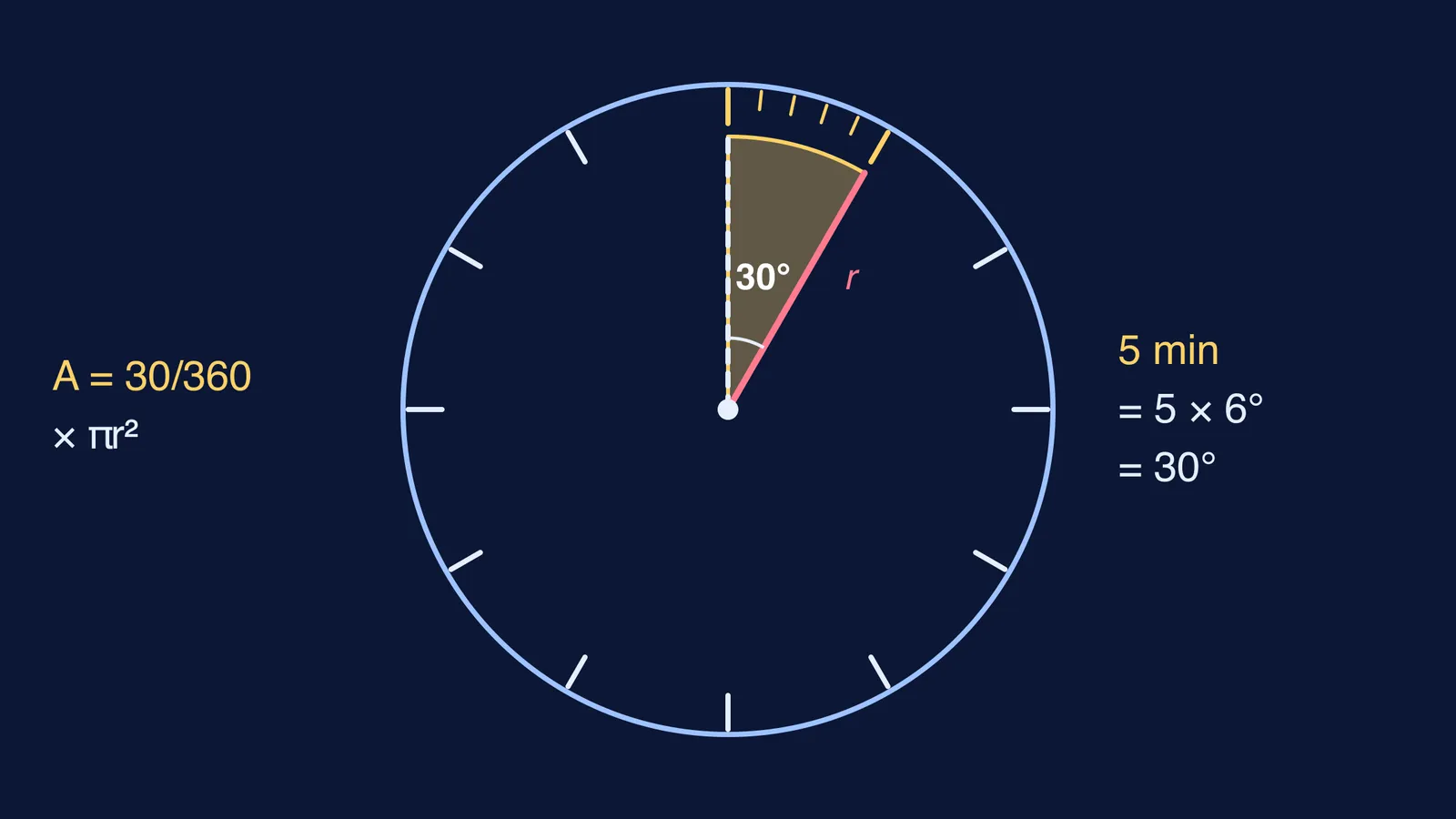
The minute hand goes all the way round, 360°, in 60 minutes. So it turns 360 ÷ 60 = 6° every minute. Five minutes is 5 × 6° = 30°, fifteen minutes is 90°, and half an hour is 180°.
The hour hand is much slower: it turns 360° in 12 hours, which is 30° per hour or 0.5° per minute. For the speeds in radians per second, see our guide to angular speed of clock hands.
What is the area swept by the minute hand in 5 minutes?
The region the hand sweeps is a sector: the part of a circle enclosed by two radii and the arc between them, as defined in the NCERT chapter. The radius is the length of the hand, and the angle is the one you just worked out.
The area of a sector of angle θ (in degrees) is (θ/360) × πr², the formula NCERT derives in the same chapter.
Exercise 11.1, question 3 of that chapter asks exactly this: the minute hand of a clock is 14 cm long, so find the area it sweeps in 5 minutes. The exercise says to use π = 22/7 unless stated otherwise. Worked out:
Angle: 5 minutes × 6° per minute = 30°.
Fraction of the circle: 30/360 = 1/12.
Area of the full circle the hand traces: πr² = (22/7) × 14 × 14 = 616 cm².
Sector area: 616 × 1/12 = 154/3 cm², about 51.33 cm².
So the area swept by a 14 cm minute hand in 5 minutes is 154/3 cm², roughly 51.33 cm².
Is there a faster way to find the area swept by a clock hand?
Yes. Because every minute adds the same 6°, every minute also adds the same slice of the NCERT sector formula: πr² ÷ 60. Call it the area per minute. Then:
Area swept by the minute hand in m minutes = m × πr²/60, for m up to 60.
Area swept by the hour hand in h hours = h × πr²/12, for h up to 12.
For the 14 cm hand, the area per minute is 616 ÷ 60, about 10.27 cm², so 5 minutes gives 5 × 616/60 = 154/3 cm².
If your class uses radians, 30° is π/6 and the sector formula becomes ½r²θ. That gives ½ × 196 × π/6 = 49π/3 cm². With π = 22/7 this is again 154/3 cm²; with a calculator's π it is about 51.31 cm². Use the value of π the question states. For the conversion itself, see degrees to radians, arc length and sector area.
Where do students lose marks on clock-hand sector sums?
Using the hour hand's rate. The hour hand moves 0.5° per minute, not 6°. Read which hand the question names.
Using the clock face instead of the hand. The radius of the sector is the length of the hand, even if the dial is bigger.
Mixing up area and distance. NCERT gives the arc length as (θ/360) × 2πr in the same chapter. In the same 5 minutes, the tip of the 14 cm hand travels an arc of 30/360 × 2 × (22/7) × 14 = 22/3 cm, about 7.33 cm. That is a length, not an area.
Rounding π too early. Keep 22/7 or π as it is until the last line.
If you keep picking the wrong formula, the Fermi Problem Library has worked problems with a step-by-step solver that explains the reasoning rather than printing an answer, so you can see which step went wrong.
Practice set: can you do these in two minutes each?
These follow the pattern of NCERT Exercise 11.1. Use π = 22/7 and a 14 cm minute hand unless stated.
Area swept by the minute hand in 20 minutes.
Area swept by the minute hand in 35 minutes.
Area swept by the minute hand from 9:10 to 9:25.
Area swept by a 7 cm hour hand from 12 o'clock to 2 o'clock.
Answers: (1) 120°, so 616/3 cm², about 205.33 cm². (2) 210°, so 1078/3 cm², about 359.33 cm². (3) 15 minutes is 90°, so 154 cm². (4) 2 hours is 60°, so (1/6) × (22/7) × 49 = 77/3 cm², about 25.67 cm².
If a sector or a radian still feels shaky, the Fermi Concept Library gives every concept in mathematics its own lesson, so you can fix the idea before doing more sums.
For the full set of sector and arc formulas, including clock and wiper sums, read our guide to area of sector and arc length.


