On this page
Chapter 2 of the NCERT Class 11 psychology textbook asks how psychologists study behaviour and mental processes in a way others can check. Each method is good at one job and weak at others. If you can say what each method can and cannot show, this chapter gets much easier.
What are the methods of enquiry in psychology in Class 11?
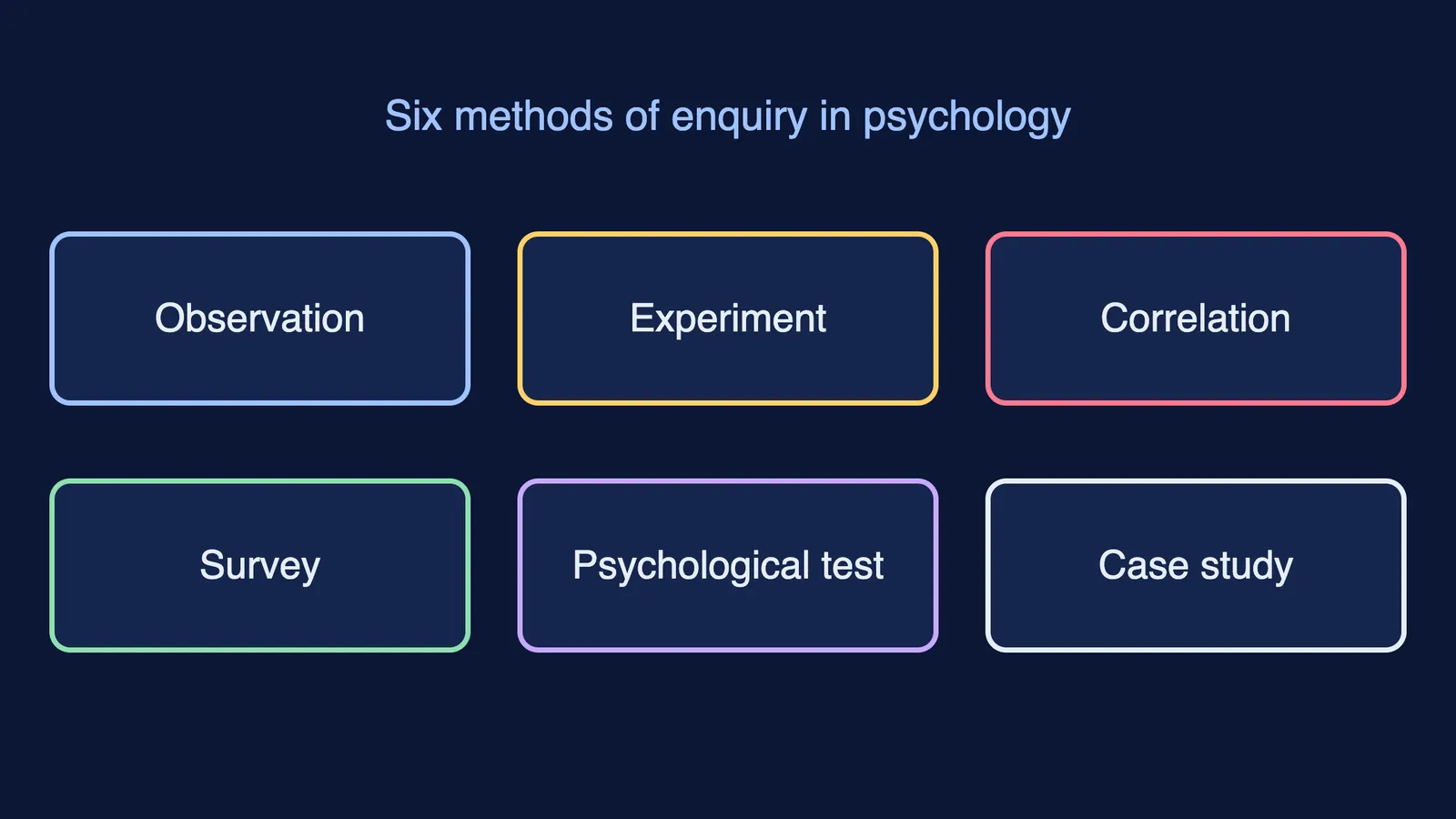
The NCERT chapter Methods of Enquiry in Psychology says observation, experimental method, correlational research, survey, psychological testing and case study are the methods used most often. It sets out the goals of enquiry as description, prediction, explanation and control of behaviour, and application of the knowledge gained.
The goals and methods line up: observation describes, correlation predicts, and experiments establish cause and effect.
How is observation different from an experiment?
In observation, you watch and record behaviour without changing it. The NCERT chapter splits it into naturalistic versus controlled, and participant versus non-participant observation. Its strength is studying people in a natural situation. Its weaknesses: it is labour-intensive, time-consuming and open to the observer's bias.
An experiment changes one factor, the independent variable, and measures its effect on another, the dependent variable, while keeping other relevant factors constant. The textbook's example is a smoke-filled waiting room study by Bibb Latané and John Darley, published in 1968 as Group inhibition of bystander intervention in emergencies. As the NCERT chapter reports it, 75 per cent of students waiting alone reported the smoke. Groups of three students reported it only 38 per cent of the time, and only 10 per cent of students sitting with two people told to do nothing reported it.
The independent variable is whether others are present; the dependent variable is whether the smoke is reported. The textbook notes that lab experiments can have low external validity: results may not carry over to real life. Some problems cannot be studied by experiment because it would be unethical.
What is the difference between correlation and an experiment?
Correlational research measures two variables as they already are and asks whether they move together. According to the NCERT chapter, the correlation coefficient can range from +1.0 through 0.0 to -1.0. Positive means both rise together, negative means one rises as the other falls, and close to zero means no significant relationship.
The textbook's example is study time and marks: a correlation of +.85 would mean a strong positive association. It would not prove that studying longer causes higher marks, because nothing was changed and other factors could explain both. Our guide to correlation vs causation, with examples works through this trap.
When do psychologists use a survey, a test or a case study?
A survey collects opinions, attitudes or facts from many people through interviews, questionnaires or telephone. The NCERT chapter describes a December 2004 magazine survey of 817 people aged 25 to 55 in eight Indian cities, in which about 47 per cent said they were extremely happy. Surveys gather information quickly from thousands of people, but people may misremember, hide what they think, or say what they believe the researcher wants to hear.
A psychological test is a standardised, objective instrument that measures where a person stands on a characteristic such as intelligence or personality, compared with others. A usable test needs reliability, validity and norms, and the textbook says decisions about people should not rely on any single test.
A case study looks in depth at one person, a small group, an institution or an event, using interviews, observation and tests together. The chapter notes that Piaget developed his theory of cognitive development from observations of his three children, and warns you to be very cautious about generalising from individual cases.
How do you choose the right method in an exam answer?
Ask these questions in order and stop at the first yes:
Does it ask whether one thing causes another, and can the researcher change it safely? Experiment.
Does it ask whether two things are related or predict each other? Correlational research.
Does it ask what many people think, feel or do? Survey.
Does it ask you to measure a trait such as intelligence or anxiety? Psychological test.
Is it one person, group or event in depth? Case study. Natural behaviour in a real setting? Observation.
Try it on the textbook's Activity 2.5. "Does noise influence the problem solving ability of the people?" is a cause you can test safely: experiment. "Assessing the anxiety level of Class XI students of your school" measures a trait: test. "Tracing the major life events of your favourite leader" is one person in depth: case study.
Our post on why experiments need a control group shows the same logic in biology. If the correlation coefficient is the hard part, the Fermi Concept Library has a lesson for every concept in physics, chemistry, biology, mathematics and computing.
Parents still deciding can read whether your child should take psychology in Class 11.