

On this page
“Show that A² − 5A + 7I = O, where A = [3 1; −1 2]” is a short question with a useful second half: once the equation is proved, it gives you A⁻¹ in one line, with no minors, cofactors or adjoint. It sits in the Miscellaneous Exercise of the NCERT Class 12 Matrices chapter, as this worked solution of the question records. Here a matrix is written row by row with a semicolon between rows, so [3 1; −1 2] has first row 3, 1 and second row −1, 2.
How do you show A² − 5A + 7I = O?
Work it in three blocks and write each one out. The marks are in the steps, not just the final zero matrix.
Square A. Multiply row by column. Top-left: 3×3 + 1×(−1) = 8. Top-right: 3×1 + 1×2 = 5. Bottom-left: (−1)×3 + 2×(−1) = −5. Bottom-right: (−1)×1 + 2×2 = 3. So A² = [8 5; −5 3].
Scale. 5A = [15 5; −5 10] and 7I = [7 0; 0 7].
Combine entry by entry. Top-left: 8 − 15 + 7 = 0. Top-right: 5 − 5 + 0 = 0. Bottom-left: −5 + 5 + 0 = 0. Bottom-right: 3 − 10 + 7 = 0.
Every entry is zero, so A² − 5A + 7I = O. If one entry comes out non-zero, recheck the square first; a sign slip in the bottom-left of A² is a common culprit.
How do you find A⁻¹ from A² − 5A + 7I = O?
Move the identity term across and factor out A:
A² − 5A = −7I
A(A − 5I) = −7I
A(5I − A) = 7I
A · (1/7)(5I − A) = I
So (1/7)(5I − A) multiplied by A gives I. Because 5I − A is built only from A and I, it commutes with A, so the product in the other order is I too. That is the definition of an inverse: the equation proves A is invertible and finds A⁻¹ at the same time.
Now compute it. 5I − A = [5−3 0−1; 0−(−1) 5−2] = [2 −1; 1 3], so A⁻¹ = (1/7)[2 −1; 1 3].
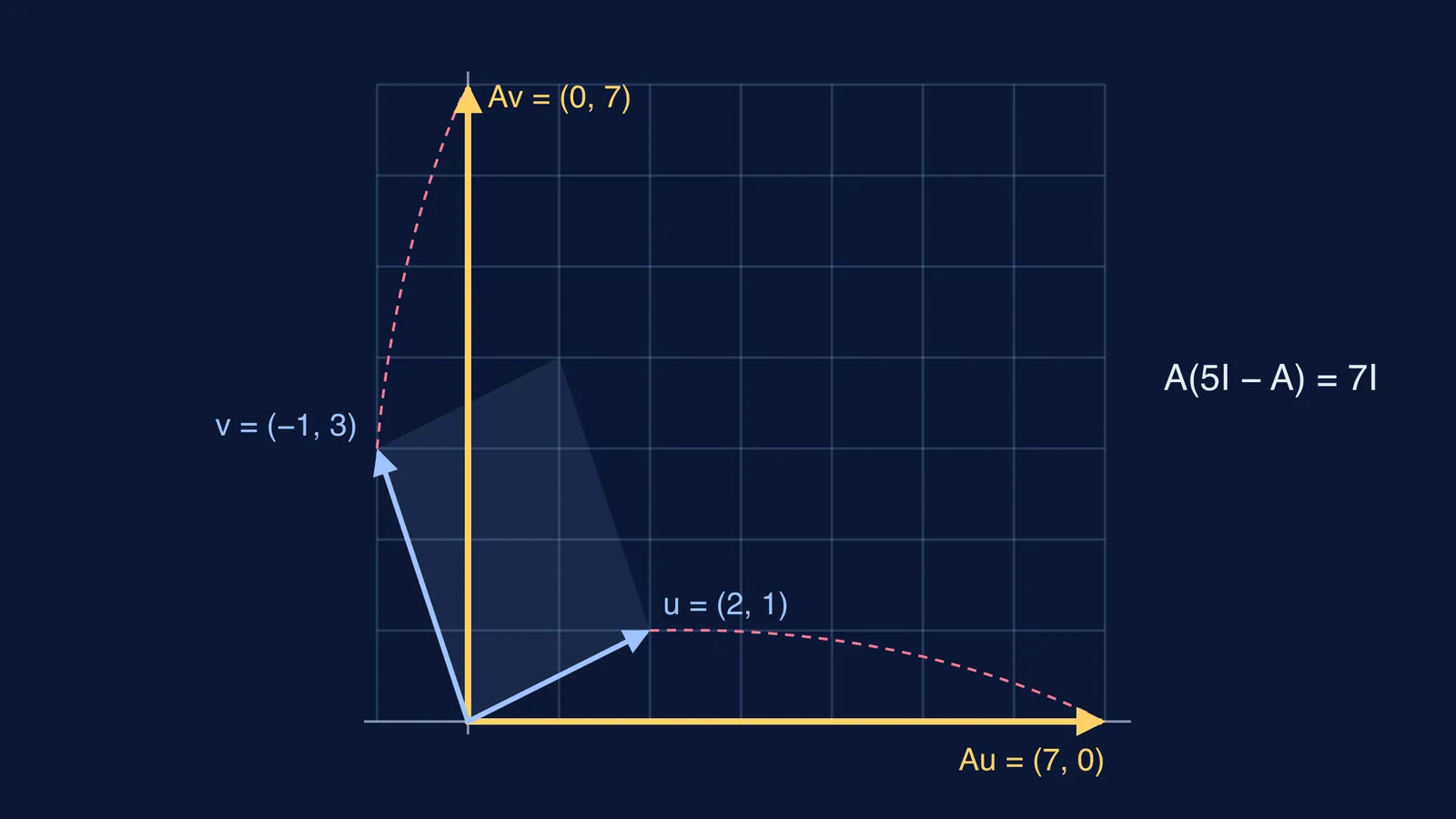
Check it before moving on. A times [2 −1; 1 3] has top row 3×2 + 1×1 = 7 and 3×(−1) + 1×3 = 0, and bottom row (−1)×2 + 2×1 = 0 and (−1)×(−1) + 2×3 = 7. That is 7I, and dividing by 7 leaves I. The diagram at the top shows the same check as arrows: A sends each column of 5I − A onto an axis, at length 7.
Why do the numbers 5 and 7 appear?
They are not random. The trace of A (the sum of its diagonal) is 3 + 2 = 5, and its determinant is 3×2 − 1×(−1) = 7.
The Cayley-Hamilton theorem says every square matrix is annihilated by its own characteristic polynomial; for a 2×2 matrix [a b; c d] that means A² − (a + d)A + (ad − bc)I = O, as Wolfram MathWorld's entry on the theorem sets out. Put in a + d = 5 and ad − bc = 7 and you have this exam question.
The same reasoning gives a general 2×2 shortcut, A⁻¹ = (tr A · I − A)/det A, which is the inverse formula in the Wikipedia article on the Cayley-Hamilton theorem written out for two rows. It is the swap-and-negate rule in disguise: tr A · I − A swaps the diagonal entries and flips the signs off it, as our post on the shortcut for the inverse of a 2x2 matrix explains.
What should your answer look like in the exam?
Use this order so every step is visible:
Write A² as a product and show all four entries.
Write 5A and 7I separately.
Show A² − 5A + 7I entry by entry and conclude “= O”.
Factor out A (or pre-multiply by A⁻¹) to reach A⁻¹ = (1/7)(5I − A).
Give A⁻¹ = (1/7)[2 −1; 1 3] and, if time allows, one line of check.
If the question says “hence”, it is asking you to use the equation you just proved, so build the inverse from it rather than switching to the adjoint. For 3×3 versions the same idea works with a cubic; our walkthrough of the Cayley-Hamilton theorem for finding A⁻¹ and A⁵⁰ shows how, and finding the inverse of a 3x3 matrix step by step covers the adjoint route for comparison.
To practise more “show that, hence find” problems, the Fermi Problem Library has worked problems with a step-by-step solver that explains the reasoning rather than printing an answer. If trace, determinant or the identity matrix still feel shaky, the Fermi Concept Library gives each mathematics concept its own lesson.


