

On this page
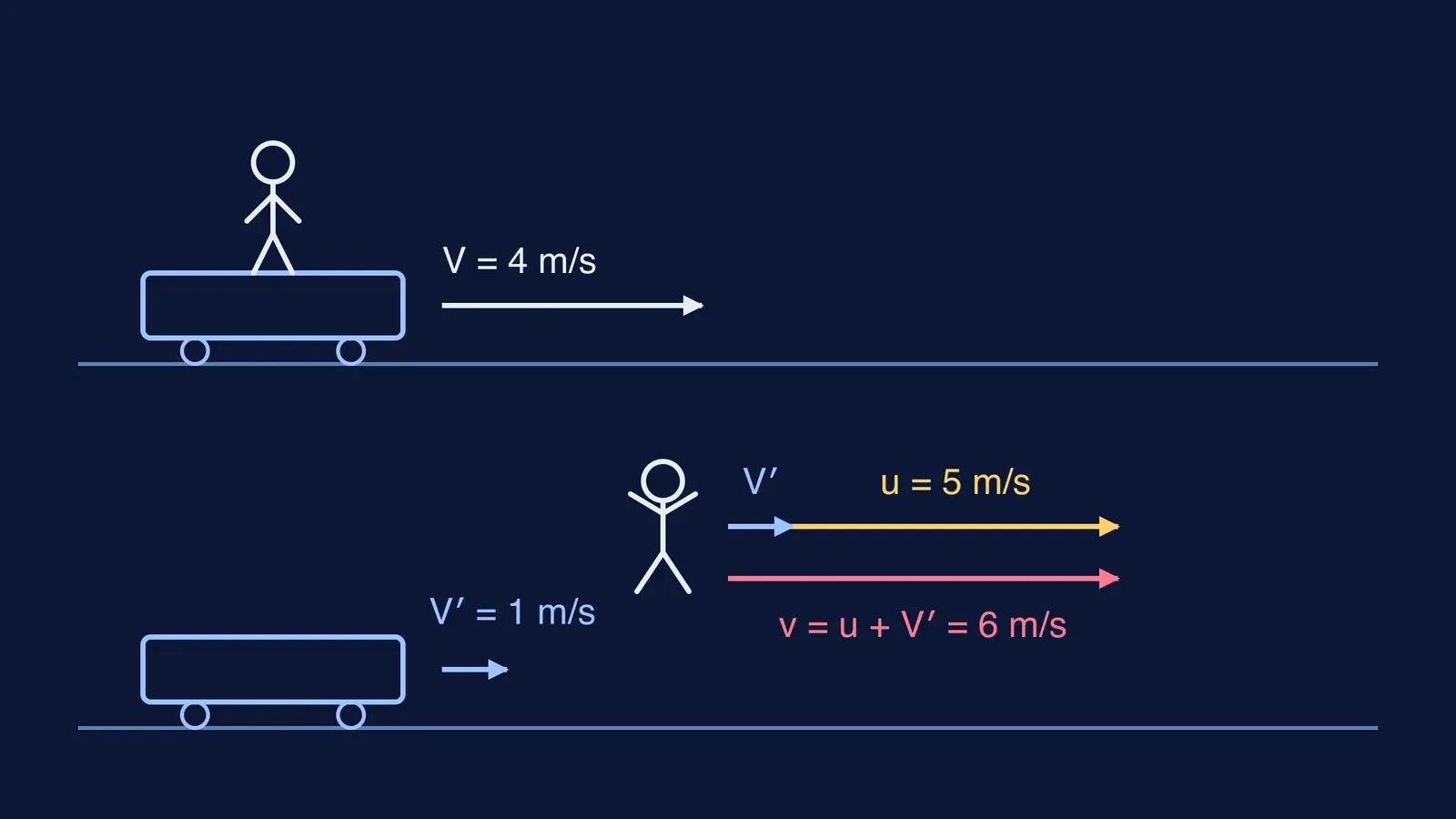
Here is a typical problem. A 60 kg man stands on a 40 kg cart rolling at 4 m/s on a smooth floor. He jumps off forwards with a speed of 5 m/s relative to the cart. How fast is the cart moving afterwards?
Most wrong answers come from one step: deciding which cart velocity the words "relative to the cart" refer to. Get that right and the rest is one line of algebra.
What does "velocity relative to the cart" actually mean?
Relative velocity follows an addition rule. OpenStax University Physics states it as: the velocity of a particle relative to S equals its velocity relative to S′ plus the velocity of S′ relative to S. Here S is the ground and S′ is the cart, so the man's ground velocity is u plus the cart's velocity.
Which cart velocity? The man pushes on the cart only while his feet are on it, and that push changes the cart's speed. By the moment he leaves, the cart already has its new velocity V′, and "5 m/s relative to the cart" is measured against that moving cart.
MIT OpenCourseWare's 8.01SC Classical Mechanics lesson on relative velocity and recoil sets up a person jumping off a cart the same way. In a frame moving with the cart's velocity after the jump, the cart is at rest and the person moves at u, so the person's ground velocity is the cart's velocity plus u (lecture transcript).
How do you solve the man-jumps-off-cart problem?
Take forwards as positive. The floor is smooth, so there is no horizontal external force. In that case the horizontal momentum of the system after the jump equals the momentum before, as the MIT recoil lecture puts it. The system here is the man plus the cart.
Before: (60 + 40) × 4 = 400 kg m/s.
After: the cart moves at V′ and the man at V′ + 5.
Momentum: 400 = 60(V′ + 5) + 40V′ = 100V′ + 300.
So V′ = 1 m/s forwards, and the man moves at 1 + 5 = 6 m/s over the ground.
Check: 60 × 6 + 40 × 1 = 400 kg m/s, the same as before.
For a man of mass m on a cart of mass M moving at V, the same steps give V′ = V − mu/(M + m). With V = 0 this becomes −mu/(M + m), the result the MIT lecture derives for a person jumping off a cart at rest.
What goes wrong if you use the old cart velocity?
The tempting shortcut is to say the man moves at 4 + 5 = 9 m/s. Then 400 = 60 × 9 + 40V′, which gives V′ = −3.5 m/s: the cart shoots backwards.
That answer contradicts the question itself. The man's speed relative to the cart would be 9 − (−3.5) = 12.5 m/s, not the 5 m/s you were given. In the correct solution, 6 − 1 = 5 m/s, which matches the question.
Two signs you have made this slip:
Subtracting your two final velocities does not give back the relative speed in the question.
The cart's velocity before the jump appears on the after side of your momentum equation.
One caution: a few problems say "relative to the ground" or "relative to the cart before the jump". Then use what is written. The u + V′ rule is for the usual wording, "relative to the cart".
Does the rule work if he jumps backwards?
Yes. Put u = −5 m/s. Then V′ = 4 − (60 × −5)/100 = 7 m/s, and the man moves at 7 − 5 = 2 m/s, still forwards over the ground. Check: 60 × 2 + 40 × 7 = 400 kg m/s. Jumping backwards speeds the cart up, and the man can still drift forwards.
The same idea, a velocity given relative to a body that is itself recoiling, runs through gun recoil problems, rocket thrust and exhaust speed and the man walking on a boat.
A 30-second checklist before you write the equation
Label every velocity in the question: relative to the ground or relative to the cart.
Convert to ground velocities using the cart's new velocity: v = u + V′.
Write momentum before = momentum after using ground velocities only.
Solve, then subtract the final velocities to check you get u back.
Try a limiting case: if the cart were very heavy, V′ should barely change from V.
If the frames still feel slippery, the Fermi Concept Library gives relative velocity and momentum conservation each its own lesson. For practice, the Fermi Problem Library has worked problems with a step-by-step solver that explains the reasoning rather than printing an answer, so you can see the exact line where the frame changes.
Next time you see "relative to the cart", write V′ before you write anything else.


