

On this page
You will meet this one in Class 12 vector algebra and again in JEE Main practice: a, b and c are mutually perpendicular unit vectors, so find |2a + b + c|. The answer is √6. The method behind it is to square the vector and let the dot product do the work, and it handles a whole family of questions.
Why do you square a vector to find its magnitude?
You cannot just add the magnitudes. |2a + b + c| is not 2 + 1 + 1 = 4, because the three pieces point in different directions. What you can use is the dot product of a vector with itself: OpenStax Calculus Volume 3 gives the property v · v = ‖v‖². So you square first and take the root last.
Two more facts do the rest. The same chapter states that nonzero vectors are orthogonal if and only if their dot product is zero. And a unit vector has magnitude 1, so a · a = 1.
How do you find |2a + b + c| step by step?
Write the square as a dot product: |2a + b + c|² = (2a + b + c) · (2a + b + c).
Expand it like a bracket and keep every pair: 4(a · a) + (b · b) + (c · c) + 4(a · b) + 4(a · c) + 2(b · c).
Use perpendicularity: a · b, b · c and a · c are all 0, so every cross term vanishes.
Use unit length: 4(1) + 1 + 1 = 6.
Take the square root: |2a + b + c| = √6 ≈ 2.449.
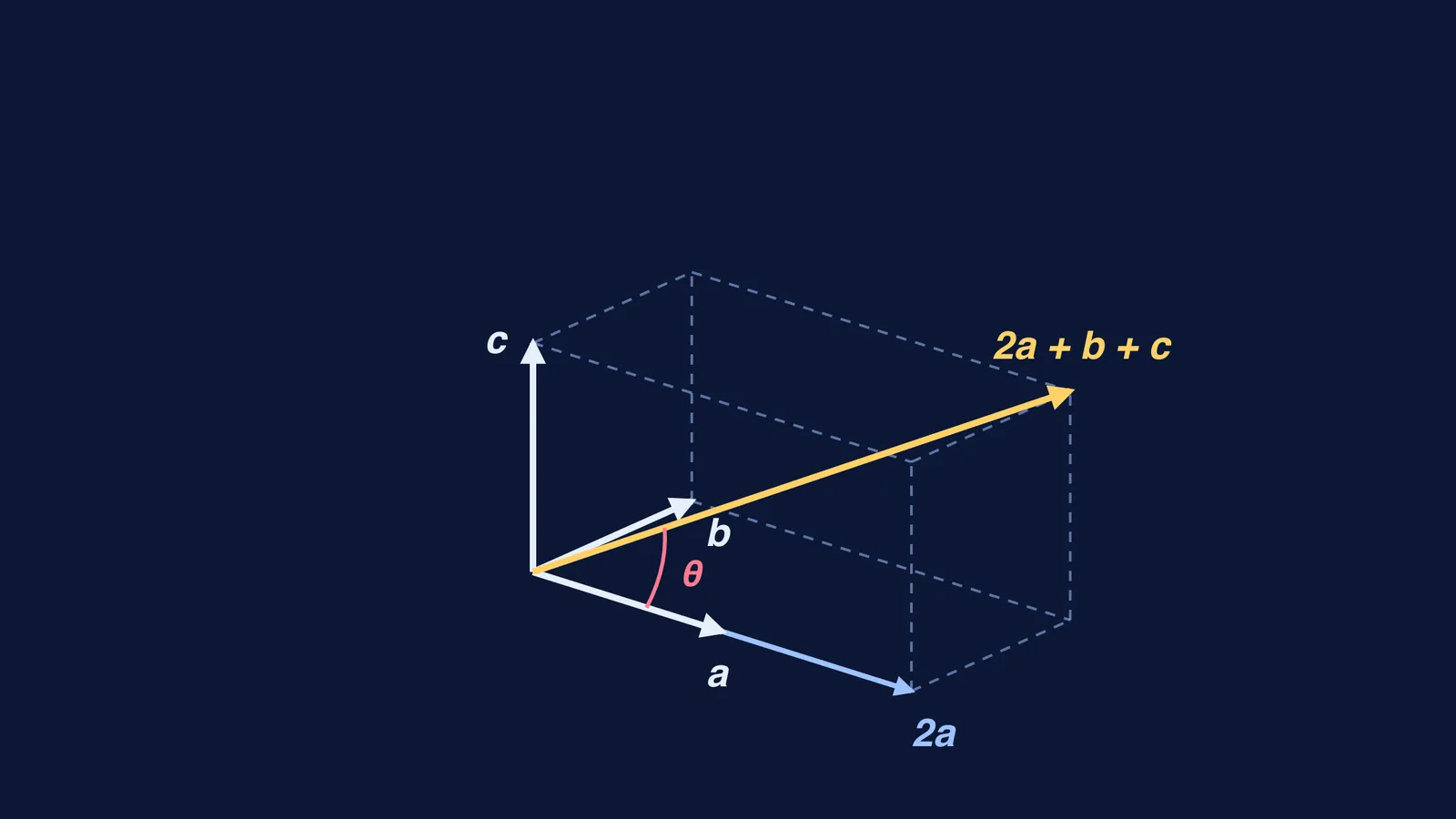
The general rule follows straight away. For mutually perpendicular unit vectors, |pa + qb + rc| = √(p² + q² + r²). That is Pythagoras in three dimensions, and the diagram above shows it: 2a + b + c is the long diagonal of a 2 × 1 × 1 box.
What angle does 2a + b + c make with a, b and c?
Use the angle formula from the OpenStax dot product chapter: cos θ = (u · v) / (|u||v|). Dot the sum with a: (2a + b + c) · a = 2(a · a) + (b · a) + (c · a) = 2. Then divide by |2a + b + c||a|, which is √6 × 1.
With a: cos θ = 2/√6, so θ ≈ 35.26°.
With b: cos θ = 1/√6, so θ ≈ 65.91°.
With c: cos θ = 1/√6, so θ ≈ 65.91°.
These three cosines are the direction cosines of 2a + b + c in the a, b, c frame, and an exercise in the same chapter asks you to show that their squares add up to 1. Here 4/6 + 1/6 + 1/6 = 1, so the numbers check out. The vector leans towards a because a has the biggest coefficient.
The equal-coefficient case is a textbook exercise. NCERT's Class 12 Mathematics Part II asks you to show that if a, b and c are mutually perpendicular vectors of equal magnitude, then a + b + c is equally inclined to all three (question and worked solution). For unit vectors, |a + b + c| = √3 and each angle is cos⁻¹(1/√3) ≈ 54.74°.
For more on the formula itself, see our guide to finding the angle between vectors using the dot product.
What changes if the vectors are not unit vectors?
Only the self terms change. Say |a| = 3, |b| = 4 and |c| = 5, still mutually perpendicular. Then |2a + b + c|² = 4(9) + 16 + 25 = 77, so the magnitude is √77.
If the vectors are unit vectors but not perpendicular, the cross terms stay, and you need the dot products the question gives you. That is the setup in three unit vectors that add to zero. For a quick perpendicularity test, read why equal sum and difference magnitudes mean the vectors are perpendicular.
What should you check in any |pa + qb + rc| question?
Square it: write |v|² = v · v first.
List the self terms: p²|a|², q²|b|², r²|c|².
List the cross terms: 2pq(a · b), 2qr(b · c), 2pr(a · c). Cross out the zeros.
Add them up, and take the root only at the end.
For an angle, dot the sum with the single vector, then divide by both magnitudes.
Sanity check for perpendicular vectors: the answer cannot be smaller than the biggest single piece (2 here) or bigger than the sum of the magnitudes (4 here). √6 ≈ 2.449 fits.
If your answer keeps coming out different, try a similar question in the Fermi Problem Library. Its step-by-step solver explains the reasoning rather than printing an answer, so you can check your work line by line. If the dot product itself feels shaky, the Fermi Concept Library gives each mathematics concept its own lesson.


