

On this page
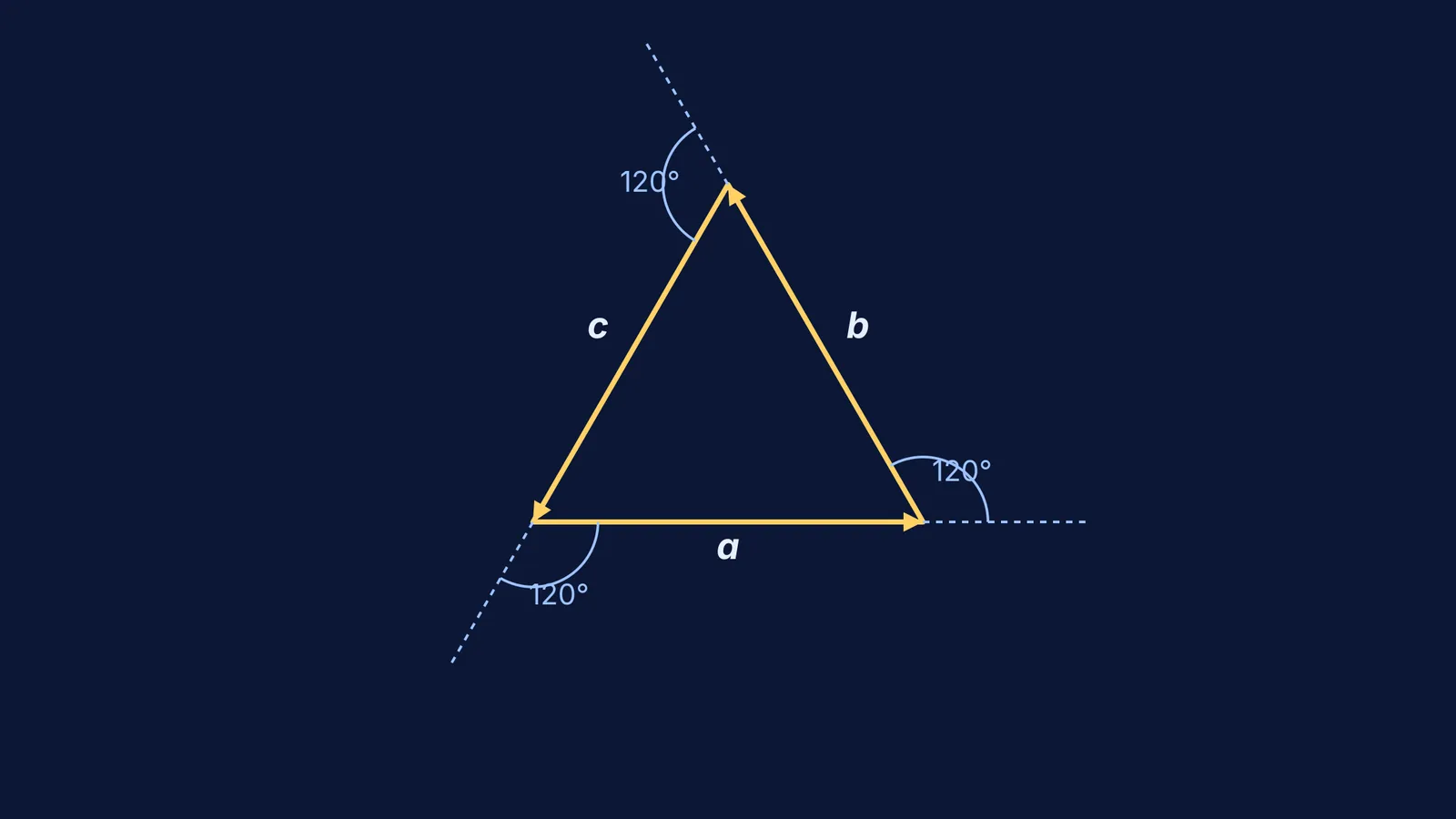
When you place three vectors head-to-tail and they add to zero, they form a closed triangle. If all three are unit vectors (meaning they each have a length of 1), that triangle must be equilateral. This geometry gives us a specific relationship between their directions.
But you do not need to draw the triangle to find the sum of their dot products. The fastest way to solve this common vector algebra problem is algebraic: you square the entire sum.
Why do three unit vectors add to zero?
Vectors that add to zero always form a closed loop when placed head-to-tail. Because these three vectors are unit vectors, their magnitudes are identical. A closed triangle with three equal sides is an equilateral triangle.
How do you find the sum of their dot products?
The problem gives two pieces of information:
The vectors add to zero: a + b + c = 0
They are unit vectors, so their magnitudes are 1: |a| = |b| = |c| = 1
To find the dot product sum (a·b + b·c + c·a), you square both sides of the zero-sum equation. According to the identity for the magnitude of a sum of three vectors, squaring a + b + c gives:
|a + b + c|² = |a|² + |b|² + |c|² + 2(a·b + b·c + c·a)
Since a + b + c = 0, the left side is 0.
0 = |a|² + |b|² + |c|² + 2(a·b + b·c + c·a)
Now substitute the magnitudes. Because they are unit vectors, each squared magnitude is 1.
0 = 1 + 1 + 1 + 2(a·b + b·c + c·a)
0 = 3 + 2(a·b + b·c + c·a)
Rearranging this to isolate the dot products gives the final value:
2(a·b + b·c + c·a) = −3
a·b + b·c + c·a = −3/2
The sum of the dot products of three unit vectors that add to zero is always exactly −3/2. This method is highly effective because it relies entirely on the algebraic expansion of the squared sum, avoiding the need for complex geometric reasoning.
What if the vectors have different magnitudes?
The same algebraic method works for any set of three vectors that add to zero, as long as you know their individual magnitudes.
If a problem states that a + b + c = 0 and gives the lengths |a| = 3, |b| = 4, and |c| = 5, you start with the same squared identity.
0 = |a|² + |b|² + |c|² + 2(a·b + b·c + c·a)
0 = 3² + 4² + 5² + 2(a·b + b·c + c·a)
0 = 9 + 16 + 25 + 2(a·b + b·c + c·a)
0 = 50 + 2(a·b + b·c + c·a)
a·b + b·c + c·a = −25
You can use this approach to handle any magnitudes. If you find yourself guessing which formula to use, the Fermi Problem Library has worked problems with a step-by-step solver that explains the reasoning rather than printing an answer. It helps you see why squaring the sum is the right first step.
How do you find a single dot product?
Sometimes a problem asks for just one dot product, such as a·b, rather than the sum of all three. In this case, you isolate the third vector before squaring.
If a + b + c = 0, then: a + b = −c
Squaring both sides gives: |a|² + |b|² + 2(a·b) = |c|²
You can rearrange this to find a·b directly: a·b = (|c|² − |a|² − |b|²) / 2
This rearrangement is useful in mechanics when finding torque about a point with vectors or determining collinear points with vectors using position vectors. Whenever you face a vector sum that equals zero, squaring the equation—either the whole sum or an isolated pair—is usually the key to the solution.


