

On this page
When given the condition |a + b| = |a - b|, the quickest way to find the geometric relationship between two vectors a and b is to square both sides. Because vector magnitudes represent Euclidean lengths, they are always non-negative real numbers, meaning |a + b| = |a - b| holds if and only if |a + b|² = |a - b|².
Why does |a + b| = |a - b| mean the vectors are perpendicular?
According to OpenStax Calculus Volume 3, the squared magnitude of any vector v equals its scalar dot product with itself: |v|² = v · v. Using this fundamental identity, we express the squared equation in terms of dot products: (a + b) · (a + b) = (a - b) · (a - b)
Because the dot product is distributive and commutative (a · b = b · a), expanding both sides yields:
Left side: |a|² + 2(a · b) + |b|²
Right side: |a|² - 2(a · b) + |b|²
Equating both expressions gives |a|² + 2(a · b) + |b|² = |a|² - 2(a · b) + |b|². Subtracting |a|² and |b|² leaves 2(a · b) = -2(a · b), which simplifies directly to 4(a · b) = 0, or a · b = 0.
By definition, the scalar product is a · b = |a| |b| cos θ, where θ is the angle between the vectors (0° ≤ θ ≤ 180°). As outlined in Chapter 10 of the official NCERT Mathematics curriculum, if neither vector is zero, then |a| ≠ 0 and |b| ≠ 0. The product vanishes only when cos θ = 0, which occurs at θ = 90° (π/2 radians). Therefore, non-zero vectors satisfying |a + b| = |a - b| are perpendicular.
What is the geometric meaning of equal diagonals in a parallelogram?
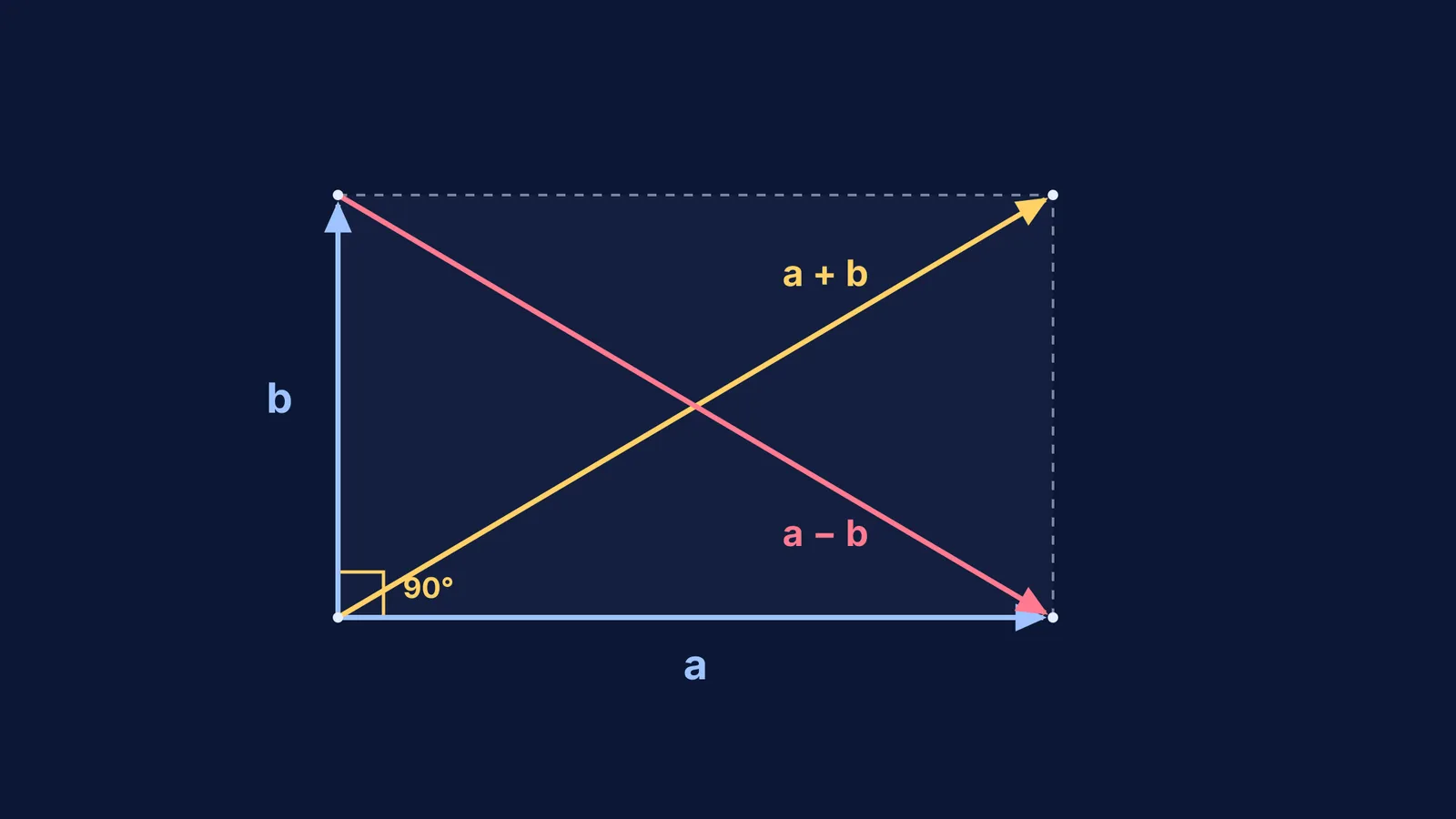
Visualizing vectors geometrically makes the algebraic result intuitive. When placed tail-to-tail, vectors a and b define adjacent sides of a parallelogram.
By the parallelogram law of vector addition, the diagonal extending from the shared tail to the opposite corner represents the sum vector, a + b. The second diagonal, connecting the head of b to the head of a, represents the difference vector, a - b. This construction is detailed in OpenStax University Physics Volume 1.
The condition |a + b| = |a - b| states that the two diagonals have identical lengths. In Euclidean geometry, a classic theorem documented on Wikipedia establishes that a parallelogram has equal diagonals if and only if it is a rectangle. Because every interior angle of a rectangle is 90°, the adjacent side vectors a and b must be perpendicular.
Students connecting geometric figures with coordinate algebra often review Vectors in JEE physics: common errors and how to avoid them. To explore how altering angles dynamically shifts vector components, the Fermi Simulation Lab provides interactive simulations for the ideas that are easier to see than to read.
What happens if one of the vectors is zero?
Competitive exams like JEE Main frequently test edge cases involving zero vectors. What occurs if a = 0 or b = 0?
If vector b is the zero vector, then |a + 0| = |a| and |a - 0| = |a|. The equality |a + b| = |a - b| holds trivially for any vector a. However, the zero vector has no specific direction, meaning the angle θ between a and 0 is undefined. While the dot product identity 0 · a = 0 holds arithmetically, perpendicularity requires two distinct non-zero directions. Standard examination questions therefore specify non-zero vectors so you can conclude θ = 90° without ambiguity.
How do you solve this in exam questions?
Recognizing this identity saves valuable time during competitive examinations. Consider a typical numerical problem:
Find the scalar constant k if the vectors a = 3i - 2j + 4k and b = 2i + k j - 2k satisfy |a + b| = |a - b|.
Solution:
Core condition: Because |a + b| = |a - b|, the dot product a · b must equal zero.
Component product: a · b = (3)(2) + (-2)(k) + (4)(-2) = 6 - 2k - 8 = -2k - 2.
Solve for k: Setting -2k - 2 = 0 gives -2k = 2, so k = -1.
Expanding component magnitudes from scratch requires calculating nested square roots of binomials, which invites calculation mistakes. Recognizing that |a + b| = |a - b| means a · b = 0 instantly reduces the problem to basic arithmetic.
You will apply similar dot product principles when calculating mechanical work or evaluating rotational problems, such as Torque as r × F: finding torque about a point with vectors. If you need structured guidance on setting up vector proofs, the Fermi Problem Library has worked problems with a step-by-step solver that explains the reasoning rather than printing an answer.
What checklist catches vector magnitude traps?
Before choosing an option in an exam, check your work against these four checkpoints:
Keep cross terms: Never expand |a + b|² as |a|² + |b|². The expansion contains the dot product cross term: |a + b|² = |a|² + |b|² + 2(a · b).
Separate magnitude from direction: Remember that |a - b| is a scalar distance, whereas a - b is a directed displacement vector.
Distinguish rectangles from rhombuses: Diagonal lengths are equal (|a + b| = |a - b|) when vectors are perpendicular (a ⟂ b). Diagonals are perpendicular ((a + b) · (a - b) = 0) when adjacent sides are equal in length (|a| = |b|).
Verify the non-zero clause: Confirm that the problem states both vectors are non-zero before concluding θ = 90° in theoretical multiple-choice questions.
Developing these verification habits prevents sign slips and maintains rigorous mathematical reasoning, similar to using position vectors in Collinear points with vectors: the position vector test.


