

On this page
Magnification is the image height divided by the object height, and its sign tells you which way up the image stands. You get it from distances too: for spherical mirrors m = h'/h = -v/u, and for lenses m = h'/h = v/u, as set out in IIT Kanpur's SATHEE notes on the Class 10 chapter Light: Reflection and Refraction.
That minus sign, present for mirrors and missing for lenses, is where exam marks go.
What does negative magnification mean?
A negative m means the image is inverted, and a positive m means it is upright. OpenStax University Physics, Volume 3 puts it plainly for mirrors: if m is positive the image is upright, and if m is negative the image is inverted.
The size of m tells you the rest. If |m| is more than 1 the image is bigger than the object, and if it is less than 1 the image is smaller, according to the same OpenStax section.
So m = -2 means inverted and twice as tall, and m = +0.5 means upright and half as tall.
Why is magnification -v/u for mirrors but v/u for lenses?
In the New Cartesian sign convention used in Class 10, every distance is measured from the pole of the mirror or the optical centre of the lens. Distances in the direction the incoming light travels are positive, and distances measured against it are negative. The object usually sits to the left, so u is negative.
Mirror: light bounces back, so a real image forms on the same side as the object. u and v are both negative, so v/u comes out positive. The minus sign in m = -v/u flips it, so a real (and inverted) image gets a negative m.
Lens: light passes through, so a real image forms on the far side. u is negative and v is positive, so v/u is already negative. No extra minus sign is needed.
Either way, a real, inverted image gets a negative m. The mirror's extra minus sign only corrects for light turning back.
In OpenStax's thin lens section, di is positive for a real image on the far side of the lens. Pick one convention and keep it for the whole problem.
Worked examples: does the sign match the picture?
Here are three cases with cm values, using the Class 10 mirror formula 1/v + 1/u = 1/f and lens formula 1/v - 1/u = 1/f.
Concave mirror, f = -15, object at u = -20. Then 1/v = -1/15 + 1/20 = -1/60, so v = -60 and m = -(-60)/(-20) = -3. Real, inverted, three times as tall.
Same mirror, object at u = -10. Then 1/v = -1/15 + 1/10 = 1/30, so v = +30 (behind the mirror) and m = -(30)/(-10) = +3. Virtual, upright, three times as tall: this is a shaving mirror.
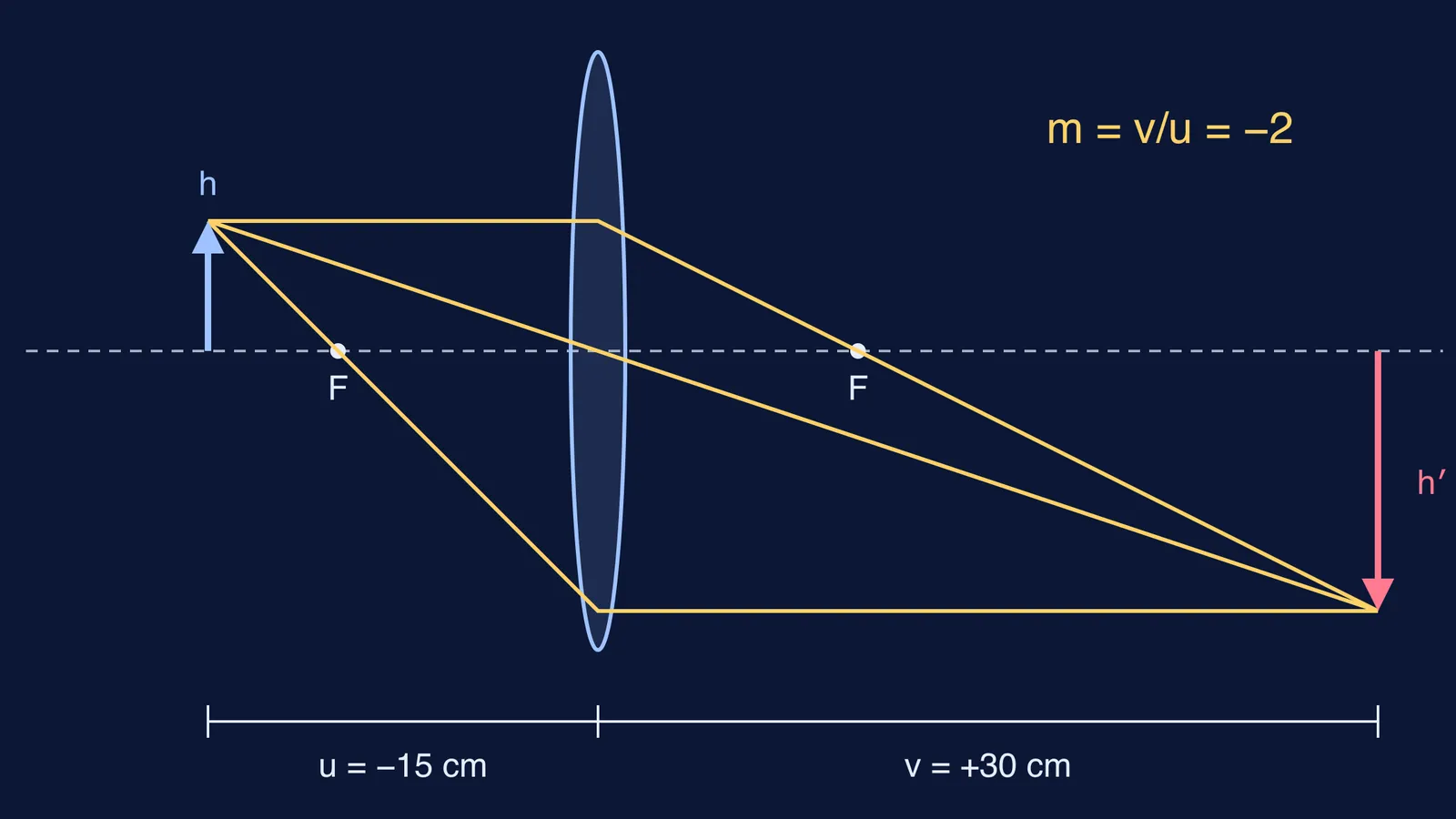
Convex lens, f = +10, object at u = -15. Then 1/v = 1/10 - 1/15 = 1/30, so v = +30 and m = 30/(-15) = -2. Real, inverted, twice as tall (the diagram above).
The sign of m matches the ray diagram each time. If you get "virtual and inverted" for a single mirror or lens with a real object, a sign has slipped.
Does negative magnification always mean a real image?
Not always. "Negative means real" holds for a single mirror or lens with a real object, which is the usual board-exam setup. It breaks in two places.
Virtual objects. If light is already converging when it reaches the lens, the object distance u is positive. With f = +20 and u = +10, you get 1/v = 1/20 + 1/10, so v = +20/3, a real image, yet m = v/u = +2/3. That image is real and upright. Our post on lens problems with a virtual object works through more of these.
Two or more elements. In a microscope or telescope you multiply the magnifications, so the overall sign gives the final orientation, not whether each image along the way is real.
How to stop losing marks on the sign
Write the convention at the top: light goes left to right, so u is negative.
Put a sign on every value before you substitute, including f. A concave mirror's f is negative, and a convex lens's f is positive.
After solving, sketch a two-ray diagram and check that its orientation matches your sign.
If the mirror formula's signs trip you up, start with our guide to the mirror formula and New Cartesian signs. Then use this test for real and virtual images to check your answer.
For more practice, the Fermi Problem Library has worked problems with a step-by-step solver that explains the reasoning rather than printing an answer.


