

On this page
In ray optics, everything you see through a lens or mirror falls into one of two categories. The difference comes down to what the light rays are actually doing when they leave the optical device and enter your eye.
Here is how to tell the difference between a real and virtual image, whether you are solving a physics numerical or figuring out how a magnifying glass works.
What is the difference between a real and virtual image?
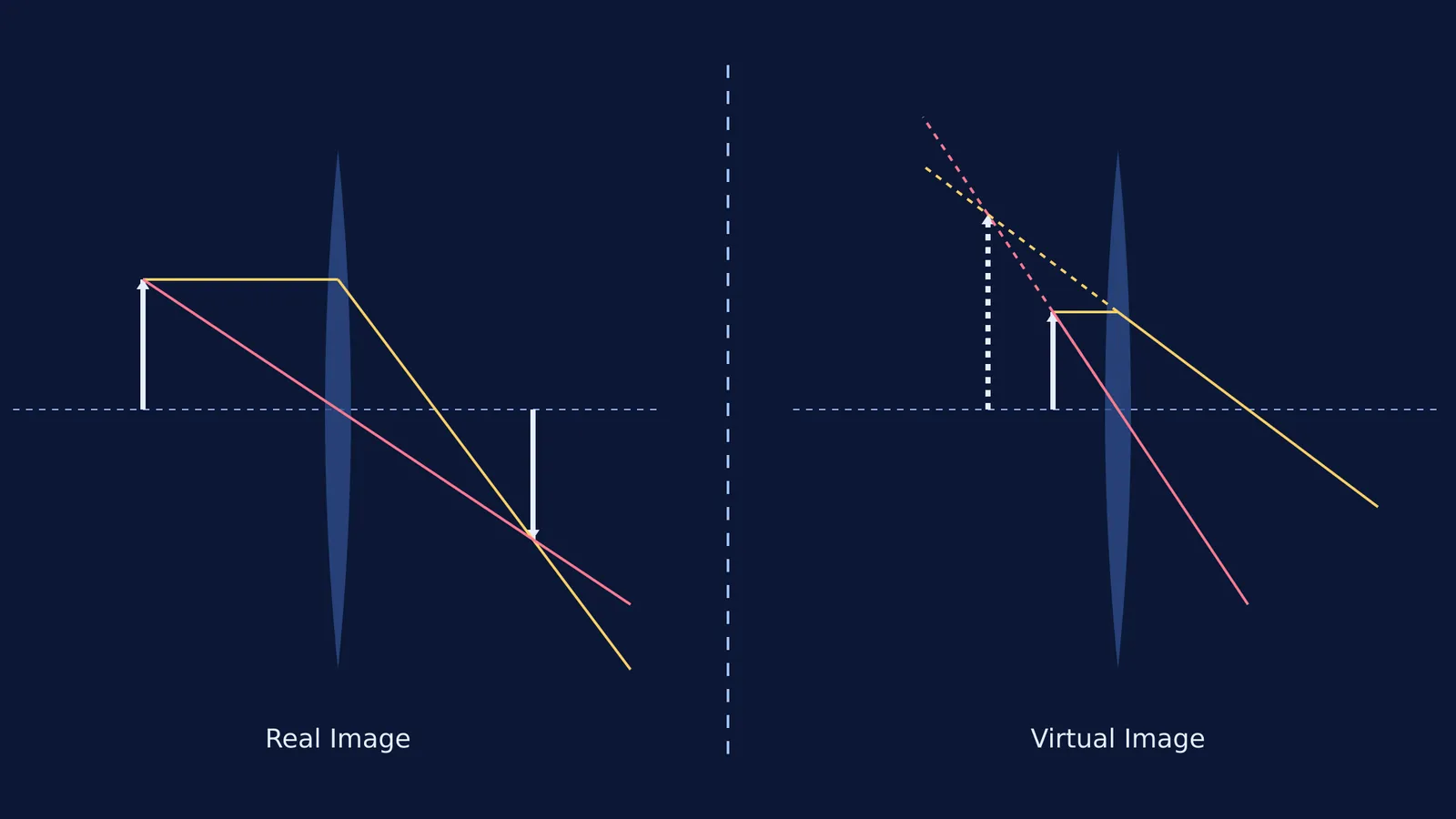
According to OpenStax's University Physics textbook, a real image can be projected onto a screen because the rays physically go through the image. A virtual image cannot be projected onto a screen because the rays only appear to originate from a common point behind the mirror or lens.
When light reflects off an object, the rays spread out in all directions. A lens or mirror bends those rays to change their path:
Real images: The lens or mirror forces the spreading rays to converge and actually meet at a point. If you placed a piece of paper exactly at that meeting point, you would see a sharp image. The image formed on the retina of your eye is a real image because light rays actually hit the back of the eye.
Virtual images: The rays leaving the lens or mirror are still diverging (spreading apart). Because they are spreading, they will never physically cross paths. However, if you trace those diverging rays backward in a straight line, they seem to originate from a single point. Your eye catches the diverging rays and your brain assumes light travels in straight lines, so you "see" an image at that virtual point.
Can a virtual image be caught on a screen?
No, a virtual image cannot be caught on a screen. Because no light actually reaches the location of a virtual image, there is nothing for a screen to catch.
If you hold a piece of paper behind a flat mirror where your reflection seems to be, it will remain blank. (This is why calculating the minimum mirror height to see your full image relies on tracing virtual rays backward, not on catching physical light). But if you hold a piece of paper at the exact focal point of a converging lens held under the Sun, the real image of the Sun will project perfectly onto it (and might set the paper on fire).
A movie projector in a cinema relies on this principle. It uses a series of lenses to form a large, real image directly onto the physical screen in the theatre.
How can you tell if an image is real or virtual?
If you are working through ray diagrams or the mirror equation, you can use these quick rules to identify the image type:
Sign convention: In the standard thin-lens and mirror equations, a positive image distance (v) means the image is real. A negative image distance means it is virtual.
Orientation: Real images are generally inverted (upside down) relative to the object. Virtual images are generally upright.
Diverging devices: A convex mirror (like a car's side mirror) or a concave lens (like the glasses for short-sightedness) will always form a virtual image, no matter where you place the object.
Converging devices: A concave mirror or a convex lens will form a real image if the object is far away, but they will switch to forming a virtual image if you move the object closer than the focal length. (You can review concave mirror images for all six object positions, Class 10 to see exactly where this transition happens).
When drawing these diagrams, a single mistake in a sign or a traced line can flip an image from real to virtual. If you find yourself struggling to remember which cases form which image, the Fermi Concept Library holds lessons that map out every optical case step by step.
A checklist for ray optics problems
Before you calculate the magnification or distance in an optics problem, ask yourself these three questions. (For more advanced cases, like a lens and mirror set apart: tracing the image through both, keeping track of which intermediate images are real or virtual is critical):
Did I check the focal length? If the object is placed inside the focal length of a converging lens, expect a virtual image.
Are the rays drawn solidly? Always use solid lines for real rays that actually travel space, and dotted or dashed lines for the virtual rays you trace backward.
Do the signs match the theory? If you know the image should be virtual, ensure your final answer for the image distance is negative.
If your numerical answers keep clashing with the rules, try running the specific case through the Fermi Problem Library. Instead of just printing the final number, Fermi's AI tutor works out what you already know, builds a plan for the session, and teaches through it—drawing the figure and checking your understanding as it goes.


