On this page
Textbooks give the Biot-Savart law for a current in a wire, but board and JEE questions often ask about a single moving charge, such as an electron going round a nucleus. The step from one to the other is one line of algebra. We do that step, then use it to find the field an electron in hydrogen makes at the proton.
How do you get the magnetic field of a moving point charge from Biot-Savart?
The Biot-Savart law says a short piece of wire dl carrying current I makes a field dB = (μ0/4π) I dl × r̂ / r² at a point a distance r away, where μ0 = 4π × 10⁻⁷ T m/A (OpenStax University Physics Vol. 2, section 12.1).
Current is charge per unit time, so I dl = (dq/dt) dl = dq v: a current element is a small charge moving with velocity v. Shrink it to one charge q and you get:
B = (μ0/4π) q (v × r̂)/r², or equivalently B = (μ0/4π) q (v × r)/r³
the magnitude is B = (μ0/4π) q v sin θ / r², where θ is the angle between v and r
r points from the charge to the point where you want the field
The field is perpendicular to both v and r, and for a negative charge it points opposite to v × r̂ (Georgia Tech Physics Book: Moving Point Charge).
What is the magnetic field at the nucleus of a hydrogen atom?
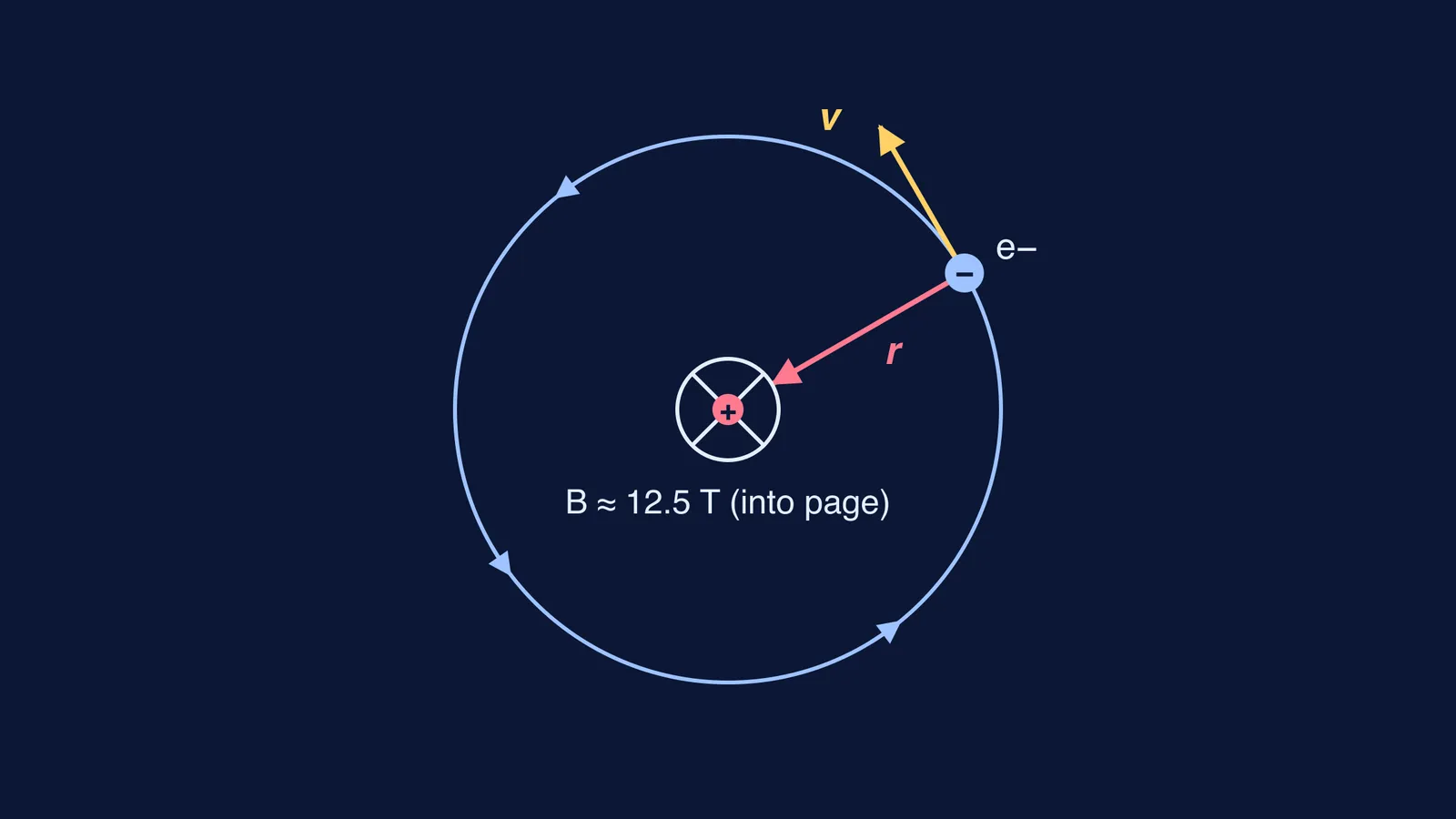
Take the Bohr model's ground state. The electron moves in a circle of radius a0 around the proton, so r (from electron to nucleus) is always at 90° to v, and sin θ = 1.
The numbers, from the 2022 CODATA values published by NIST:
Electron charge: e = 1.602176634 × 10⁻¹⁹ C, exact by definition (NIST: elementary charge).
Orbit radius: a0 = 5.29177210544 × 10⁻¹¹ m (NIST: Bohr radius).
μ0 = 1.25663706127 × 10⁻⁶ N A⁻², so μ0/4π is 1.000 × 10⁻⁷ T m/A (NIST: magnetic constant).
For the speed, Bohr's model gives vn = (1/4πε0)(e²/ħ)(1/n) (OpenStax University Physics Vol. 3, section 6.4). For n = 1 this equals αc, because the fine-structure constant is α = e²/4πε0ħc, and α = 7.2973525643 × 10⁻³ (NIST: fine-structure constant).
Now work it through:
Speed: v = αc = 7.2974 × 10⁻³ × 2.9979 × 10⁸ m/s = 2.188 × 10⁶ m/s.
Top line: (μ0/4π) e v = 10⁻⁷ × 1.6022 × 10⁻¹⁹ × 2.188 × 10⁶ = 3.505 × 10⁻²⁰.
Bottom line: a0² = (5.2918 × 10⁻¹¹)² = 2.800 × 10⁻²¹ m².
Divide: B = 3.505 × 10⁻²⁰ / 2.800 × 10⁻²¹ ≈ 12.5 T.
Direction: if the electron goes anticlockwise as you look at the page, v × r points out of the page. The electron is negative, so the field at the nucleus points into the page.
Can you check it with the current-loop formula?
Yes, and getting the same number two ways is a useful check in an exam hall. The field at the centre of a circular loop is B = μ0I/2R (OpenStax University Physics Vol. 2, section 12.4).
The orbiting electron is a tiny current loop. Its period is T = 2πa0/v = 1.520 × 10⁻¹⁶ s, so the current is I = e/T = 1.054 × 10⁻³ A, about 1 mA. Put in R = a0 and you get 12.5 T again. Algebraically the two are identical: μ0(ev/2πa0)/2a0 = μ0ev/4πa0². If the loop formula is new to you, our walk-through of the magnetic field on the axis of a circular loop derives it, and Biot-Savart and Ampère's law covers wires and solenoids.
When does the point-charge formula stop working?
It is a low-speed result, valid when v is much smaller than c. Here v/c is exactly α, about 0.73% (NIST: fine-structure constant), so the error is negligible at JEE level.
The bigger limit is the model. A sharp circular orbit is Bohr's picture; real atoms are described by quantum mechanics. Treat 12.5 T as the answer to a Bohr-model question, not a measured property of hydrogen. Our post on the limitations of the Bohr model explains where the picture breaks.
A five-point check before you write the answer
Is r drawn from the charge to the field point, not the other way round?
Did you use sin θ, and is θ really 90° here?
Did you flip the direction for a negative charge?
Is r squared in the denominator (or r cubed if you kept the vector r on top)?
Does the current-loop method give the same number?
If you keep getting the size right and the direction wrong, work a few more in the Fermi Problem Library, where the step-by-step solver explains the reasoning rather than printing an answer. If the gap is in what a cross product means, the Fermi Concept Library has a lesson for each concept.