

On this page
Many naming mistakes in Class 11 organic chemistry happen after you have found the right chain, when you decide which end to call carbon 1. The lowest locant rule settles it, and the phrase that often trips students up is "first point of difference". Here is how IUPAC defines it, how to apply it term by term, and when alphabetical order takes over.
What does "lowest locants" mean in IUPAC naming?
A locant is the number that tells you where a group sits on the parent chain. In the current IUPAC recommendations, the 2013 Blue Book, section P-14.3.5, the lowest set of locants is the set that, compared term by term with other sets, each written in increasing order, has the lowest term at the first point of difference.
The Blue Book gives its own example: the set 2,3,5,8 is lower than 3,4,6,8 and also lower than 2,4,5,7. Against 3,4,6,8 the first terms already differ, 2 against 3. Against 2,4,5,7 the first terms tie, so you move to the second term, where 3 beats 4. The 8 against 7 at the end never gets a vote.
How do you compare locant sets term by term?
Use the same four steps every time:
Number the chain from the left end and list every substituent locant, repeats included, in increasing order.
Do the same from the right end.
Read the two lists side by side, one position at a time.
Stop at the first position where they differ. The list with the smaller number there wins.
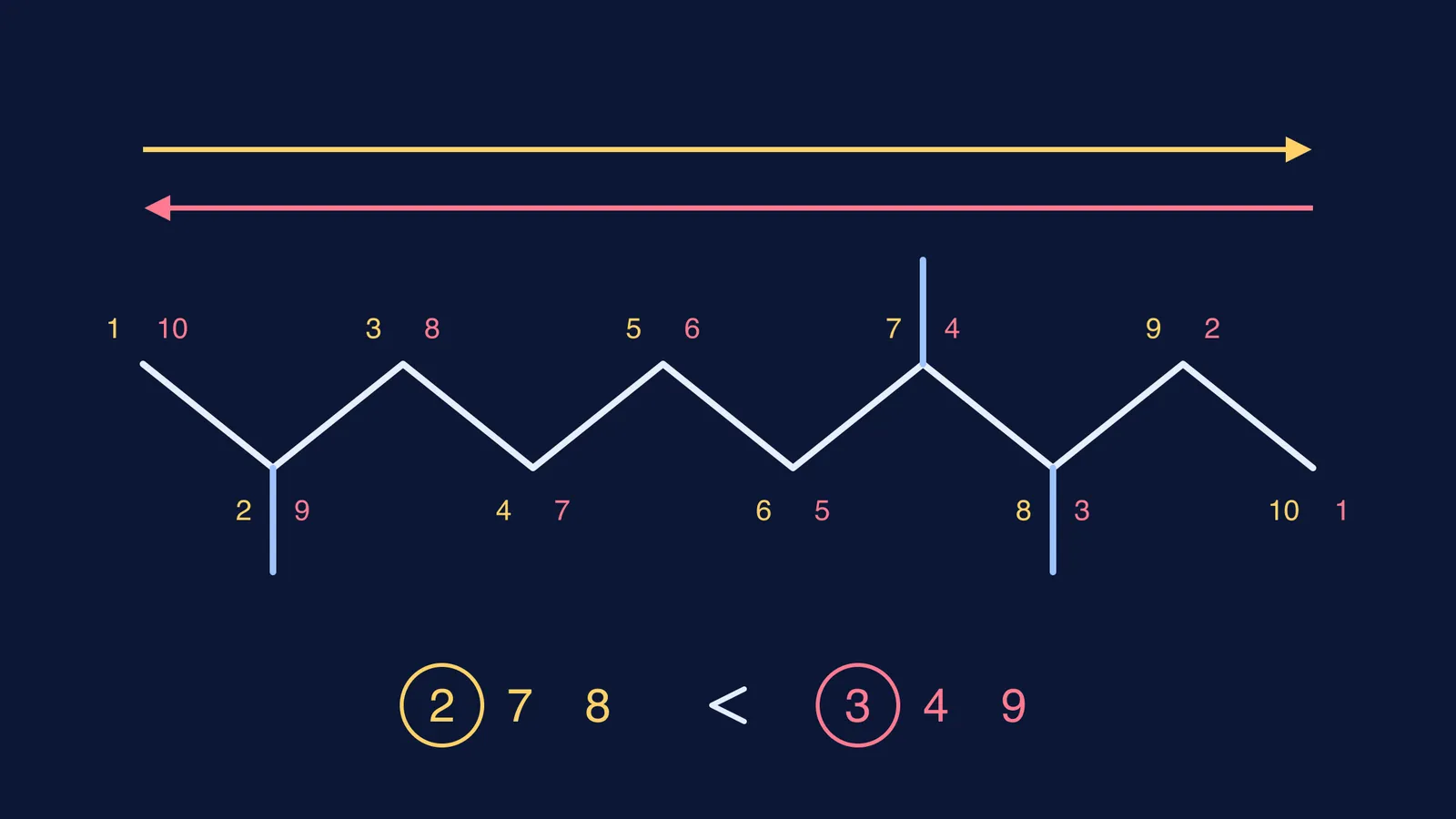
Worked example 1. Decane with methyl groups on C2, C7 and C8. From the other end the same groups sit on C3, C4 and C9. Compare 2,7,8 with 3,4,9: the first terms differ, and 2 is less than 3, so the name is 2,7,8-trimethyldecane.
Worked example 2. Iso-octane has methyl groups on C2, C2 and C4 from one end, or C2, C4 and C4 from the other. The first terms tie at 2. At the second term, 2 beats 4, so the name is 2,2,4-trimethylpentane. Repeated locants count as separate terms, which is why you write the 2 twice.
Which gets the lowest number: the suffix, the double bond or the substituent?
The first point of difference works inside a longer order of priorities. The Blue Book's numbering criteria in P-14.4 are applied one after another, and for everyday Class 11 and JEE compounds the ones that matter are:
the principal characteristic group named as a suffix, such as -ol or -oic acid (criterion c)
hydro prefixes and "ene" and "yne" endings (criterion e)
all detachable prefixes such as chloro and methyl, taken together as one set (criterion f)
the prefix cited first in alphabetical order (criterion g)
So in Cl-CH2-CH2-CH(OH)-CH3 the -OH decides first, and the name is 4-chlorobutan-2-ol, even though numbering from the chlorine end would give chloro a 1. In CH2=CH-CH2-CH(CH3)-CH3 the double bond decides, giving 4-methylpent-1-ene. If you are unsure which group becomes the suffix, our guide to the IUPAC functional group priority order covers it.
When does alphabetical order break the tie?
Only when the full prefix sets are identical from both ends. Take CH3-CH(Cl)-CH2-CH(CH3)-CH3. From either end the locants are 2 and 4, so criterion (f) cannot choose. Under the Blue Book's criterion (g), the prefix cited first in the name gets the lower locant. Chloro comes before methyl, so the name is 2-chloro-4-methylpentane.
Two traps sit here. First, di and tri do not change alphabetical order: P-14.5 of the Blue Book says simple prefixes are alphabetised first and multiplying prefixes are inserted afterwards, so dimethyl is filed under m. Second, do not reach for the alphabet too early. In 5-ethyl-3,3-dimethylheptane, numbering from the other end gives 3,5,5 instead of 3,3,5. The sets already differ at the second term, so criterion (f) decides, even though ethyl ends up with the higher number.
A 60-second check before you write the name
Is the parent chain right? Numbering cannot fix a wrong chain.
Does a suffix group or a multiple bond already decide the direction?
Did you write both locant sets in increasing order, with repeats?
Did you stop at the first difference instead of adding?
If the sets are identical, does the first-cited prefix have the lower number?
Branched substituents add one more layer: see how to name complex substituents like 1-methylethyl. For rings, read our walkthrough on naming substituted cycloalkanes.
When you practise, number each structure both ways on paper before you check. The Fermi Problem Library has worked problems with a step-by-step solver that explains the reasoning rather than printing an answer. If the priority order itself feels shaky, the Fermi Concept Library has its own lesson for each concept in chemistry.


