On this page
When conditions are normal, the desert locust (*Schistocerca gregaria*) is a solitary, harmless insect. It is camouflaged in green and brown, actively avoids other locusts, and flies alone in the arid regions of Africa, the Near East, and South-West Asia. During these quiet periods, locusts go largely unnoticed.
But when heavy rains follow a drought, vegetation blooms and their numbers explode. As the dry season returns and the greenery shrinks, these millions of locusts are forced into tight, crowded patches of remaining food. This crowding flips a biological switch, triggering a phenomenon known as phase polyphenism. Just as internal signals dictate how the body knows when to feel thirsty, intense external signals can completely rewrite a locust's biology.
In a matter of hours, the insects transform. They change colour, seek out one another, and gather into massive, aggressive swarms that can devastate agriculture across continents.
Why do locusts form swarms?
The ultimate trigger for swarming is purely physical crowding. When locusts are forced into close quarters to feed, they constantly bump into and brush against each other.
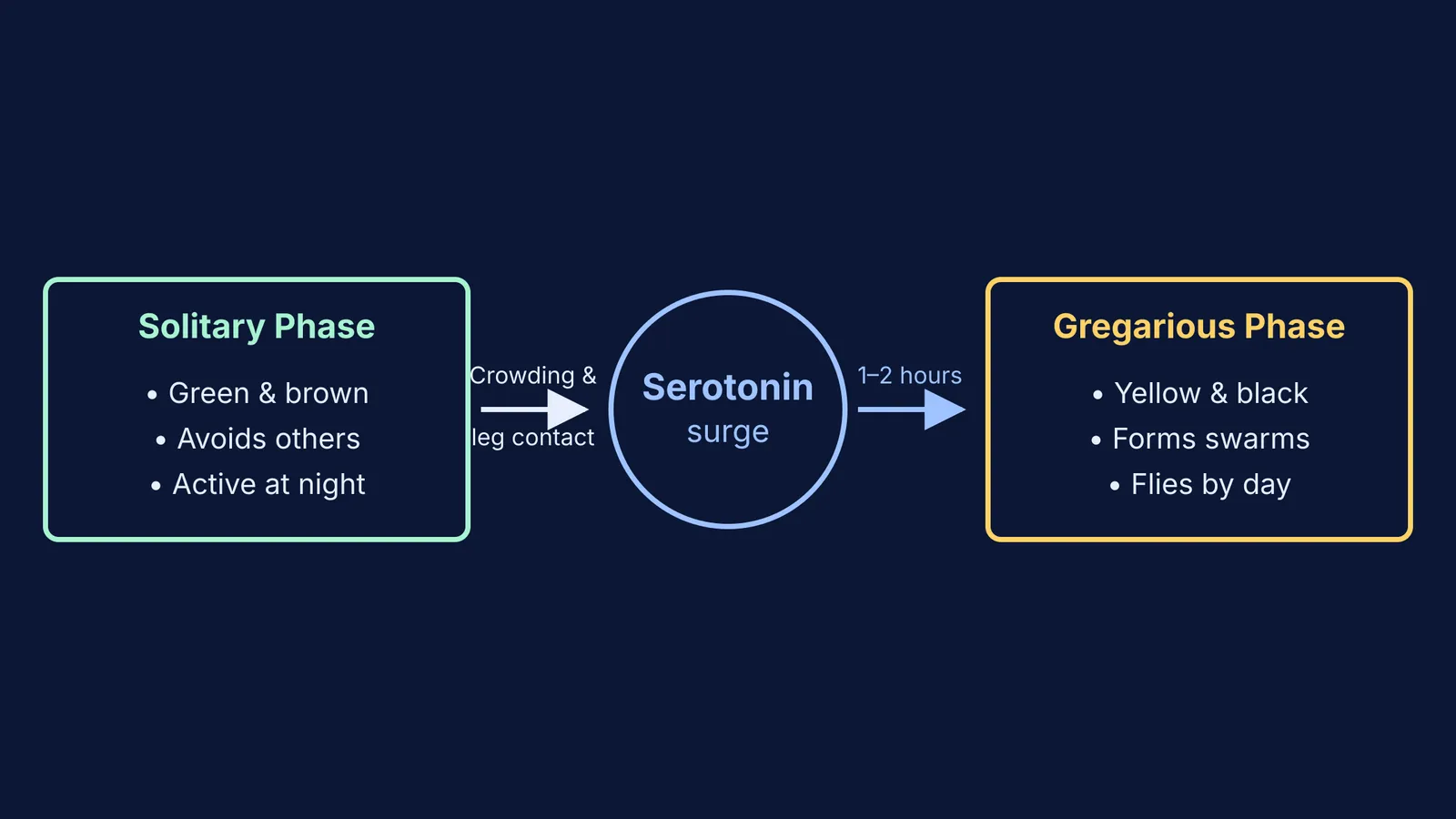
A 2009 study in *Science* by Michael L. Anstey and his colleagues found that tactile stimulation of the locust's hind legs acts as the master switch. As locusts repeatedly brush against one another's hind femurs in a crowded space, sensory nerves send a signal that causes a threefold surge of serotonin in their thoracic ganglia.
Serotonin is an evolutionarily conserved chemical that acts as a neurotransmitter. (If you are reviewing chemical coordination, see Neurotransmitter vs Hormone: The Difference Explained). In humans, it helps regulate mood and sleep, but in locusts, it drives an extreme behavioural shift. Anstey's research demonstrated that this serotonin surge is both necessary and sufficient to induce swarming. If serotonin is chemically blocked, a crowded locust remains solitary; if serotonin is artificially injected, a solitary locust begins acting like a gregarious one even when completely alone.
If you are studying how physical stimuli create physiological changes, the Fermi Concept Library contains every concept in biology, each with its own lesson and its place in the map. Fermi's AI tutor can help you trace these neural pathways from sensory input to the organism's response, holding a line of reasoning across a whole session and checking your understanding as it goes.
How do locusts change in a swarm?
The shift from the "solitarious" phase to the "gregarious" phase is rapid and total.
Within just one to two hours of crowding, their behaviour reverses entirely. Instead of actively avoiding one another, the locusts become strongly attracted to the scent and sight of other locusts, ensuring the swarm stays glued together.
Dramatic physical changes follow this behavioural switch. According to the Food and Agriculture Organization (FAO), the wingless young, known as hoppers, shed their green camouflage and turn a striking black and yellow. As they mature into adults, they transition from pinkish hues to bright yellow when they are ready to breed. Their bodies also adapt physically for endurance, growing longer wings and a different shape to support continuous, long-distance flight.
How much damage can a swarm do?
Once in the gregarious phase, locusts form dense, highly mobile groups that can travel vast distances. The FAO reports that swarms fly downwind during the day, covering up to 150 km daily.
The scale of a swarming event is difficult to comprehend without the numbers:
A 1 km² swarm contains up to 80 million adult locusts.
A single desert locust consumes its own weight in fresh food every day (about 2 grams).
Therefore, a 1 km² swarm can eat the same amount of food in one day as 35,000 people.
In optimal weather conditions, their numbers increase exponentially with each generation. A desert locust population can multiply 20-fold in three months, 400-fold in six months, and up to 8,000-fold in nine months, requiring massive international monitoring to control outbreaks before they destroy regional food security.
What are the key differences between the phases?
When revising insect biology or phenotypic plasticity for exams, use this breakdown to contrast the two phases of the desert locust. Memorising these contrasting traits will help you tackle assertion-reason questions on environmental triggers.
Solitary Phase: Camouflaged green or brown colour; repelled by other locusts; active mainly at night; causes no coordinated economic damage.
Gregarious Phase: Black and yellow (nymphs) or bright yellow (mature adults); strongly attracted to other locusts; flies in dense swarms during the day; highly destructive to crops.
The Switch Mechanism: Intense physical contact against the hind legs triggers a serotonin surge in the nervous system, shifting the locust from solitary to gregarious within hours.