On this page
Figure 9.1 in NCERT Class 11 Biology, Chapter 9 (Biomolecules), groups its lipid drawings under "Fats and oils (lipids)": a fatty acid (palmitic acid), glycerol, a triglyceride, lecithin and cholesterol (NCERT Class 11 Biology, Chapter 9). Lecithin is built like a triglyceride with one arm swapped, and that one swap is why it can build a cell membrane.
What lipid structures does NCERT draw in Class 11?
The chapter's text says (NCERT Chapter 9).
Fatty acid: a carboxyl group (–COOH) attached to an R group, which can be a methyl (–CH3), an ethyl (–C2H5) or a longer run of –CH2 groups; NCERT gives the range as 1 to 19 carbons.
Palmitic acid: drawn as CH3–(CH2)14–COOH, it has 16 carbons including the carboxyl carbon; arachidonic acid has 20.
Saturated or unsaturated: saturated fatty acids have no double bond; unsaturated ones have one or more C=C double bonds.
Glycerol: trihydroxy propane, three carbons each carrying one –OH.
If saturated and unsaturated still blur together, our explainer on saturated and unsaturated fatty acids goes through them.
How is a triglyceride made from glycerol?
Each –OH of glycerol can react with the –COOH of a fatty acid to form an ester. OpenStax Biology 2e describes the fatty acids attaching to each of glycerol's three carbons through an ester bond, with three water molecules released (OpenStax Biology 2e, 3.3 Lipids).
NCERT calls the products monoglycerides, diglycerides and triglycerides, depending on how many fatty acids are attached, and sorts them into fats and oils by melting point: oils such as gingelly (sesame) oil melt lower and stay liquid in winter (NCERT Chapter 9).
In NCERT's triglyceride drawing all three carbons look alike: CH2–O–CO–R1 on top, R2–CO–O–CH in the middle and CH2–O–CO–R3 at the bottom.
What is the structure of lecithin, and how is it different?
Put the lecithin drawing next to the triglyceride and cover the bottom line. The top two lines are identical: two fatty acids on glycerol's first and second carbons.
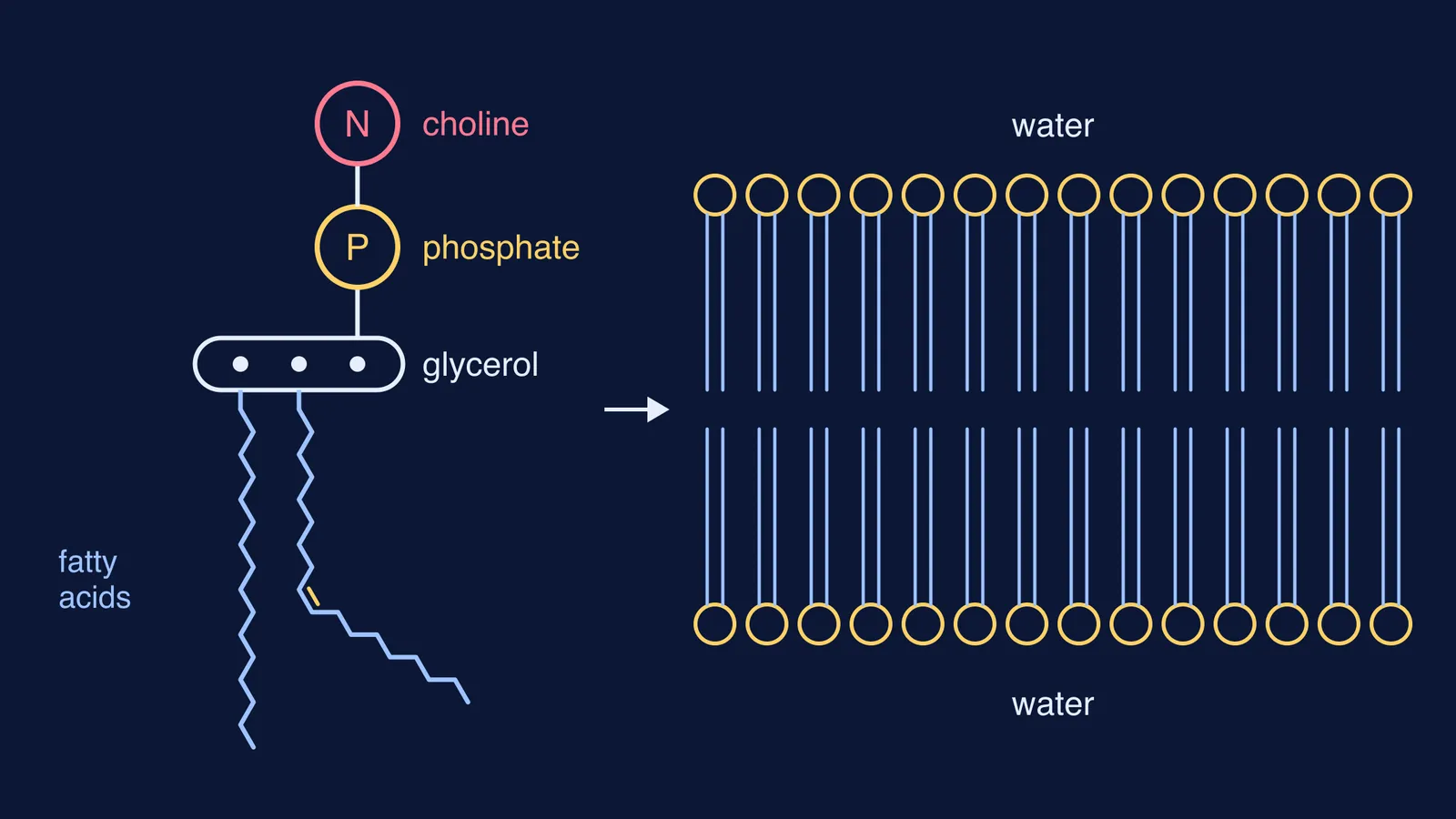
The difference is the third carbon. In place of a third fatty acid, NCERT draws CH2–O–P(=O)(OH)–O–CH2–CH2–N(CH3)3: a phosphate group, a two-carbon bridge, then a nitrogen carrying three methyl groups (NCERT Chapter 9). The –CH2–CH2–N(CH3)3 end is choline.
The US National Library of Medicine's MeSH vocabulary defines phosphatidylcholines as derivatives of phosphatidic acids in which the phosphoric acid is bound in ester linkage to a choline moiety (NCBI MeSH: Phosphatidylcholines). Commercial lecithin, from soybeans and egg yolk, is a lipid mixture rich in phosphatidylcholines (NCBI MeSH: Lecithins). In NCERT's drawing, lecithin means the single molecule, phosphatidylcholine.
NCERT's definition is the one to write in an exam: phospholipids contain phosphorus and a phosphorylated organic compound, they are found in cell membranes, and lecithin is one example.
Why do phospholipids like lecithin suit cell membranes?
OpenStax explains that a phospholipid is amphipathic: its fatty acid chains are hydrophobic, while the phosphate-containing group is hydrophilic (OpenStax Biology 2e). A triglyceride has three water-avoiding tails and no water-loving end to turn towards water.
NCERT's Cell chapter says the major lipids of the membrane are phospholipids arranged in a bilayer, with polar heads towards the outer sides and hydrophobic tails towards the inner part (NCERT Class 11 Biology, Chapter 8). The same page notes that the human red blood cell membrane is about 52 per cent protein and 40 per cent lipid.
Tail shape matters too. A cis double bond puts a kink in a fatty acid that stops the chains packing tightly (OpenStax Biology 2e).
For how scientists worked this out, read about Gorter and Grendel's lipid bilayer experiment and Singer and Nicolson's fluid mosaic model.
How do you draw lecithin yourself?
Draw it from memory, then tick each line against NCERT Figure 9.1.
Draw glycerol as a vertical three-carbon spine: CH2, CH, CH2.
On the top CH2, write –O–CO–R1, with the C=O oxygen above. That is ester one.
On the middle CH, write the second ester to the left: R2–CO–O–.
Stop. If you add a third –O–CO–R, you have drawn a triglyceride, not lecithin.
On the bottom CH2, write –O–P, with =O above the P and –OH below it.
Continue from P: –O–CH2–CH2–N.
Put three CH3 groups on that nitrogen. This is choline.
Count the oxygens around phosphorus: four (one double-bonded, one –OH, two linking).
Label glycerol, two fatty acids, phosphate and choline, then circle the hydrophilic head and bracket the hydrophobic tails.
If the gap sits one step back, such as what an ester bond is, the Fermi Concept Library gives every concept in biology and chemistry its own lesson and its place in the map, so you can fix that before redrawing.
Draw lecithin once today and once tomorrow, both from memory, and compare each attempt with the textbook.