

On this page
Your Class 11 chapter on the cell gives the fluid mosaic model a paragraph and a diagram. Behind it is a 12-page paper, some chemical reasoning, and an experiment that fused mouse and human cells. Knowing that story makes the model easier to explain in an exam.
How did Singer and Nicolson propose the fluid mosaic model?
S. Jonathan Singer of the University of California, San Diego, and Garth L. Nicolson of the Salk Institute published "The Fluid Mosaic Model of the Structure of Cell Membranes" in Science on 18 February 1972, volume 175, pages 720 to 731.
Their starting point was chemistry. A protein has charged and polar groups that are comfortable in water, and nonpolar groups that avoid it. Singer and Nicolson reasoned that a membrane protein should settle where each part is comfortable. In the words of the paper's abstract, integral proteins have "ionic and highly polar groups protruding from the membrane into the aqueous phase, and the nonpolar groups largely buried in the hydrophobic interior."
They then described recent experiments, using many techniques and membrane systems, and argued that all fitted this picture. The abstract sums up the result: the membrane is like "a two-dimensional oriented solution of integral proteins" in "the viscous phospholipid bilayer solvent."
Singer later wrote a history of this period, noting that when the work began, "practically nothing was known about the molecular structure" of membranes.
What were the membrane models before 1972?
The bilayer itself was not new. Once cell theory was put together, the next question was what wraps a cell.
1925: Gorter and Grendel extracted lipids from red blood cells and concluded the cells are covered by "a layer of fatty substances that is two molecules thick" (Journal of Experimental Medicine).
1935: Danielli and Davson published a model usually drawn as a lipid bilayer sandwiched between two layers of protein (summary of the Davson-Danielli model).
By Singer and Nicolson's logic, the sandwich has a problem. A protein spread flat over the surface leaves its water-avoiding parts exposed to water. Pushing proteins into and through the bilayer removes that problem.
What evidence showed the membrane is fluid?
One key piece of evidence came two years earlier. In their 1970 study, L. D. Frye and M. Edidin fused mouse cells with human cells and tracked each species' surface antigens with fluorescent antibodies. Within 40 minutes, the two sets had mixed completely in over 90% of the fused cells. Blocking protein synthesis or ATP production did not stop the mixing; only lowering the temperature did. They concluded that the cell surface "is not a rigid structure" but fluid enough for surface antigens to diffuse.
Singer and Nicolson's paper ended with a note added in proof on a new lymphocyte study: antibodies made surface immunoglobulin molecules cluster, which can happen only if they "are free to diffuse in the membrane" (PubMed abstract).
How do you write the fluid mosaic model in a Class 11 answer?
Use this five-point plan for a long answer, one or two sentences per point:
Name and date: proposed by Singer and Nicolson in 1972.
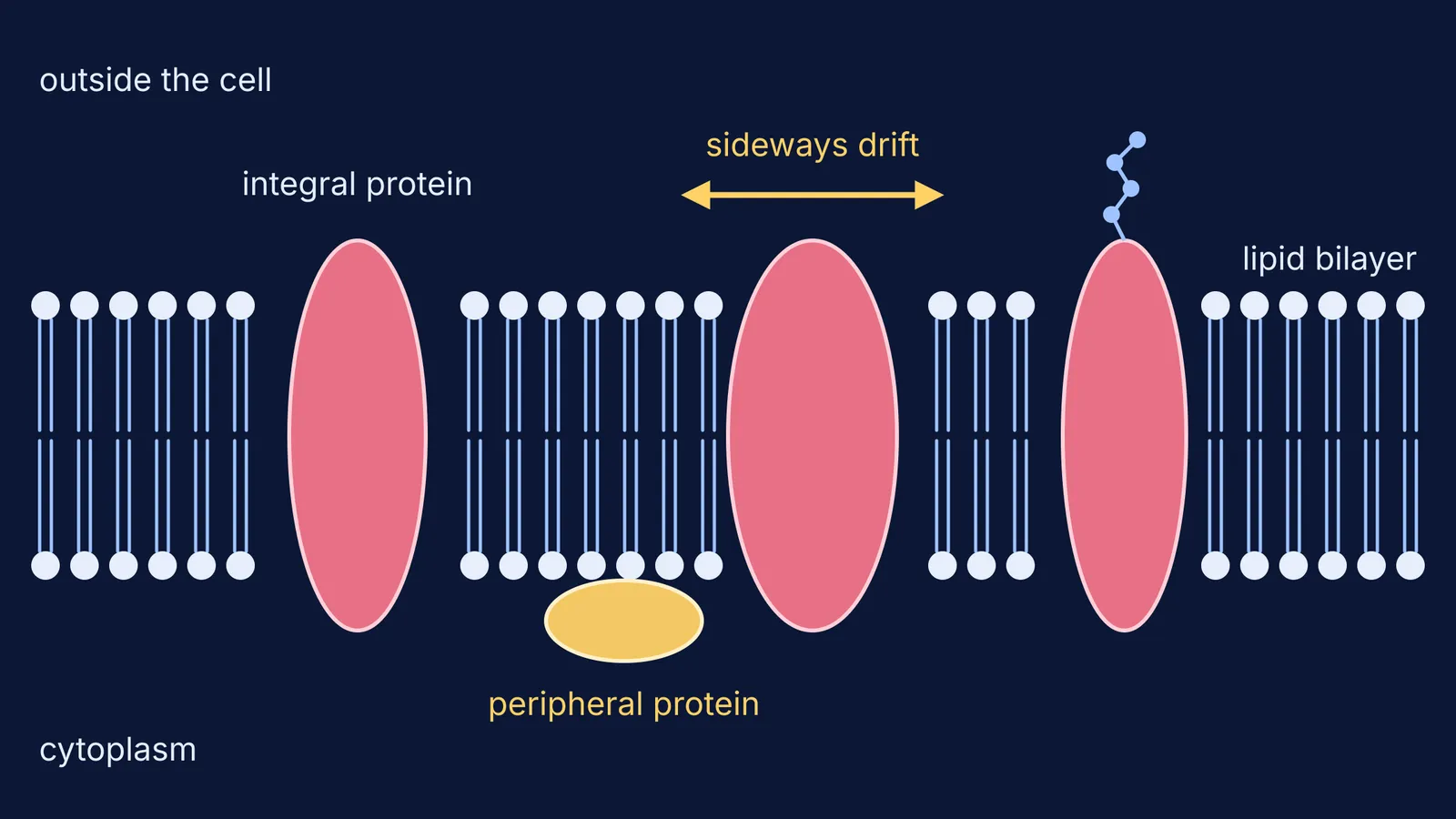
Lipids: a phospholipid bilayer, polar heads facing water on both sides, nonpolar tails inside.
Proteins: integral proteins sit partly or fully inside the bilayer; peripheral proteins sit on its surface.
Fluid: proteins and lipids move sideways in the plane of the membrane; give the Frye and Edidin cell-fusion experiment as evidence.
Mosaic: different proteins scattered through the lipid, like tiles in a pattern.
Then check your answer against four common slips:
Calling 1972 the discovery of the bilayer. The bilayer idea dates to 1925.
Drawing proteins only on the two surfaces. That is the older sandwich picture.
Swapping integral and peripheral proteins.
Forgetting the evidence. One line on the mouse-human experiment lifts a plain description into an explanation.
Quick self-test: in the Frye and Edidin experiment, what would you predict if the fused cells were kept cold? (Answer: the antigens stay largely unmixed, because lowering the temperature was the one treatment that blocked mixing.)
If the sideways drift is hard to picture from a flat textbook figure, the Fermi Simulation Lab has interactive simulations for ideas that are easier to see than to read. For the vocabulary around this topic, such as hydrophobic, polar and integral, the Fermi Concept Library gives each biology concept its own lesson.
Is the fluid mosaic model still accepted today?
Yes, in outline. In a 2014 review, Nicolson argued that the model is still relevant after more than 40 years, while newer work has added specialised domains such as lipid rafts and protein complexes, and shown that the cytoskeleton and structures outside the cell limit how far membrane components move. The membrane is more organised than the 1972 picture suggested, but the core idea has held.
Next, see how this structure controls what enters and leaves the cell in the cell membrane: fluid mosaic model and transport, explained, and place the membrane among the other organelles in Cell: the unit of life for NEET, with organelles compared.


