

On this page
If a limit question has 1² + 2² + … + n² on top and n³ underneath, you do not need the full formula. You only need its first term. Here is why the sum of kth powers behaves like nᵏ⁺¹/(k + 1), two short proofs, and a quick method for ratios of power sums.
Why does 1ᵏ + 2ᵏ + … + nᵏ grow like nᵏ⁺¹/(k + 1)?
Start with the formulas you already know. From the table of power sums on Wolfram MathWorld:
1 + 2 + … + n = n(n + 1)/2, which is n²/2 + n/2
1² + 2² + … + n² = n(n + 1)(2n + 1)/6, which is n³/3 + n²/2 + n/6
1³ + 2³ + … + n³ = n²(n + 1)²/4, which is n⁴/4 + n³/2 + n²/4
The leading coefficients are 1/2, 1/3 and 1/4. That is not a coincidence. Faulhaber's formula says the sum of the pth powers of 1 to n is a polynomial in n of degree p + 1 whose leading term is n^(p+1)/(p + 1) and whose second term is n^p/2. The same page notes that Jacob Bernoulli's general formula appeared in his Ars Conjectandi in 1713, and the NIST Digital Library of Mathematical Functions (equation 24.4.7) writes the sum exactly using Bernoulli polynomials.
Divide by nᵏ⁺¹ and every term except the first goes to zero. So the limit is 1/(k + 1).
How do you prove the limit without the formula?
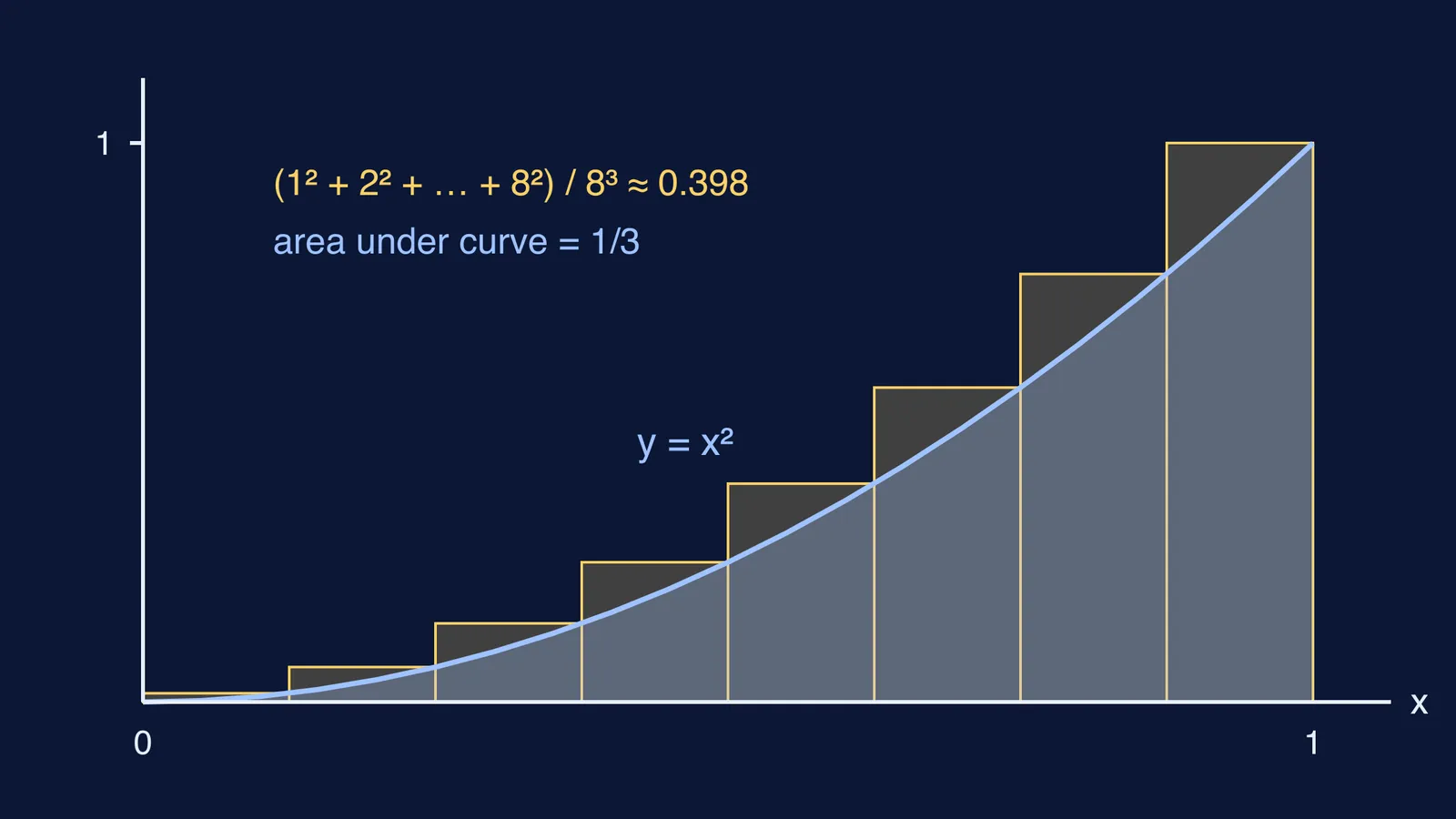
Route 1: the sum is an integral. Write the ratio as (1/n)[(1/n)ᵏ + (2/n)ᵏ + … + (n/n)ᵏ]. That is a right-endpoint Riemann sum for y = xᵏ on [0, 1] with n strips of width 1/n. As n → ∞ it approaches the integral of xᵏ from 0 to 1, which is 1/(k + 1). OpenStax Calculus Volume 1, section 5.1 builds areas this way, using the same sum formulas. To see the rectangles settle onto the curve, try our explainer on when Riemann sums over- or underestimate area.
Route 2: squeeze it between two integrals. For k ≥ 0, xᵏ never decreases for x ≥ 0, so each term iᵏ lies between the area under xᵏ from i − 1 to i and from i to i + 1. Adding up gives nᵏ⁺¹/(k + 1) ≤ 1ᵏ + … + nᵏ ≤ [(n + 1)ᵏ⁺¹ − 1]/(k + 1). Divide by nᵏ⁺¹. Both bounds tend to 1/(k + 1), so the middle does too.
How do you find the limit of a ratio of power sums?
Use this four-step degree check. Write Sₖ for 1ᵏ + 2ᵏ + … + nᵏ.
Replace each Sₖ by nᵏ⁺¹/(k + 1). Leave plain powers of n as they are.
Work out the total degree of n on top and underneath.
If the top degree is higher, the limit is infinite. If it is lower, the limit is 0.
If they are equal, the limit is the ratio of the leading coefficients.
Three worked examples:
S₃/(n·S₂). Top: n⁴/4. Bottom: n · n³/3 = n⁴/3. Same degree, so the limit is (1/4)/(1/3) = 3/4.
S₅/(S₂)². Top: n⁶/6. Bottom: (n³/3)² = n⁶/9. The limit is 9/6 = 3/2.
(1ᵏ + 3ᵏ + 5ᵏ + … + (2n − 1)ᵏ)/nᵏ⁺¹. Pull out 2ᵏ: the sum becomes 2ᵏ times a sum of ((i − 1/2)/n)ᵏ, a midpoint Riemann sum for xᵏ on [0, 1]. The limit is 2ᵏ/(k + 1). Check with k = 1: the first n odd numbers add to n², so the ratio is exactly 1, and 2/2 = 1.
Where do students lose marks on these limits?
Leading terms cancel. In lim [S₂/n² − n/3], the n/3 wipes out the leading term, so you need the next one. S₂/n² = n/3 + 1/2 + 1/(6n), so the limit is 1/2. Whenever you see a difference, keep the second term n^k/2.
Wrong power underneath. S₂/n² goes to infinity and S₂/n⁴ goes to 0. Only nᵏ⁺¹ gives a finite, non-zero answer.
Forgetting the direction of the bounds. The squeeze in Route 2 assumed k ≥ 0, so the terms never decrease. For a decreasing function, flip the inequalities.
If you want to rebuild the exact formula yourself, our post on deriving the sum of squares with the telescoping method does it step by step. Leading terms also cancel in the limit of √(x² + x) − x.
When you cannot tell whether your method or your algebra went wrong, the Fermi Problem Library has worked problems with a step-by-step solver that explains the reasoning rather than printing an answer. If the gap is the idea of a definite integral itself, start with the lesson in the Fermi Concept Library.
Try it now: find the limit of S₄/(n²·S₂), then check that your answer is 3/5.


