

On this page
Lie detectors turn up in films and crime news, tracing neat lines as someone answers questions. The real question: do those lines reveal a lie, or just a nervous body?
What does a polygraph actually measure?
A polygraph records "respiration, heart rate, blood pressure, and electrodermal response (electrical conductance at the skin surface)", according to the US National Research Council's 2003 review, The Polygraph and Lie Detection. In plain terms: your breathing, your pulse, the pressure of blood in your vessels, and how much your skin sweats, since sweat carries current.
The same review notes that "practitioners do not claim that the instrument measures deception directly". The idea is that lying makes you anxious, and anxiety changes these signals.
Those changes come from the autonomic nervous system, the part you do not control by choice. Our post on the divisions of the nervous system explains its branches, and why your heart races when you're scared shows the adrenaline step. The catch: fear, embarrassment and anger set off the same response as guilt.
Does a lie detector really work?
Better than guessing, but not well enough to trust. The committee behind the review, chaired by statistician Stephen Fienberg, said polygraph testing "rests on weak scientific underpinnings despite nearly a century of study" (National Academies news release, 2002).
Three findings stand out:
Above chance, below perfection. Tests about one specific incident "can discriminate lying from truth telling at rates well above chance, though well below perfection", says the review's executive summary.
The best numbers come from labs. Across 52 laboratory data sets, the median accuracy index was 0.86, with the middle half between 0.81 and 0.91, on a scale where 0.5 is a coin toss and 1.0 is perfect; it is not a percentage correct (chapter 5 of the review). The committee said this range "most likely over-states" accuracy in real investigations.
The research is thin. Only 57 of the 194 studies the committee examined both met minimal standards of scientific adequacy and gave usable accuracy data (chapter 4 of the review).
People can also beat the machine: the review says all the signals it records "can be altered by conscious efforts" (executive summary).
Has anything changed since? In 2019, researchers William Iacono and Gershon Ben-Shakhar reviewed the newer research in Law and Human Behavior and concluded that the report's "landmark conclusions still stand".
Why do innocent people fail a polygraph?
Because the test reads arousal, and an honest person can be very aroused. India's Supreme Court made the same point in Selvi v. State of Karnataka (5 May 2010): the body's changes "could be triggered by nervousness, anxiety, fear, confusion or other emotions".
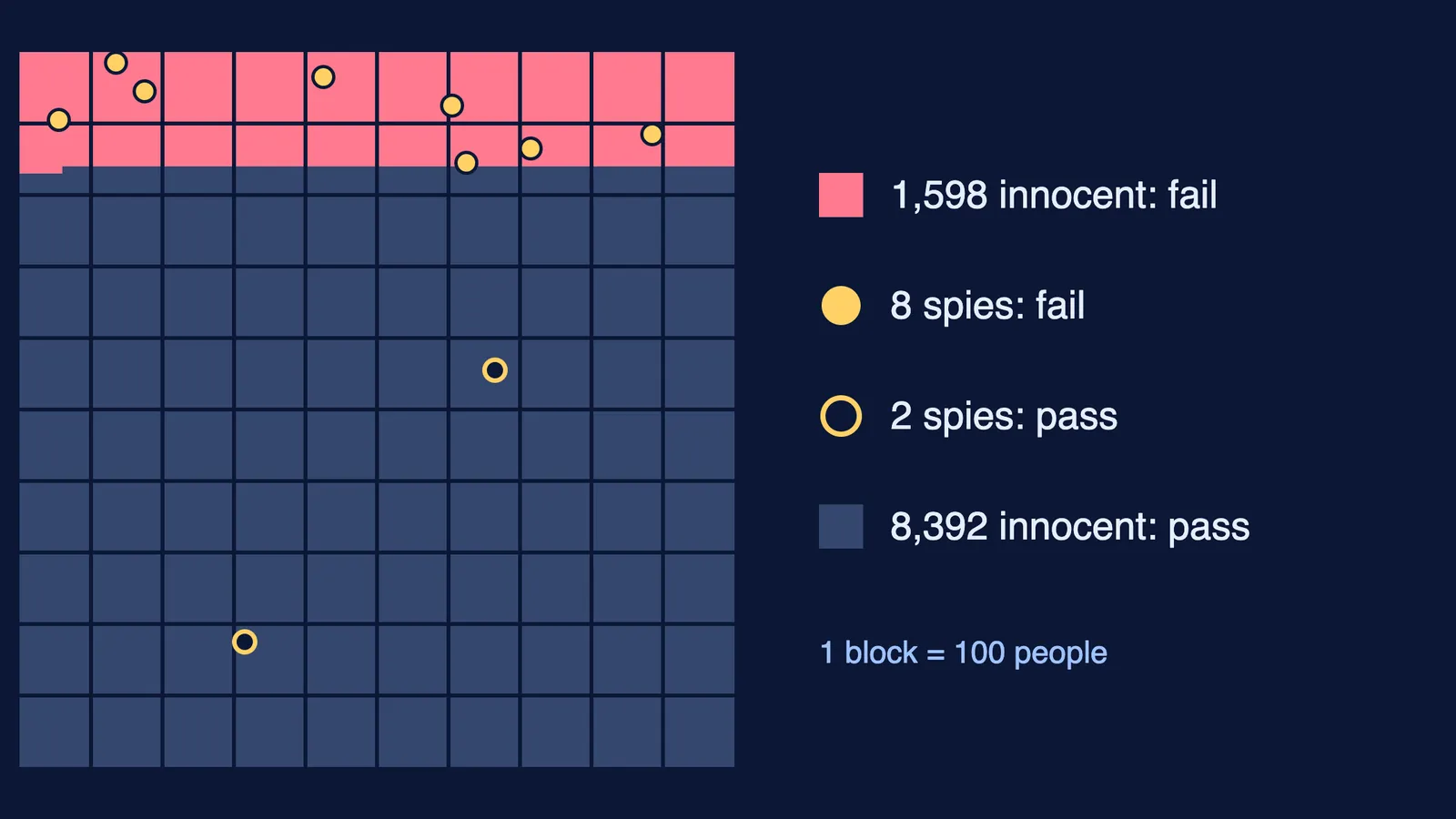
The bigger problem is arithmetic. Here is the review's own worked example from its executive summary. It even assumes a test more accurate (accuracy index 0.90) than the research supports.
Screen 10,000 employees, of whom 10 are spies.
Set the test to catch 8 of the 10 spies.
It also fails 1,598 loyal employees, so 1,606 people fail in total.
Of those who fail, only 8 are spies: about 1 in 200.
Make the test stricter to cut false alarms, and 39 innocent people fail, but now 8 of the 10 spies pass.
When the thing you are looking for is rare, even a fairly good test produces mostly false alarms. That is why the committee judged the polygraph not accurate enough to rely on for screening federal employees. Our post on Bayes' theorem and a positive test result works through the same logic for a medical test.
Is a polygraph test legal in India?
In Selvi, a three-judge bench held that forcing anyone to take a polygraph, narcoanalysis or brain electrical activation profile (BEAP) test violates the right against self-incrimination under Article 20(3). A person may agree to a test, but "the test results by themselves cannot be admitted as evidence"; only material later discovered with their help can be. The court also told agencies to follow the National Human Rights Commission's guidelines, including consent recorded before a Judicial Magistrate.
How can you judge any "detector" claim?
Use this four-question check the next time a news story, app or viral video claims to catch liars, cheats or anything rare:
What does it actually measure? Name the signal (sweat, pulse, voice pitch, eye movement), then ask what else could cause it.
Where do the accuracy numbers come from? Volunteers lying about a mock theft in a lab are not suspects with real stakes.
How rare is the thing it looks for? If it is rare, most positives will be false, as the 10,000-person example shows.
Can it be gamed? If a person can change the signal on purpose, the result says little.
If the base-rate arithmetic in step 3 still feels slippery, the Fermi Problem Library has a step-by-step solver that explains the reasoning, so you can check each step of a calculation like this one. For the biology behind the signals, the Fermi Concept Library gives every concept in biology its own lesson.


