

On this page
Two circles cross at two points. The segment joining those points is their common chord, and finding its length is a common exercise in Class 11 coordinate geometry and JEE Main preparation. It takes four short steps, each using something you already know.
What is the common chord of two circles?
The radical axis of two circles is the locus of points with equal power with respect to both circles, and when the circles meet at two points it is the line through those points (Wolfram MathWorld). So the common chord is a piece of the radical axis.
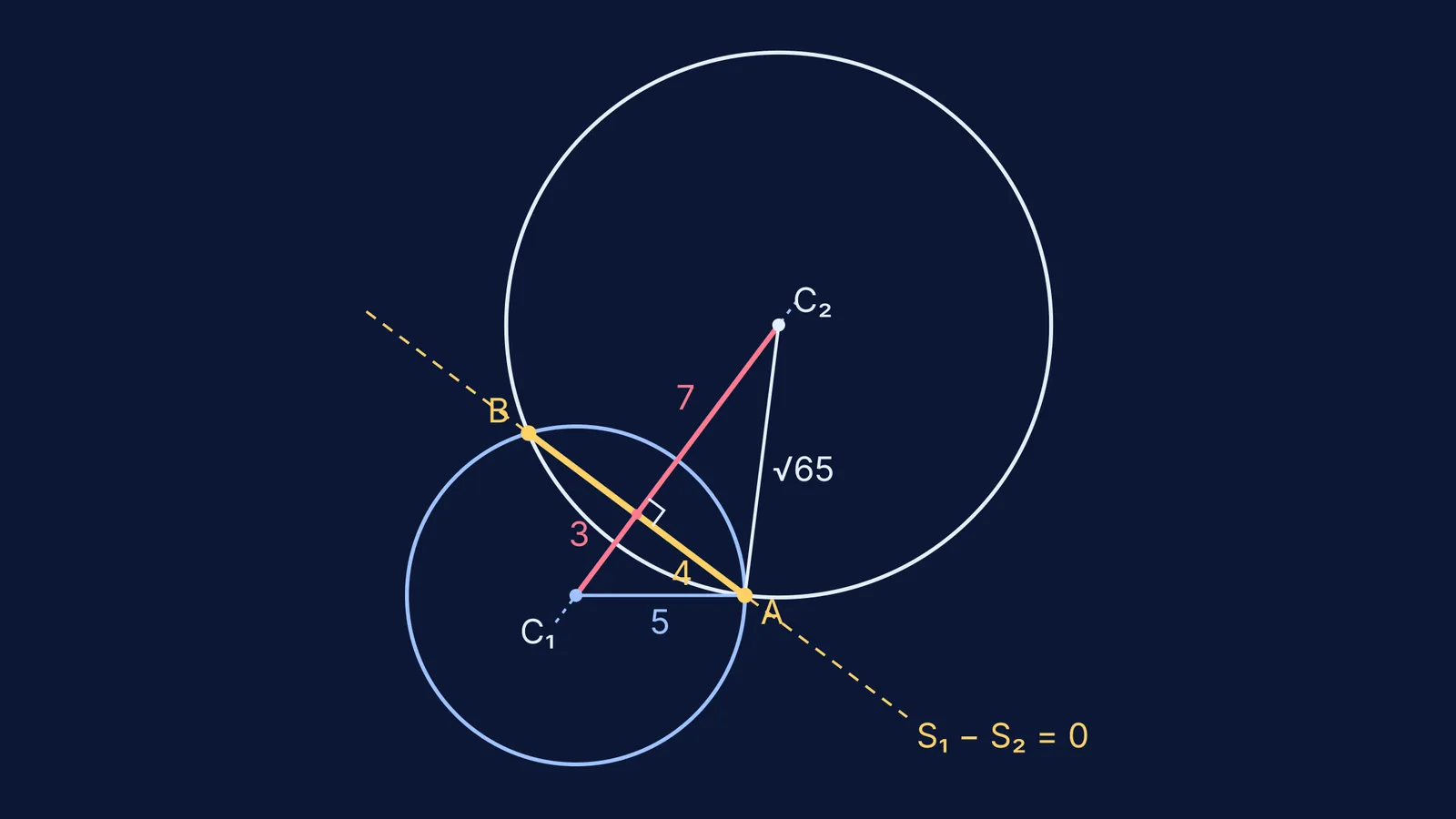
The radical axis is always perpendicular to the line joining the two centres (Wikipedia: Radical axis). That right angle is what makes the length easy to find.
How do you find the equation of the common chord?
Write both circles in the form S = x² + y² + 2gx + 2fy + c = 0, with the coefficients of x² and y² equal to 1. Then subtract: S₁ − S₂ = 0. The x² and y² terms cancel and a straight line is left.
Why this works: any point on both circles makes S₁ = 0 and S₂ = 0, so it also makes S₁ − S₂ = 0. Both intersection points sit on this line, so it is the line of the chord. For the reason in terms of power of a point, see our post on why S₁ − S₂ = 0 gives the radical axis.
How do you find the length of the common chord?
Get the chord's line from S₁ − S₂ = 0.
Pick either circle. Find its centre C and radius r by completing the square.
Find p, the perpendicular distance from C to the chord's line.
Length = 2√(r² − p²).
For step 3, the distance from a point (x₀, y₀) to the line ax + by + c = 0 is |ax₀ + by₀ + c| / √(a² + b²) (Wikipedia: Distance from a point to a line).
Step 4 is Pythagoras. The perpendicular from the centre to any chord bisects it, so the radius, the distance p and half the chord form a right triangle. Half the chord is √(r² − p²); double it.
Worked example: two circles with a chord of length 8
Find the length of the common chord of S₁: x² + y² − 25 = 0 and S₂: x² + y² − 12x − 16y + 35 = 0.
Step 1, the chord's line. S₁ − S₂ = 12x + 16y − 60 = 0. Divide by 4: 3x + 4y − 15 = 0.
Step 2, a centre and radius. S₁ has centre (0, 0) and radius 5.
Step 3, the distance. p = |3(0) + 4(0) − 15| / √(9 + 16) = 15/5 = 3.
Step 4, the length. Half chord = √(25 − 9) = 4, so the common chord has length 8.
Check with the other circle. Completing the square, S₂ is (x − 6)² + (y − 8)² = 65, so its centre is (6, 8) and r² = 65. Its distance to the line is |18 + 32 − 15| / 5 = 7, and √(65 − 49) = 4 again. The intersection points (5, 0) and (−7/5, 24/5) satisfy both equations and are 8 apart.
Is there a formula using only the radii and the distance between centres?
Yes. For circles of radii R and r whose centres are d apart, the chord length is a = (1/d)√(4d²R² − (d² − r² + R²)²) (Wolfram MathWorld: Circle-Circle Intersection).
In our example, R = 5, r² = 65 and d = 10, so a = (1/10)√(10000 − 3600) = 80/10 = 8. It agrees. The formula is handy for checking, but the step method also gives the chord's equation.
What mistakes cost marks on this question?
Unequal x² coefficients. If one circle is written as 2x² + 2y² + ..., divide through by 2 before subtracting, or the squares will not cancel.
Sign of the centre. For x² + y² + 2gx + 2fy + c = 0 the centre is (−g, −f), not (g, f).
Forgetting to double. √(r² − p²) is half the chord.
Circles that do not meet. If p is bigger than r, there is no common chord. The circles meet at two points only when the distance between centres is less than the sum of the radii and more than their difference.
Mixing radii. Use p and r from the same circle.
If your answer keeps coming out wrong, try a similar question in the Fermi Problem Library, where a step-by-step solver explains the reasoning rather than printing an answer. If the gap is the idea itself, the Fermi Concept Library has a lesson for each concept.
Next, try how many common tangents two circles have, and how long they are, then the circle through the intersection of a circle and a line, which uses S + λL = 0 in the same spirit as S₁ − S₂ = 0.


