

On this page
Understanding how curves combine is a major part of coordinate geometry. When you have a circle and a line, or two circles, finding the exact circle that passes through their intersection points can seem like a long, tedious process of solving simultaneous equations. But there is a faster, more elegant way.
What happens when a circle and a line intersect?
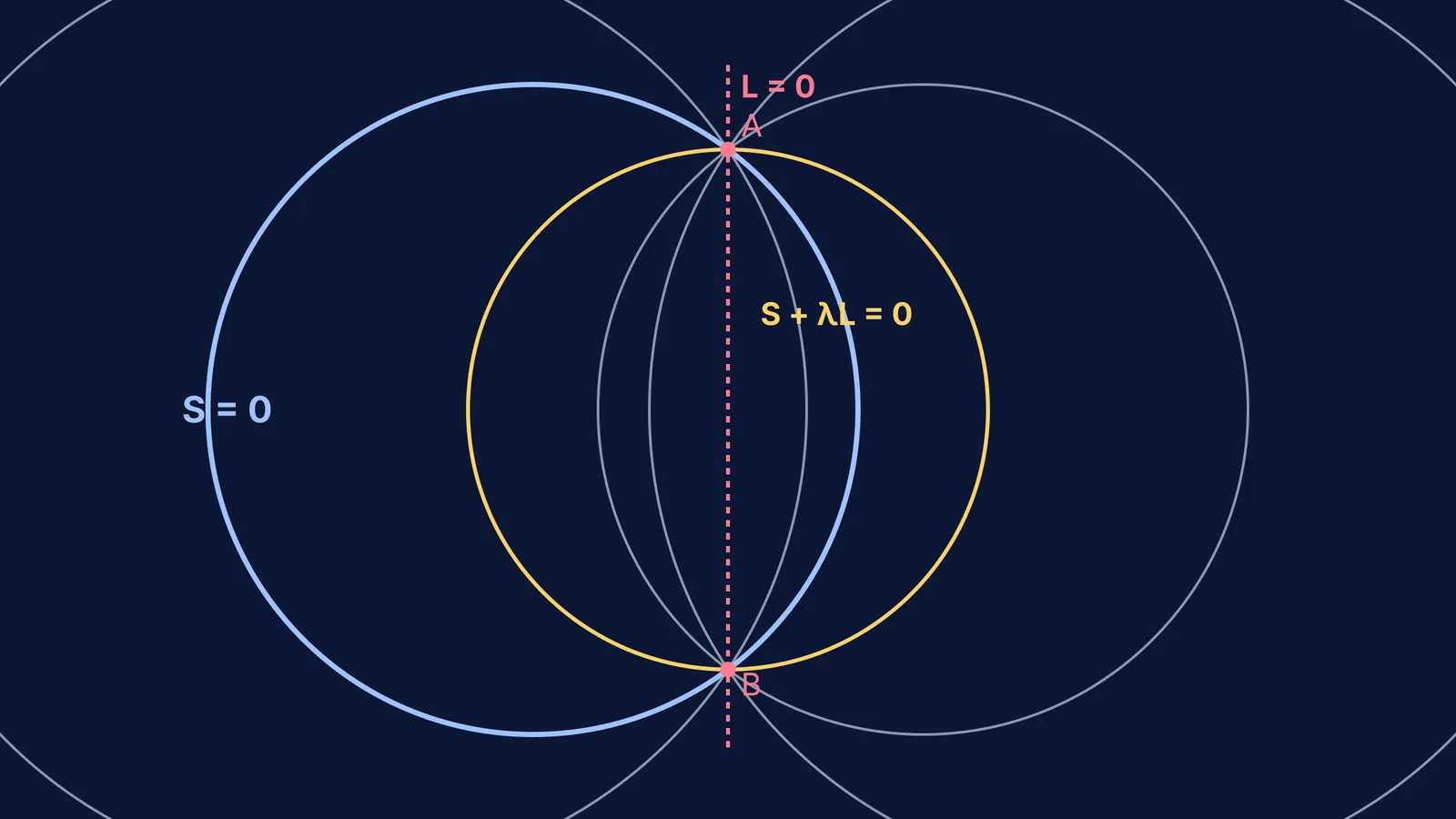
Let a given circle be S = 0, where S = x² + y² + 2gx + 2fy + c. Let a given straight line be L = 0, where L = ax + by + c′.
If the line cuts the circle at two distinct points, A and B, there are infinitely many other circles that also pass through A and B. The equation for every single one of these circles is given by:
S + λL = 0
Here, λ (lambda) is a real number. By changing the value of λ, you sweep through the entire family of circles passing through those two points.
This approach is highly visual. Scott Freeman and his team at the University of Washington published a massive meta-analysis in PNAS showing that students in traditional lecture courses are 55% more likely to fail STEM subjects than those in active learning environments. Taking the time to actively draw these curves helps build the mental model you need for exams. If you have gaps in your understanding, the Fermi Concept Library offers a lesson for every mathematical concept to help you learn actively rather than just memorising algebraic forms.
Why does S + λL = 0 work for all circles in the family?
If you take any point that lies on both the circle and the line, its coordinates will make S equal to 0 and L equal to 0.
When you substitute those exact coordinates into the new expression S + λL, you get:
0 + λ(0) = 0
This proves that the intersection points will always satisfy the new equation, regardless of what number λ is. Because the resulting equation still has x² and y² terms with equal coefficients and no xy term, it remains the equation of a circle. (You can read more about forming circles in our post on finding a circle through three given points).
How do you find the exact circle you need?
Because λ can be any real number, S + λL = 0 represents an infinite family. To pin down the exact circle you want, an exam question will give you one extra condition.
For example, you might be told that the new circle passes through a specific third point.
Write down the family equation: S + λL = 0.
Substitute the x and y coordinates of the third point into this equation.
Solve for λ.
Put that value of λ back into the family equation and expand it to get your final circle.
Other extra conditions might be that the new circle's centre lies on a certain line, or that it has a specific radius. (If you are working with lines instead, the condition for three lines to be concurrent uses a similar parameter approach).
What about the intersection of two circles?
The same logic applies to two circles, S₁ = 0 and S₂ = 0. The family of circles passing through their intersection points is written as:
S₁ + λS₂ = 0
There is one important rule here: λ cannot be −1. If λ = −1, the x² and y² terms cancel out completely. The equation collapses into a straight line, S₁ − S₂ = 0. This line is the radical axis, which passes straight through the two intersection points.
Why can λ never give you the second circle itself?
Look closely at S₁ + λS₂ = 0. By picking different values of λ, you can generate almost every circle in the family.
But what if you want to generate S₂ = 0 itself? To get exactly S₂ = 0, you would need the equation to have only the S₂ terms. You would have to divide the whole equation by λ to get (S₁ / λ) + S₂ = 0, and then make the S₁ part vanish.
The only way for 1/λ to become zero is if λ approaches infinity. Since λ is a finite real number, no finite value will completely erase S₁. Therefore, S₂ = 0 is the one and only circle in the family that the formula cannot produce.
If you are stuck on coordinate geometry problems like this, the Fermi Problem Library has worked problems with a step-by-step solver that explains the reasoning rather than just printing an answer.


