

On this page
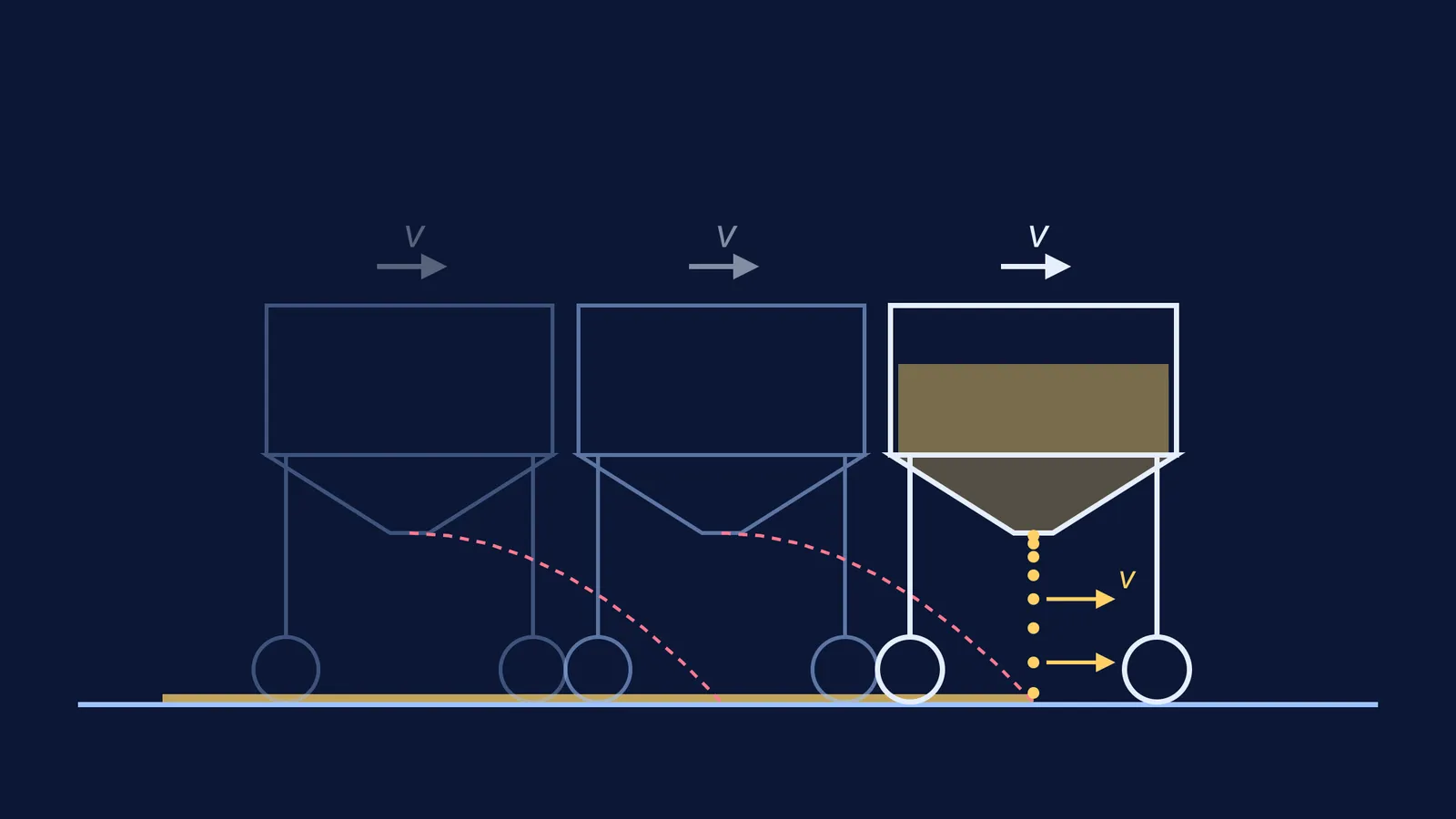
A cart full of sand rolls along a smooth track, and sand trickles out through a hole in its floor. Does the lighter cart speed up? It is a classic exam trap in momentum questions. The answer is no, as long as the sand falls straight down relative to the cart.
Does the speed of a cart change when sand leaks out of it?
No, provided no horizontal force acts on the cart (smooth track, no air drag). IIT Guwahati's first-year physics notes on variable mass problems use the same set-up with an ice skater holding a bag of sand that leaks straight down. The notes say the sand “does not transport any momentum away from the object in the direction of motion of the object”. In plain words, the falling sand gives the cart no horizontal push.
Why does the speed stay the same?
Track momentum, not mass. Take the cart plus a small bit of sand dm that is about to fall out, all moving at speed v.
Before: momentum = (m + dm)v.
After: the cart (mass m) moves at v + dv, and the bit of sand, which was moving with the cart, leaves with horizontal speed v.
With no outside horizontal force, momentum is conserved: (m + dm)v = m(v + dv) + dm·v.
Cancel the terms and you get m·dv = 0, so dv = 0.
The cart's momentum mv does fall, because m falls, but each grain carries its own share, dm·v, out with it. A grain keeps moving forward at v while it falls, so every grain stays directly under the hole until it lands.
The general rule in the same IIT Guwahati notes is the rocket equation: F = m(dv/dt) − (dm/dt)u, where u is the velocity of the leaving mass relative to the body. For the leaking cart, F = 0 and u = 0, so m(dv/dt) = 0.
Why is "the lighter cart goes faster" wrong?
The usual mistake is to write F = d(mv)/dt for the cart alone, set F = 0, and conclude that a lighter cart must go faster. That treats the cart as a closed system while sand, and its momentum, is leaving.
Physicists have disagreed about how to write the law for systems that gain or lose mass. K. Nakayama's 2018 paper in the European Journal of Physics (doi:10.1088/1361-6404/aac751) addresses “misinterpretations” of the law for variable mass systems found in the literature. The safe habit for exams is to draw a boundary around the body plus the bit of mass that is leaving or arriving, then conserve momentum for that whole system.
Worked example: leaking cart, rain cart and pushed cart
An empty cart has mass 50 kg and carries 150 kg of sand. It moves at 2 m/s on a smooth track, and sand leaks through the floor at 5 kg/s, so the cart is empty after 30 s. The numbers are invented for practice; the methods are the ones in the IIT Guwahati variable mass notes.
Sand leaks straight down: the final speed is still 2 m/s. The cart's momentum falls from 400 to 100 kg m/s, and the missing 300 kg m/s left with the sand.
The tempting wrong answer: setting 200 × 2 = 50 × v gives v = 8 m/s. That would need the sand to leave with zero ground-frame speed, pushed backward.
Rain falls into the empty cart instead: vertical rain brings no horizontal momentum, which is example 1 in the notes. If 150 kg collects, 50 × 2 = 200 × v gives v = 0.5 m/s, because arriving mass has to be brought up to speed.
A steady 100 N push while the sand leaks, starting from rest: the notes' freight-car example gives F = m(t)(dv/dt), which leads to v = (F/b)ln(m₀/m). Here that is 20 × ln 4, about 27.7 m/s, when the sand runs out.
When does the speed of a cart actually change?
Check this before writing any equation:
Mass leaves with zero velocity relative to the body (a leak, a dropped stone): speed unchanged.
Mass leaves backward relative to the body (rocket exhaust, a person jumping off the back): the body speeds up.
Mass arrives with no horizontal velocity (rain, coal from a hopper): the body slows down.
An outside force acts as well: add it to F in F = m(dv/dt) − (dm/dt)u.
The same bookkeeping explains the force needed to keep a conveyor belt moving as sand falls. See also block dropped onto a moving cart and rocket thrust and relative exhaust speed.
If you keep picking the wrong system, the Fermi Problem Library has worked problems with a step-by-step solver that explains the reasoning rather than printing an answer. To revise momentum and variable mass from the ground up, start with the Fermi Concept Library.


