

On this page
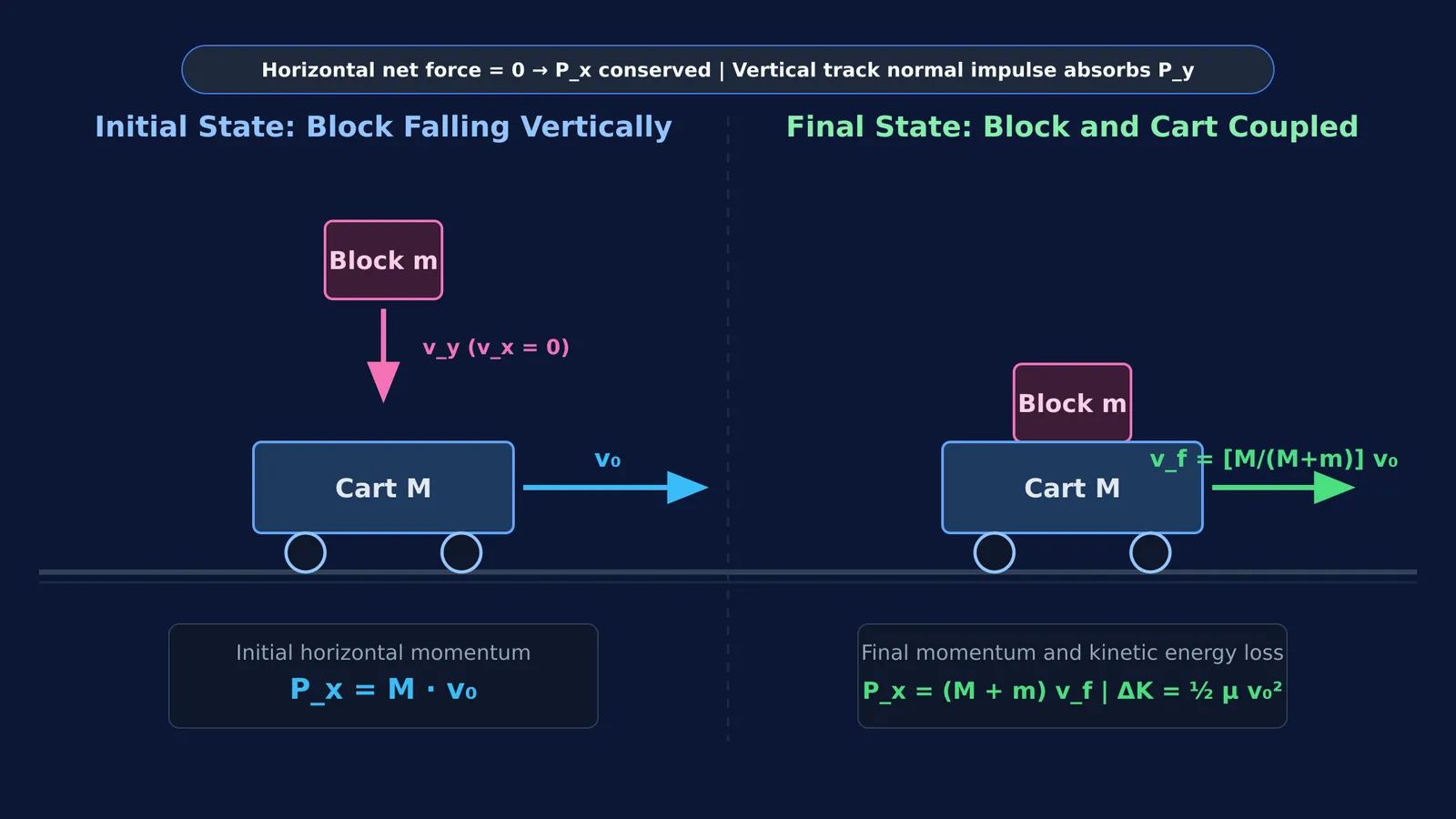
Imagine a cart of mass M rolling along a frictionless track at velocity v₀. A block of mass m is dropped gently onto the cart from directly above with zero initial horizontal velocity. As the surfaces touch, kinetic friction accelerates the block forward while exerting an equal and opposite backward force on the cart.
Because the track is frictionless, no external horizontal force acts on the two-body system. Under the principle of conservation of linear momentum in OpenStax University Physics Volume 1, total momentum remains constant whenever net external force is zero: M × v₀ = (M + m) × v_f.
Solving for the new speed yields v_f = [M / (M + m)] × v₀. Because M / (M + m) is less than 1, the cart slows down.
Why is vertical momentum not conserved during the drop?
Students preparing for exams like JEE Main often wonder why momentum is conserved horizontally but not vertically. Linear momentum is a vector, so Newton's second law applies independently along each coordinate axis.
Before landing, the dropped block has downward vertical momentum m × v_y. When it strikes the cart bed, the track exerts an external upward normal impulse that cancels this vertical momentum. As outlined in the mechanics syllabus published by the National Testing Agency, momentum is conserved only along axes where net external force is zero. Horizontally, external forces sum to zero; vertically, they do not.
In physics education research published in the *American Journal of Physics*, Chandralekha Singh tested how 20 physics professors and students solved counterintuitive mechanics problems in American Journal of Physics (Singh, 2002). Singh found that even experienced physicists make errors when relying on intuition rather than systematically applying formal conservation principles.
How much kinetic energy is lost to sliding friction?
Although horizontal momentum is conserved, mechanical kinetic energy is not. The dropped block acts as a completely inelastic collision along the horizontal axis. As explained in OpenStax University Physics on inelastic collisions, completely inelastic interactions produce the maximum loss of kinetic energy compatible with momentum conservation.
Initial kinetic energy is K_i = ½ M v₀², while final kinetic energy is K_f = ½ (M + m) v_f² = ½ [M² / (M + m)] v₀². The lost kinetic energy is ΔK = K_i − K_f = ½ [M m / (M + m)] v₀² = ½ μ v₀², where μ is the reduced mass. Sliding friction converts this energy into heat during relative slip. For students reviewing the relationship between kinetic energy and momentum, recognizing this loss prevents trying to find final speed with energy conservation.
What happens when rain falls into or leaks out of a cart?
The dropped-block principle extends directly to continuous mass transfer. Consider an open railway wagon rolling without friction under vertical rain. Because falling rain carries zero initial horizontal velocity, the cart must exert a horizontal force to accelerate each drop, causing the wagon to decelerate continuously.
If rain accumulates at rate dm/dt = R, total horizontal momentum remains fixed at M × v₀, giving speed v(t) = (M × v₀) / (M + R × t). Maintaining constant speed requires an external force F = v₀ × (dm/dt), as analyzed in OpenStax University Physics on variable-mass systems.
Conversely, if water leaks vertically through a bottom drain, cart speed remains constant. As Kirk T. McDonald showed in the American Journal of Physics (McDonald, 1991), leaking water leaves with the cart's horizontal velocity, carrying away its momentum without exerting horizontal thrust. This differs from variable-mass systems such as rockets, where mass is ejected at relative velocity. In a 25-question diagnostic survey in the American Journal of Physics (Singh & Rosengrant, 2003), researchers noted that tracking whether moving mass carries horizontal momentum remains a key student hurdle.
How do you solve a dropped block problem step by step?
To solve dropped-block problems, apply this sequence based on OpenStax mechanics principles:
Verify horizontal forces: With a frictionless floor, horizontal momentum is conserved: M × v₀ = (M + m) × v_f.
Calculate common velocity: Solve v_f = [M / (M + m)] × v₀.
Find slipping duration: Friction f_k = μ_k m g gives relative acceleration a_rel = μ_k g (1 + m/M). Slipping lasts t = v₀ / a_rel over relative distance s_rel = v₀² / (2 a_rel).
Verify energy loss: Confirm that friction work matches lost kinetic energy: ΔK = ½ [M m / (M + m)] v₀².
For example, if a cart of mass M = 3 kg moves at v₀ = 4 m/s and receives a block of mass m = 1 kg, momentum conservation gives v_f = (3 kg × 4 m/s) / (3 kg + 1 kg) = 3 m/s, as practiced in problems on collisions and momentum. Initial kinetic energy is ½ × 3 kg × (4 m/s)² = 24 J, while final kinetic energy is ½ × 4 kg × (3 m/s)² = 18 J, with 6 J converted into heat during slipping.
To practice multi-body mechanics with detailed explanations, the Fermi Problem Library offers worked problems with a step-by-step solver that explains the reasoning rather than printing an answer. For consolidating foundational laws across units, the Fermi Concept Library organizes every concept in physics, chemistry, biology, mathematics and computing, each with its own lesson and its place in the map.


