

On this page
The waste you put out this morning does not vanish. In many Indian cities it ends up on a dump or a landfill, where it starts a slow chemical process that can run for decades. Its products are a greenhouse gas, a toxic liquid and, on a hot April day, smoke over a city.
What happens to waste after it is buried?
Microbes do the work, in stages. The US EPA says fresh waste first decomposes aerobically, with oxygen, and little methane is made. Typically within less than a year, the oxygen runs out and anaerobic conditions take over.
The US health agency ATSDR's landfill gas primer splits the process into four phases:
Phase I: aerobic bacteria use up the trapped oxygen, over days or months.
Phase II: without oxygen, bacteria turn the waste into organic acids and the landfill becomes highly acidic.
Phase III: other anaerobic bacteria eat those acids, and methane-producing bacteria move in.
Phase IV: gas comes out at a fairly steady composition and rate.
The same primer says gas production usually peaks 5 to 7 years after burial, stays steady for about 20 years, and small amounts continue for 50 years or more. It also notes that a moisture content of 40% or more (by wet weight) promotes maximum gas production, and that bacteria usually hold a landfill at about 25 to 45 °C inside. Methane-making microbes do the same job without air in rice paddy fields that release methane.
What is landfill gas made of?
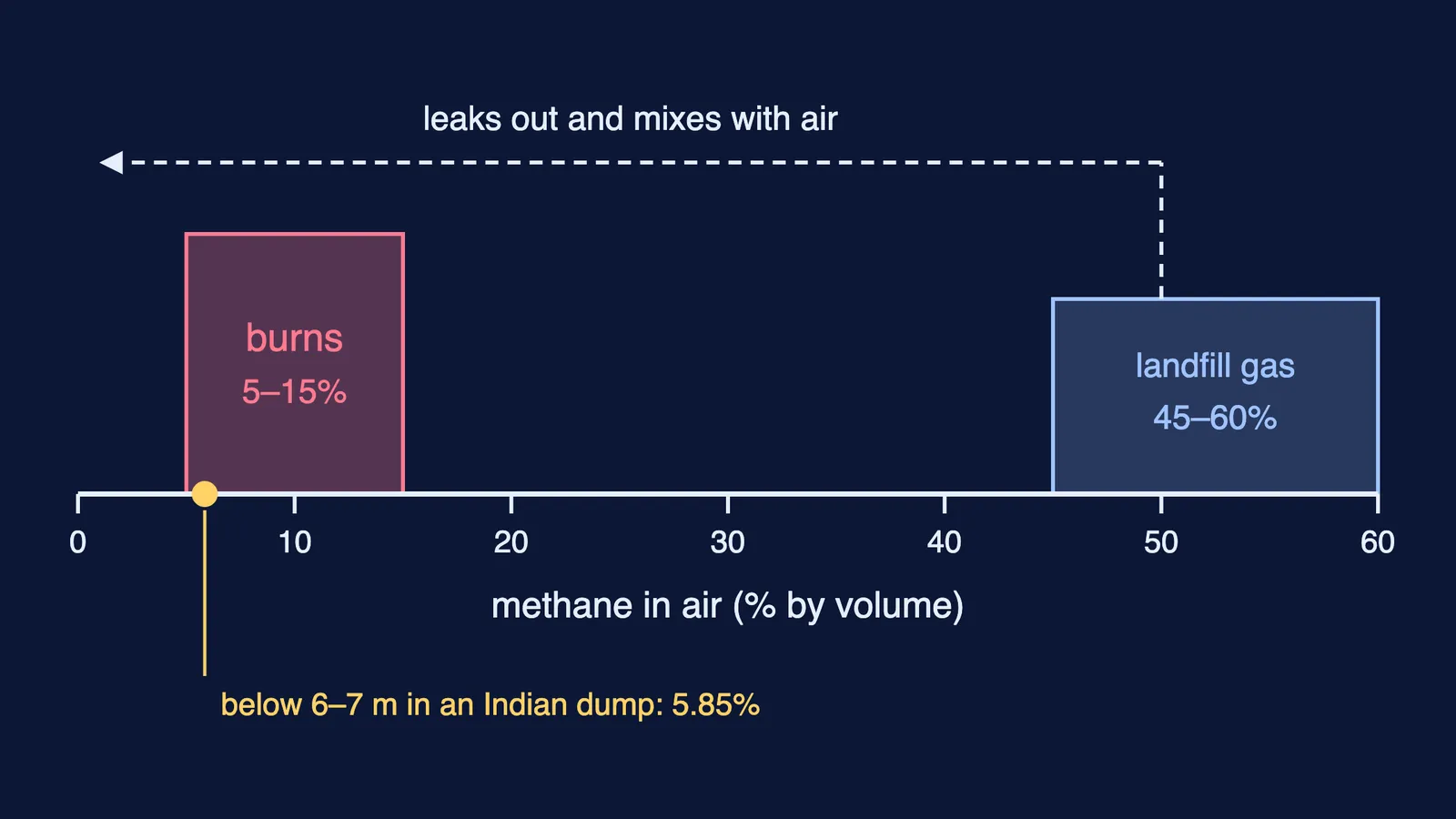
Landfill gas is roughly 50% methane and 50% carbon dioxide, with a small amount of other organic compounds, according to the US EPA. ATSDR's primer gives about 45 to 60% methane in Phase IV.
Methane is at least 28 times more effective than CO2 at trapping heat over 100 years, the EPA notes, citing the IPCC. That is why rotting waste matters for climate, much as thawing permafrost and its methane does.
What is leachate, and why does it matter?
Leachate forms when rainwater filters through waste and draws chemicals out of it, in the words of the US EPA. An unlined dump has nothing to stop it reaching groundwater.
A 2024 study in Scientific Reports examined leachate from Delhi's Ghazipur landfill and its effect on nearby groundwater. It found 22,690 to 34,525 mg/L of dissolved substances in the samples, and the authors describe leachate as highly toxic, corrosive and full of environmental pollutants.
Why do Indian dump sites catch fire?
Three things meet on an open dump: fuel, heat and methane mixed with air.
Fuel. Researchers studied an open dumpsite in a coastal Indian city (Waste Management, 2019). About 62% of the fresh waste was combustible, and plastics made up 25 to 33% of older waste samples.
Methane. The same study measured about 5.85% methane below 6 to 7 m from the surface, at the low end of methane's burning range. It concluded that haphazard dumping, the type of waste, compaction and heat spreading from deliberately lit fires may set off spontaneous fires.
Heat. Ghazipur caught fire on 21 April 2024. Down To Earth, reporting the 2024 Scientific Reports study, says its layers 30 to 50 m deep were at 60 to 70 °C.
A properly engineered landfill has a liner, a cover and pipes to collect gas. An open dump has none of these. The Brahmapuram dump in Kochi caught fire in March 2023, and the National Green Tribunal fined the Kochi Corporation ₹100 crore. Burning mixed waste also releases the toxins explained in why burning plastic is harmful.
Worked example: when does landfill gas become flammable?
ATSDR's primer, chapter 3 gives methane's lower explosive limit as 5% and upper limit as 15% by volume. Let us find how much air turns landfill gas into a fire risk.
Take 1 litre of landfill gas at 50% methane, so 0.5 L of methane. Mix it with x litres of air. The methane fraction is 0.5 / (1 + x).
Upper limit: 0.5 / (1 + x) = 0.15, so 1 + x = 3.33 and x = 2.3 L.
Lower limit: 0.5 / (1 + x) = 0.05, so 1 + x = 10 and x = 9 L.
So between about 2.3 and 9 litres of air per litre of gas, the mixture can burn.
That is why ATSDR says methane is unlikely to explode inside a landfill: the risk comes when the gas migrates, is diluted by air and collects in a confined space.
The Fermi Simulation Lab has interactive simulations for the ideas that are easier to see than to read.
What can you do with this at home?
Keep wet kitchen waste separate from dry waste, so it can be composted instead of rotting without air on a dump.
Never burn waste, even a small pile of leaves and plastic.
For exams, learn the chain: aerobic, acid, methane, steady. The same anaerobic chemistry appears in biogas plants and paddy fields.
If a step such as methanogenesis or explosive limits feels shaky, the Fermi Concept Library has a lesson for every concept in chemistry and biology.


