

On this page
Kwashiorkor and marasmus are the two classic forms of severe undernutrition in young children, and they look almost opposite. A child with marasmus is visibly thin. A child with kwashiorkor can look puffy while being just as seriously ill.
What is the difference between kwashiorkor and marasmus?
The MSD Manual's chapter on protein-energy undernutrition gives the clinical picture of each.
Marasmus is a severe deficiency of calories and protein that tends to develop in infants and very young children. The body loses its fat and muscle, so the ribs, hips, facial bones and spine become visible through the skin.
Kwashiorkor is the wet, swollen or oedematous form of undernutrition. The MSD Manual describes swelling of the limbs and around the eyes, a protruding abdomen with an enlarged liver, dry, thin skin that can darken and crack, and thin hair that can turn reddish-brown or grey. It is a risk after breastfeeding stops too early, often when a younger sibling is born, so children with kwashiorkor tend to be older than those with marasmus.
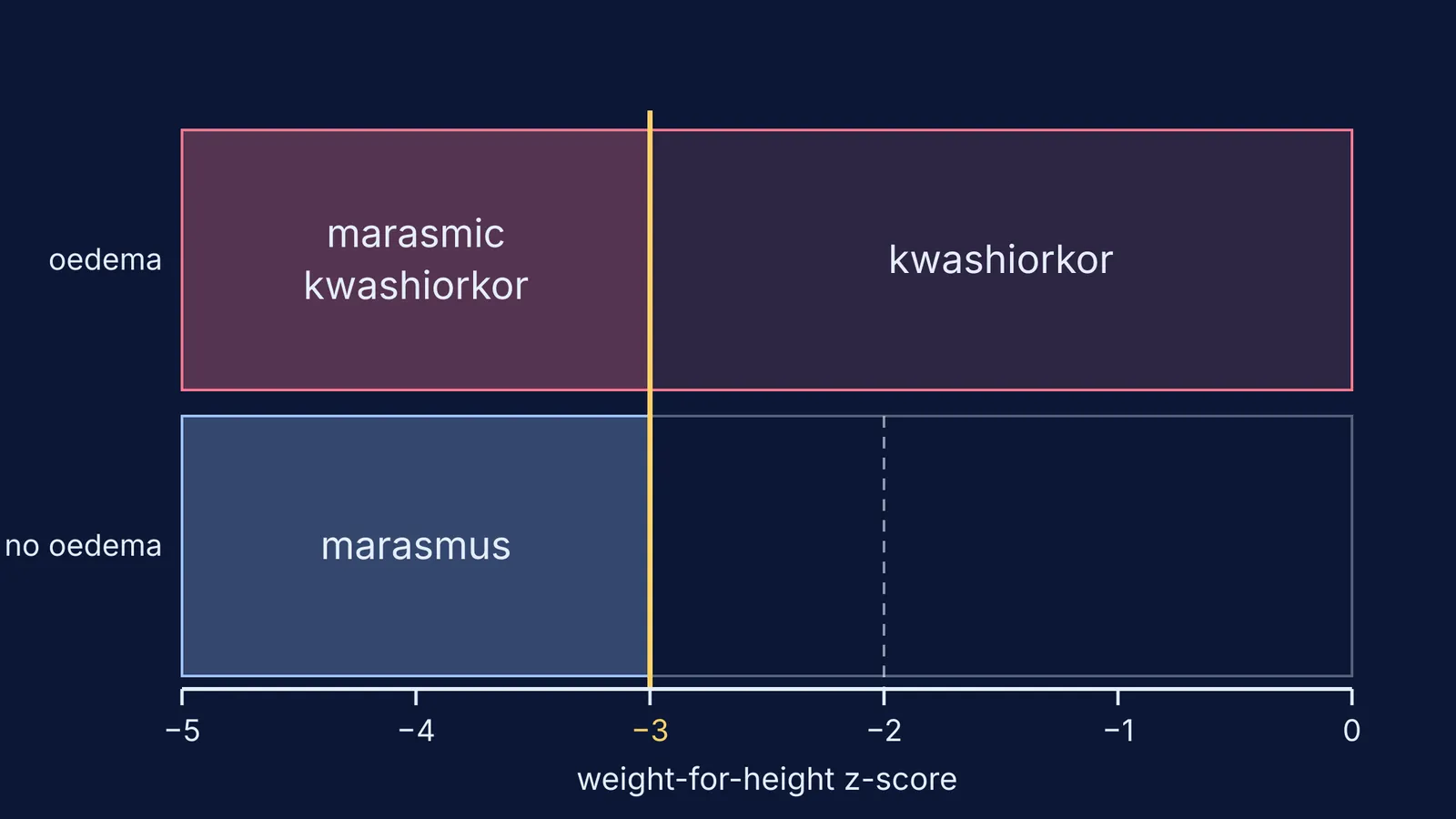
Some children have both: marasmic kwashiorkor, which the same chapter describes as having the features of both, oedema and wasting together.
Is kwashiorkor really caused by lack of protein?
Textbooks say kwashiorkor is protein shortage and marasmus is overall food and energy shortage. Scientists have argued about that for decades.
Cicely Williams described the condition in a 1933 paper in Archives of Disease in Childhood, titled "A nutritional disease of childhood associated with a maize diet". Protein deficiency later became the standard explanation.
In 1982 Michael Golden published a study in The Lancet of 103 children with oedematous malnutrition fed six different diets. How fast the swelling went down was strongly correlated with energy intake (r = 0.75) but not with protein intake (r = 0.03). In the same study, 66 children on a very low-protein diet lost their oedema as fast as children given five times as much protein. Golden suggested that protein deficiency is not the cause of the oedema of kwashiorkor.
Golden later argued, in a 2015 paper in Paediatrics and International Child Health, that kwashiorkor is fundamentally related to a defect in sulphur metabolism. A 2013 study in Science of Malawian twin pairs, where only one twin had kwashiorkor, found differences in their gut bacteria; germ-free mice given the gut bacteria of children with kwashiorkor lost weight.
So the protein-versus-energy split helps you sort the two conditions, but the exact cause of kwashiorkor is still being worked out.
How do doctors identify severe malnutrition?
WHO uses three signs for children aged 6 to 59 months. On its page on identifying severe acute malnutrition, a child counts as severely malnourished if any one of these is present:
mid-upper arm circumference below 115 mm
weight-for-height below -3 Z-scores of the WHO Child Growth Standards median
bilateral pitting oedema (swelling on both sides that keeps a dent when pressed)
The third rule matters here: swelling alone is enough, even if the child's weight looks fine.
In India, the Health Ministry's NFHS-6 release reported that severe wasting fell from 7.7% in NFHS-5 (2019-21) to 5.2% in NFHS-6 (2023-24). Over the same period stunting among children under five fell from 35.5% to 29.3%.
If you are worried about a child's growth, swelling or appetite, see a doctor or local health worker: the MSD Manual notes that feeding a severely undernourished person back up can cause refeeding syndrome, including fluid overload and heart rhythm problems.
How do you answer a kwashiorkor vs marasmus question?
Use this four-step check on any case description:
Look for swelling first. Puffy feet, legs or face means kwashiorkor, or marasmic kwashiorkor if there is also wasting.
No swelling but visible ribs, loose skin and no fat means marasmus.
Check the age clue. Infants point towards marasmus; older toddlers, often after early weaning, point towards kwashiorkor.
Look for the extra signs typical of kwashiorkor: enlarged liver, pot belly, skin and hair changes.
Worked example. "A two-year-old was weaned when a sibling was born. She now has swollen feet, a protruding belly and thin, reddish-brown hair, and she weighs close to normal." Swelling is present, the age and weaning history fit, and near-normal weight doesn't rule it out because WHO counts oedema on its own. Answer: kwashiorkor.
Swap the case: "A nine-month-old with no swelling, visible ribs and a shrunken face." No oedema, severe wasting, infant age. Answer: marasmus.
If the gap is background biology, such as what proteins and calories do in the body, the Fermi Concept Library has every concept in biology with its own lesson and its place in the map. For case-style questions, the Fermi Problem Library has worked problems with a step-by-step solver that explains the reasoning rather than printing an answer.
To go further, revise the alimentary canal and digestive glands with a labelled figure, and keep the cut-offs above on your one-sheet list of NCERT biology numbers.


