

On this page
You read "tidal volume is approx. 500 mL" in NCERT's breathing chapter ten times, it feels familiar, and in the exam you cannot tell it from the expiratory reserve volume. The fix: one sheet of numbers, grouped by chapter, tested weekly from a blank copy.
Why do NCERT biology numbers slip out of memory?
A bare number has no meaning to hang on to, and numbers in a set blur together. The breathing chapter gives you four volumes together: tidal volume about 500 mL, inspiratory reserve 2500-3000 mL, expiratory reserve 1000-1100 mL and residual volume 1100-1200 mL (NCERT Class 11 Biology, Chapter 14).
Rereading also fools you. In a 2006 experiment by Henry Roediger and Jeffrey Karpicke, students either restudied prose passages or took free-recall tests on them (Psychological Science). Restudying did better on a test 5 minutes later. On tests 2 days and 1 week later, the students who had tested themselves remembered substantially more, even though restudying had made students more confident.
How do you make a one-page sheet of NCERT biology numbers?
Use one A4 sheet and four rules:
Copy each number from the current NCERT book, not a guide, and write the page number beside it.
Group numbers by chapter, in book order.
Write the unit and a few words of context: "RBCs live 120 days" (Ch 15), not "120".
Put numbers that belong together on one line, so you learn the set and its order.
Here is what four blocks look like, each value checked against the 2026-27 reprint:
Class 11, Ch 14, Breathing (source): 12-16 breaths a minute; 97% of oxygen carried by RBCs, 3% dissolved in plasma; carbon dioxide 20-25% as carbamino-haemoglobin, 70% as bicarbonate, 7% dissolved.
Class 11, Ch 15, Body fluids (source): plasma about 55% of blood; RBCs 5-5.5 million per mm³, living 120 days; haemoglobin 12-16 g per 100 mL; WBCs 6000-8000 per mm³; heart 72 beats a minute; stroke volume 70 mL.
Class 11, Ch 16, Excretion (source): nearly one million nephrons per kidney; GFR about 125 mL a minute; about 1.5 litres of urine a day.
Class 12, Ch 4, Inheritance (source): 23 pairs of chromosomes, 22 of them autosomes; Down's syndrome is trisomy 21; Klinefelter's 47, XXY; Turner's 45, X0; colour blindness in about 8% of males and 0.4% of females.
Have a list for one chapter, like the cockroach organ numbers in NCERT? Fold it into the sheet.
Which numbers can you work out instead of memorising?
Write the working in a corner of the sheet.
Cardiac cycle: 60 seconds divided by 72 beats is 0.83 s, which NCERT gives as 0.8 seconds (Class 11, Chapter 15).
Cardiac output: 70 mL times 72 beats is 5040 mL a minute, the "5000 mL or 5 litres" in the same chapter.
Filtrate: 125 mL times 1440 minutes is 180,000 mL, the "180 litres per day" in Class 11, Chapter 16. Only 1.5 of those litres leave as urine, so nearly 99% is reabsorbed.
DNA length: 6.6 × 10⁹ bp times 0.34 × 10⁻⁹ m per bp is about 2.2 metres, NCERT's figure for a typical mammalian cell in Class 12, Chapter 5.
Learn 72, 70 and 125, and three more values follow.
What does a weekly recall check look like?
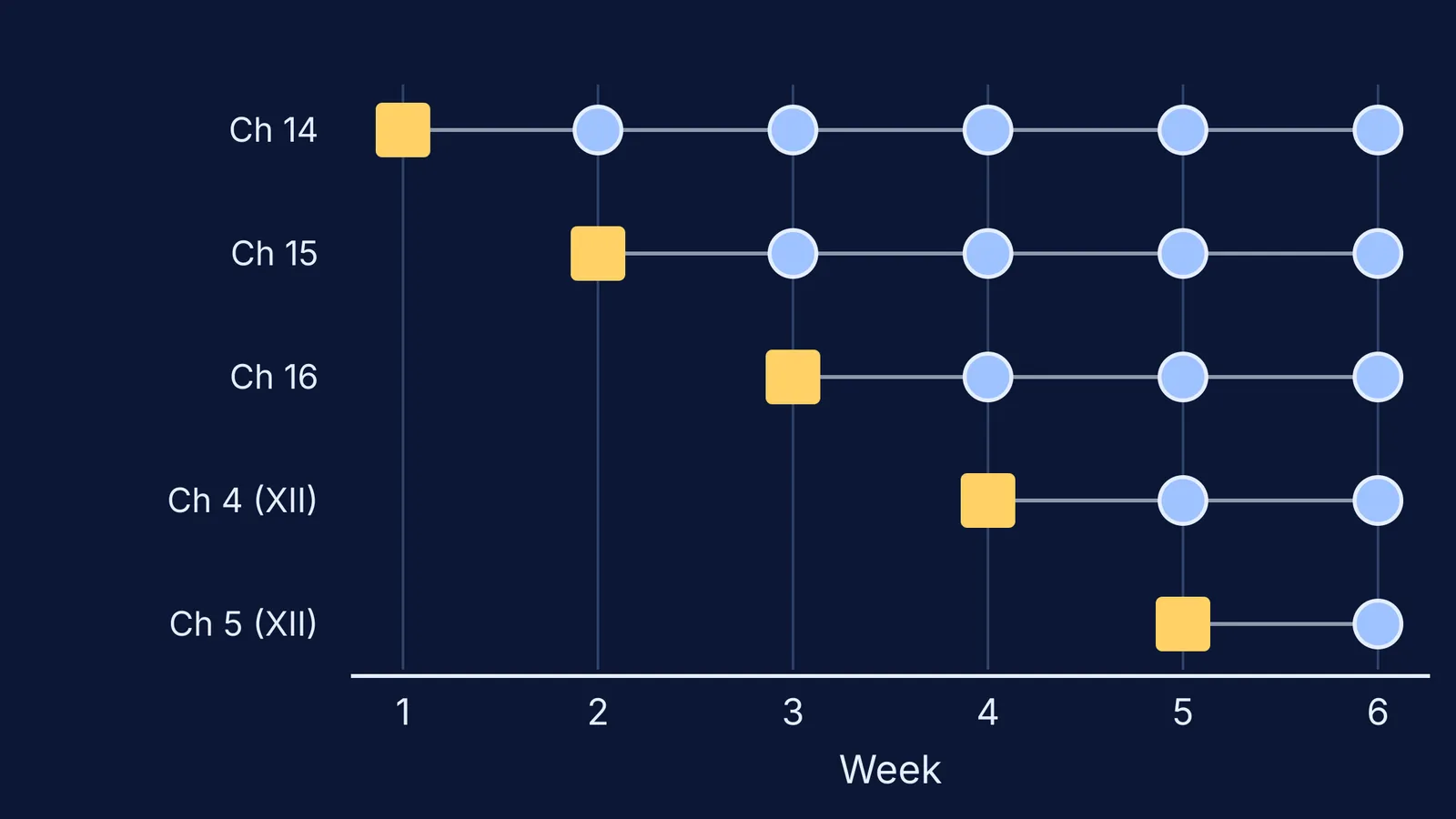
Fifteen minutes, same day each week:
Make a blank sheet with only chapter headings and prompts: "Tidal volume = ?", "GFR = ?", "Turner's karyotype = ?".
Fill in what you can from memory.
Check against the master sheet in red pen and star every miss.
Give starred numbers a two-minute check midweek.
Add the block for any chapter you finished this week.
Move a number you get right three weeks running to a monthly check.
Why weekly? In a study of more than 1,350 people, Nicholas Cepeda and colleagues found that the best gap between first study and a review grows with how far away the test is: about 20-40% of the wait for a test one week away, falling to about 5-10% for a test a year away (Psychological Science, 2008). The study tested one review, so this is a rough guide: for an exam months away, it points to gaps of one to three weeks, and weekly is easiest to keep.
The blank sheet works like the blurting revision method: write first, check second. For named organisms, see how to remember NCERT biology examples.
How can a parent help without hovering?
A parent can run the weekly check: hold the master sheet, read the prompts and say only "right" or "check that one". A good question: "Tell me three numbers from excretion and what each measures." Leave the marking to your child.
If a number keeps failing because the idea behind it is fuzzy, such as why residual volume stays in the lungs, go back to the concept. The Fermi Concept Library has a lesson for every concept in biology, physics, chemistry, mathematics and computing, each with its place in the map, so you can see where a number comes from.
Start tonight with the chapter you are studying: one block, one blank copy, one Sunday check.


