

On this page
If your practical file or Class 11 chapter on respiration mentions Kühne's (usually written Kuhne's) fermentation tube, it wants you to show one thing: yeast can break down sugar and release carbon dioxide without an oxygen supply. Here is how it works, what to write, and what to say in the viva.
What is Kuhne's fermentation tube?
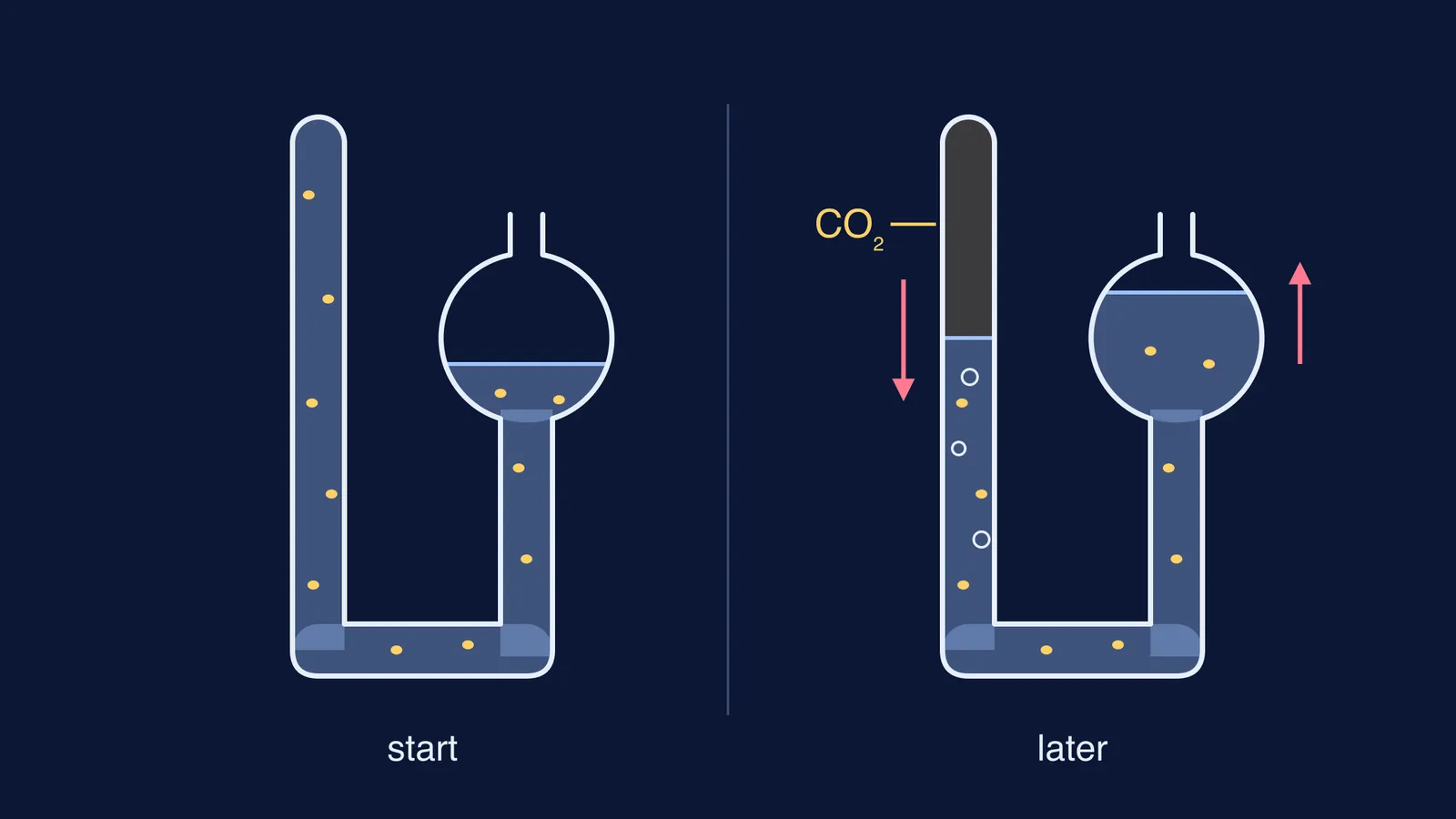
It is a glass tube with two limbs: an upright limb closed at the top, and a side tube with a bulb. The Tamil Nadu Class 11 Botany chapter on respiration, as reproduced on BrainKart's page on fermentation, describes it as "an upright glass tube with side bulb" and uses it to demonstrate alcoholic fermentation, a form of anaerobic respiration.
The closed limb is filled to the very top before you start, so it holds no air. Any gas that later appears there was made inside the tube, and the only living thing inside is yeast.
How do you set up the Kuhne's tube experiment?
The textbook version, described on BrainKart and on this Tamil Nadu state board study page, uses a 10 per cent sugar (glucose) solution mixed with baker's yeast.
Mix baker's yeast into the 10% glucose solution.
Pour the mixture in through the bulb, tilting the tube until the closed limb is completely full.
Stand the tube upright and mark the starting level of liquid in the bulb.
Leave it to stand, then look at the top of the closed limb and at the bulb.
Drop a pellet of KOH (potassium hydroxide) into the tube and watch the closed limb again.
What do you observe, and why does the liquid level fall?
According to the state board study page, after some time the solution gives out an alcoholic smell and the level in the upright tube falls because carbon dioxide collects at the top. The gas pushes the liquid down, and the displaced liquid moves into the bulb.
Both Tamil Nadu sources credit the enzyme zymase in yeast, which converts glucose into alcohol and CO2. The NCERT chapter, hosted on IIT Kanpur's SATHEE platform, gives the finer detail: after glycolysis in the cytoplasm, pyruvic acid is converted to CO2 and ethanol, and the enzymes pyruvic acid decarboxylase and alcohol dehydrogenase catalyse these reactions. NCERT adds that less than seven per cent of the energy in glucose is released in fermentation. For the comparison with muscle cells, see our explainer on alcoholic vs lactic acid fermentation.
How does KOH prove the gas is CO2?
KOH absorbs carbon dioxide. When a pellet is added, it absorbs the gas collected at the top of the closed limb and the solution rises back up the upright tube (BrainKart, Tamil Nadu Class 11 Botany). If the gas had been something KOH does not absorb, the level would not have moved.
Put the two observations together and you have your inference: the yeast released CO2, and it did so in a limb that held no air. That is anaerobic respiration. Since CO2 is given out but no oxygen is taken in, the respiratory quotient for anaerobic respiration is infinity, as the study page states.
Limewater is the other common test for CO2; our guide on how to test for hydrogen, oxygen and carbon dioxide gas covers it. For the aerobic version with germinating seeds, see the experiment to show CO2 is released in respiration.
What do examiners ask about this experiment?
These answers draw on the NCERT chapter and the Tamil Nadu study page. Practise saying each in one breath.
Why fill the closed limb completely? So there is no air in it; any gas that collects must come from the yeast.
What is the gas, and how do you know? Carbon dioxide, because KOH absorbs it and the level rises again.
Why the alcoholic smell? Yeast converts pyruvic acid to ethanol and CO2.
Which enzymes? Zymase, in the state textbook; NCERT names pyruvic acid decarboxylase and alcohol dehydrogenase.
What is the RQ here? Infinity, because CO2 is released and no oxygen is used.
Why can't yeast make very strong alcohol? NCERT says yeasts poison themselves to death when alcohol reaches about 13 per cent.
If the chain from glucose to pyruvic acid to ethanol still feels shaky, the Fermi Concept Library gives every concept in biology and chemistry its own lesson and its place in the map. For practice beyond the practical, the Fermi Problem Library has worked problems with a step-by-step solver that explains the reasoning rather than printing an answer.
Before your practical, sketch the tube twice, before and after, and label the gas, the level and the bulb.


