

On this page
Most Kp and Kc mistakes come from a wrong Δn, the wrong R, or a sign slip in the exponent. Here is the derivation, a rule for choosing R, a worked example and four quick checks.
How do you derive Kp = Kc(RT)^Δn?
Start from the ideal gas law for one gas in the mixture: pV = nRT. Divide both sides by V and you get p = (n/V)RT. The term n/V is the molar concentration, the thing written in square brackets in Kc. So for every gas, p = [gas] × RT.
Now take the general reaction aA + bB ⇌ cC + dD, all gases. Kp is built from partial pressures, Kp = (pC^c × pD^d) / (pA^a × pB^b). Replace each p with [ ] × RT:
Kp = ([C]^c [D]^d (RT)^(c+d)) / ([A]^a [B]^b (RT)^(a+b))
The concentration part is exactly Kc, and the RT parts combine to (RT)^((c+d) − (a+b))
So Kp = Kc(RT)^Δn, with Δn = (c + d) − (a + b)
This is the same result and the same definition of Δn given in OpenStax Chemistry 2e, section 13.2, which describes Δn as the difference in molar amounts of product and reactant gases.
Which value of R should you use in Kp = Kc(RT)^Δn?
Here R turns mol per litre into a pressure, so it must carry litres and your pressure unit.
The molar gas constant has the exact value 8.314 462 618… J mol⁻¹ K⁻¹, according to NIST's CODATA value. The NIST Guide to the SI lists 1 bar = 10⁵ Pa, 1 atm = 101 325 Pa and 1 L = 10⁻³ m³. From those three lines you get:
Kp in bar: R = 0.08314 L bar mol⁻¹ K⁻¹
Kp in atm: R = 0.08206 L atm mol⁻¹ K⁻¹
Kp in Pa: R = 8.314, but then concentrations must be in mol m⁻³, not mol L⁻¹
The classic trap is R = 8.314 with concentrations in mol L⁻¹. Since 1 J L⁻¹ = 1 kPa, that quietly gives Kp in kilopascals, so your answer is off by a factor of 100^Δn compared with bar. We cover the wider question of matching R to units in our post on which value of R to use in chemistry.
Temperature always goes in kelvin. Add 273 (or 273.15) before anything else.
Worked example: what happens when Δn is negative?
OpenStax works this one in Example 13.4: CS₂(g) + 4H₂(g) ⇌ CH₄(g) + 2H₂S(g), with Kc = 0.28 at 900 °C.
Convert temperature: T = 900 + 273 = 1173 K.
Count gas moles: products 1 + 2 = 3, reactants 1 + 4 = 5, so Δn = 3 − 5 = −2.
Using R = 0.0821 L atm mol⁻¹ K⁻¹, OpenStax gets Kp = 0.28 × (0.0821 × 1173)⁻² = 3.0 × 10⁻⁵.
If your textbook or exam works in bar, redo step 3 with R = 0.08314. Then RT = 97.53, (RT)² = 9512, and Kp = 0.28 / 9512 = 2.9 × 10⁻⁵. The answers differ only because bar and atm are different units; state the one your R implies. And because (RT)⁻² means divide by (RT)², Kp came out far smaller than Kc.
How can you check your answer quickly?
Run these before moving on:
Δn = 0 means Kp = Kc. For H₂(g) + I₂(g) ⇌ 2HI(g), 2 − 2 = 0, and anything to the power zero is 1. No R, no T, no calculation. Our post on pressure and equilibrium with equal gas moles uses the same reaction to show why pressure changes leave it alone.
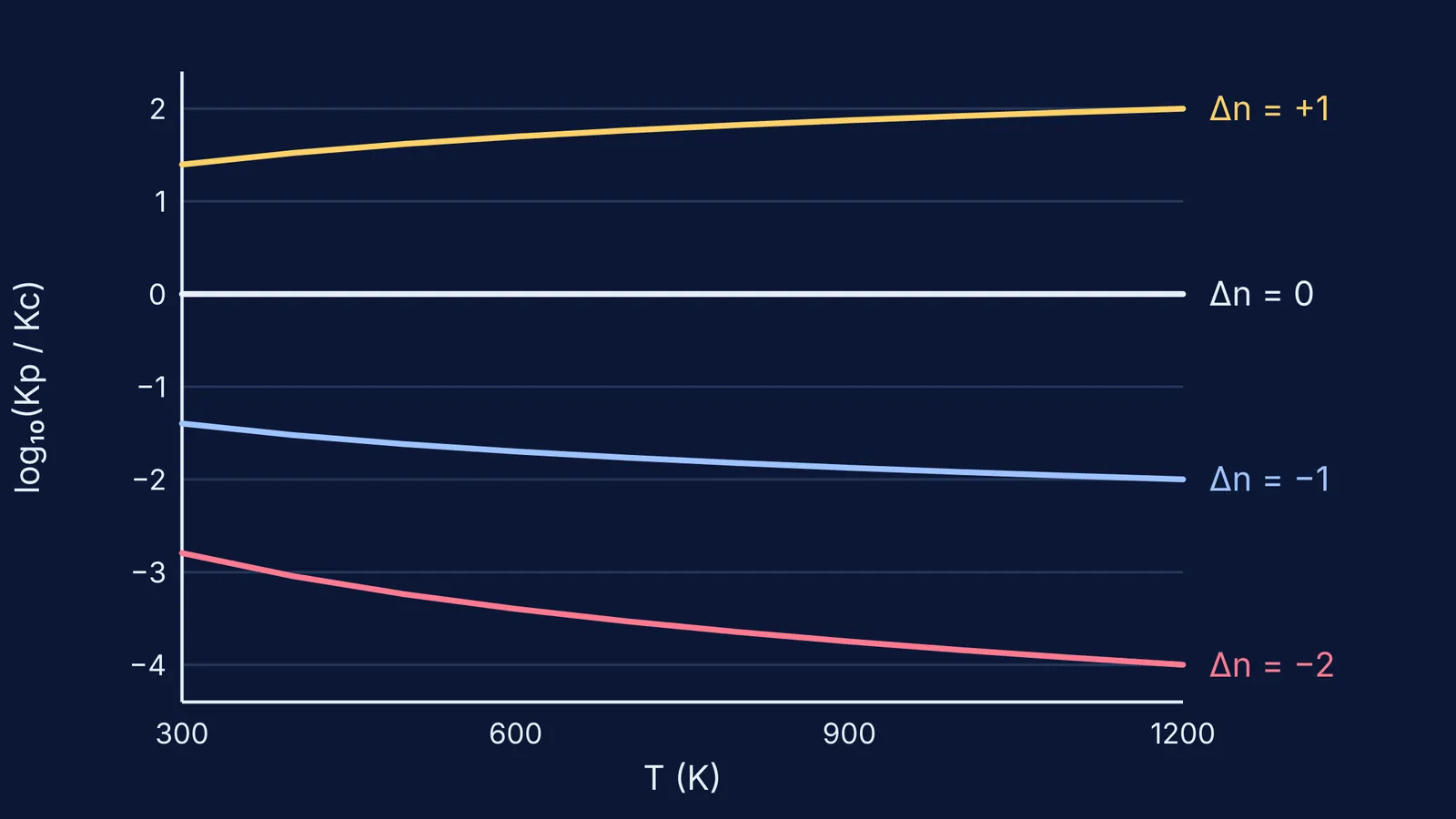
Δn negative means Kp is smaller than Kc; Δn positive means Kp is larger. This holds whenever RT is bigger than 1. With NIST's R converted to L bar mol⁻¹ K⁻¹, that is any temperature above about 12 K, so in practice always.
Rough size check. At room temperature RT is about 25 in bar units, and at 1000 K about 83. So each unit of Δn multiplies or divides Kc by roughly 25 to 100.
Fractional Δn is fine. If you halve an equation, Δn halves too, and (RT)^½ is just a square root.
A big Kp or Kc says the mixture at equilibrium favours products, not that amounts are equal. If that idea still feels slippery, read why equilibrium does not mean equal concentrations.
Where to practise next
If you keep getting the right method but the wrong number, the Fermi Problem Library has worked problems with a step-by-step solver that explains the reasoning rather than printing an answer, so you can see exactly which step went astray. If the ideal gas law itself is the shaky part, the Fermi Concept Library gives each chemistry concept its own lesson.
Try one Δn = 0, one positive and one negative case today, and run all four checks on each.


