

On this page
Make a prediction before you read on. A sealed flask holds hydrogen, violet iodine vapour and hydrogen iodide at equilibrium. You push a piston in and halve the volume. Does the equilibrium shift towards HI, back towards H₂ and I₂, or not at all?
Write your answer down, then test it with the method below.
Does a pressure change shift an equilibrium with equal moles of gas?
No. The NCERT Class 11 chemistry chapter Unit 6, Equilibrium says a pressure change made by changing the volume affects the yield only when the total moles of gaseous reactants and gaseous products are different.
For H₂(g) + I₂(g) ⇌ 2HI(g), the left side has 1 + 1 = 2 mol of gas and the right side has 2 mol of gas, so Δn = 0.
Le Chatelier's principle says the same in words: a squeezed mixture eases the pressure by moving towards fewer gas molecules. Here neither side has fewer, so there is nowhere to go.
How do you count gas moles on each side of an equation?
Balance the equation first. Count coefficients, not the number of different substances.
Check the state of every species. Only (g) counts. The NCERT chapter notes that you can ignore the effect of pressure on solids and liquids, because their volume barely depends on pressure.
Add up the gas coefficients on each side. Δn = gas moles of products minus gas moles of reactants.
Predict. Negative Δn: higher pressure pushes the reaction forward. Positive Δn: backward. Δn = 0: no shift.
Try five reactions from the same chapter before checking the answers:
N₂(g) + 3H₂(g) ⇌ 2NH₃(g): Δn = −2, so squeezing favours ammonia.
2NO₂(g) ⇌ N₂O₄(g): Δn = −1, so squeezing favours N₂O₄.
CO(g) + H₂O(g) ⇌ CO₂(g) + H₂(g): Δn = 0, so there is no shift.
C(s) + CO₂(g) ⇌ 2CO(g): Δn = +1, because solid carbon does not count. NCERT says this one runs in reverse when pressure rises.
H₂(g) + I₂(g) ⇌ 2HI(g): Δn = 0, so there is no shift.
What happens when you halve the volume of the H₂, I₂ and HI mixture?
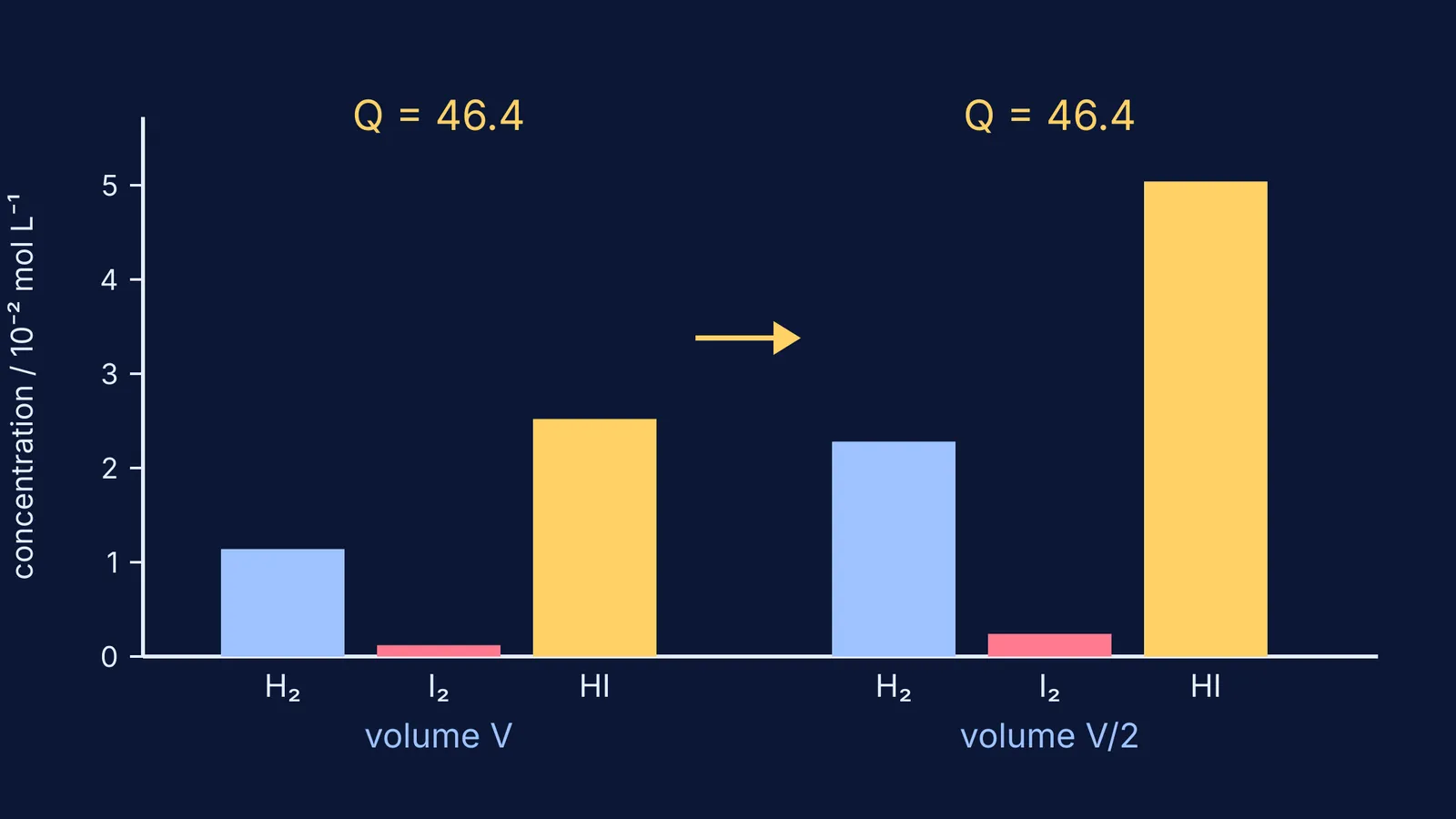
Use real numbers. In experiment 1 of Table 6.2 in NCERT's equilibrium chapter, run at 731 K, the equilibrium concentrations were [H₂] = 1.14 × 10⁻² mol L⁻¹, [I₂] = 0.12 × 10⁻² mol L⁻¹ and [HI] = 2.52 × 10⁻² mol L⁻¹.
Put them into Kc = [HI]² ÷ ([H₂][I₂]). The 10⁻² factors cancel, because there are two concentration terms on top and two on the bottom. You get Kc = (2.52)² ÷ (1.14 × 0.12) = 6.35 ÷ 0.137 ≈ 46.4, which matches the value NCERT lists for that experiment.
Now halve the volume at the same temperature. Every concentration doubles, to 2.28, 0.24 and 5.04 × 10⁻² mol L⁻¹. The new quotient is Qc = (5.04)² ÷ (2.28 × 0.24) = 25.4 ÷ 0.547 ≈ 46.4. Qc still equals Kc, so the squeezed mixture is already at equilibrium and does not shift.
Doubling puts a factor of 2² on top and 2 × 2 on the bottom, and they cancel. That cancellation is what Δn = 0 means.
Compare this with CO(g) + 3H₂(g) ⇌ CH₄(g) + H₂O(g), where 4 mol of gas become 2. NCERT halves that volume too and finds a forward shift: doubling every concentration multiplies Qc by 2² ÷ 2⁴, a quarter, so Qc drops below Kc.
Why are Kp and Kc equal for H₂ + I₂ ⇌ 2HI?
The NCERT chapter derives Kp = Kc(RT)^Δn. When Δn = 0, (RT)⁰ = 1, so Kp = Kc for this reaction. NCERT works through this exact reaction to show it.
So if an exam gives Kc for a reaction with equal gas moles and asks for Kp, you need neither R nor the temperature. For the full proof and the general rule, see our post on the relation between Kp, Kc and Kx.
Adding an inert gas is a different question from squeezing; see our post on adding an inert gas at constant volume vs constant pressure.
How can you test your prediction yourself?
Use this predict-then-test routine on each reaction in the practice list:
Write Δn and commit to a prediction: forward, backward or no shift.
Halve the volume, on paper or in a simulation, so every gas concentration doubles.
Compute Qc. Below Kc means forward, above means backward, equal means no shift.
Ask what changed. With Δn = 0 the concentrations change, but the moles of each gas do not.
The Fermi Simulation Lab has interactive simulations for ideas that are easier to see than to read, so you can change one condition and watch what the system does. For a guided example of the same habit, read our walk-through of Le Chatelier's principle in a simulation.
Next time a question says "the pressure is increased", count the gas moles before you draw the arrow.


