

On this page
Some organic reactions have two possible answers, and the question tells you which one it wants through one detail: the temperature. The classic case is HBr adding to 1,3-butadiene. Once you see why, you can handle "kinetic or thermodynamic?" questions in JEE Main, JEE Advanced and NEET-UG chemistry with the same checks.
What is the difference between a kinetic and a thermodynamic product?
Under kinetic control, the product of an irreversible reaction depends only on relative rates, not on stability (OpenStax).
Under thermodynamic (equilibrium) control, the product of a readily reversible reaction depends only on stability, not on relative rates (OpenStax).
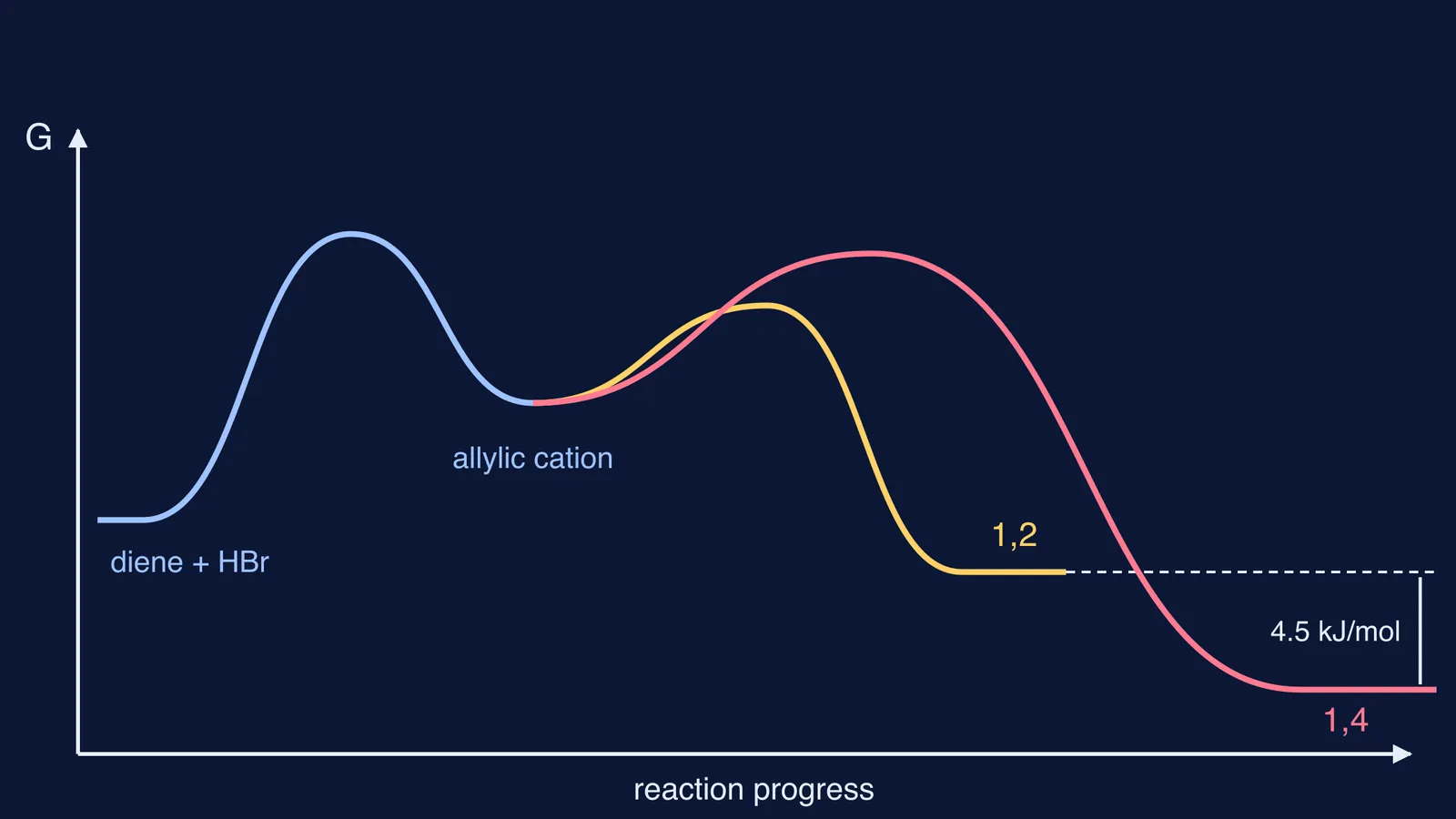
So the kinetic product sits behind the lowest energy barrier, and the thermodynamic product sits at the lowest energy. If "lowest barrier" and "lowest energy" still blur together for you, our post on thermodynamic vs kinetic stability, using diamond and graphite separates them with an everyday example.
Why does HBr with 1,3-butadiene give two products?
The proton from HBr adds to an end carbon of the diene (C-1). That gives an allylic carbocation, and OpenStax notes that its positive charge is shared by two carbons through resonance: C-2 and C-4 of the original diene chain. Bromide can attack either positive carbon:
Attack at C-2 gives 3-bromo-1-butene, the 1,2-addition product.
Attack at C-4 gives 1-bromo-2-butene, the 1,4-addition product.
Why is the 1,2 product faster? LibreTexts/14%3A_Conjugated_Compounds_and_Ultraviolet_Spectroscopy/14.03%3A_Kinetic_vs._Thermodynamic_Control_of_Reactions) explains it as a proximity effect: right after protonation, the halide ion stays close to the carbocation and is much closer to C-2 than to C-4, so attack at C-2 is much faster.
Why is the 1,4 product more stable? The same LibreTexts page points out that it has an internal, disubstituted double bond, and alkene stability increases with substitution. The 1,2 product is left with a terminal, monosubstituted double bond. For the full arrow-pushing, read our walkthrough of 1,2 vs 1,4 addition to butadiene.
Why does low temperature favour the faster product?
The numbers from OpenStax make the point. At 0 °C the reaction gives a 71:29 mixture of 1,2 and 1,4 products. At 40 °C the same reaction gives 15:85.
The giveaway is the next experiment on that page: when the 0 °C mixture is heated to 40 °C in the presence of HBr, the ratio slowly shifts from 71:29 to 15:85. With enough heat, the 1,2 product can ionise back to the allylic cation, which gets another chance to become the 1,4 product.
In the cold, molecules can cross the lower barrier but rarely climb back out of either product, so speed decides. Warm the flask and the additions become reversible, so stability decides. For what the bumps and dips of an energy profile mean, see our explainer on intermediates vs transition states.
Different books quote slightly different ratios for this reaction. A LibreTexts chapter based on Wade's textbook_Complete_and_Semesters_I_and_II/Map%3A_Organic_Chemistry_(Wade)/16%3A_Conjugated_Systems_Orbital_Symmetry_and_Ultraviolet_Spectroscopy/16.04%3A_Kinetic_versus_Thermodynamic_Control) lists 70:30 at −15 °C, 60:40 at 0 °C, 15:85 at 40 °C and 10:90 at 60 °C.
How much more stable is the 1,4 product? A worked estimate
Here is a short calculation that uses only Class 11 thermodynamics. Because heating the cold mixture to 40 °C drifts to the same 15:85 ratio (OpenStax), we can treat that ratio as an equilibrium constant for 1,2 product ⇌ 1,4 product.
K = 85 / 15 ≈ 5.67
T = 40 °C = 313 K
Use ΔG° = −RT ln K with R = 8.314 J/(K mol), as given in OpenStax Chemistry 2e.
ΔG° = −(8.314)(313)(ln 5.67) ≈ −(8.314)(313)(1.73) ≈ −4,500 J/mol
So the 1,4 product is only about 4.5 kJ/mol lower in free energy than the 1,2 product. That small gap is why you get a mixture rather than pure 1,4. (This treats each product as one compound and ignores cis and trans forms, so read it as an estimate.)
How do you decide which product an exam question wants?
Run these checks in order:
Find the intermediate. Is there one cation (or anion) that can be attacked at two places? If not, this is probably not a kinetic-vs-thermodynamic question.
Name both products and ask which forms faster. Look for the shorter path or the more stabilised transition state, like bromide sitting next to C-2.
Ask which product is more stable. For alkenes, more substituted usually wins.
Read the conditions. Low temperature or short time points to the kinetic product. High temperature, long time or a hint of reversibility points to the thermodynamic product.
Write one line of reasoning beside your answer.
If you want to practise this on fresh questions, the Fermi Problem Library has worked problems with a step-by-step solver that explains the reasoning rather than printing an answer. If the trouble is further back, with carbocation stability or resonance, the Fermi Concept Library gives each chemistry concept its own lesson and shows where it sits on the map.
Try the five checks on the next diene question you meet, and say the reason out loud before you pick an option.


