

On this page
Add one HBr to 1,3-butadiene and the textbook shows two products, not one. Both come from the same intermediate, and the temperature decides which one you mostly get.
What happens when HBr adds to 1,3-butadiene?
1,3-Butadiene (CH2=CH–CH=CH2) is a conjugated diene: its two double bonds are separated by one single bond. OpenStax Organic Chemistry, section 14.2 names the two products: 3-bromo-1-butene, the typical Markovnikov product of 1,2-addition, and 1-bromo-2-butene, the 1,4-addition product in which the double bond has moved.
1,2-addition: H goes to C-1, Br to C-2, giving CH2=CH–CHBr–CH3 (3-bromo-1-butene).
1,4-addition: H goes to C-1, Br to C-4, and the double bond shifts to C-2=C-3, giving BrCH2–CH=CH–CH3 (1-bromo-2-butene).
If you have studied Markovnikov addition to simple alkenes, the first step will look familiar: the proton goes to the end carbon so the more stable carbocation forms.
Why does the allylic carbocation give two products?
Protonating C-1 leaves a positive charge on C-2, right next to the C-3=C-4 double bond. An allylic carbocation is a carbocation next to a double bond, and it is stabilised by resonance between two forms, as OpenStax section 14.2 explains.
Push the C-3=C-4 π electrons toward C-2 and the positive charge appears on C-4. The real ion is a hybrid in which C-2 and C-4 share the charge, so bromide can attack either carbon. Attack at C-2 gives the 1,2 product; attack at C-4 gives the 1,4 product.
The same delocalised cation is why allylic halides react quickly by SN1, covered in our post on allylic and benzylic halides. If the arrow-pushing feels shaky, revise the rules for judging resonance structures first.
Which product wins at low and high temperature?
HBr and 1,3-butadiene give a 71:29 mixture of 1,2 and 1,4 adducts at 0 °C but a 15:85 mixture at 40 °C, according to OpenStax section 14.3. The LibreTexts chapter on electrophilic attack on conjugated dienes/14%3A_Delocalized_Pi_Systems%3A_Investigation_by_Ultraviolet_and_Visible_Spectroscopy/14.06%3A_Electrophilic_Attack__on_Conjugated_Dienes%3A_Kinetic__and_Thermodynamic_Control) reports a similar 70:30 split at low temperature and agrees that the 1,4 product dominates at 40 °C.
The evidence that the reaction runs backwards when warm: heating the 0 °C mixture to 40 °C with HBr present slowly shifts the ratio from 71:29 to 15:85, OpenStax reports. The 1,2 product returns to the allylic cation and leaves as the 1,4 product.
Why is the 1,2 product faster but the 1,4 product more stable?
The LibreTexts chapter/14%3A_Delocalized_Pi_Systems%3A_Investigation_by_Ultraviolet_and_Visible_Spectroscopy/14.06%3A_Electrophilic_Attack__on_Conjugated_Dienes%3A_Kinetic__and_Thermodynamic_Control) gives two reasons the 1,2 product forms faster. The product from the secondary-cation resonance form comes out in higher yield than the one from the primary-cation form, as carbocation stability predicts. And just after protonation the bromide ion is still close to the cation, much nearer C-2 than C-4. Its evidence: DCl adding to 1,3-pentadiene at −78 °C without solvent, where both resonance forms are secondary, still gives roughly 75:25 1,2 to 1,4 products.
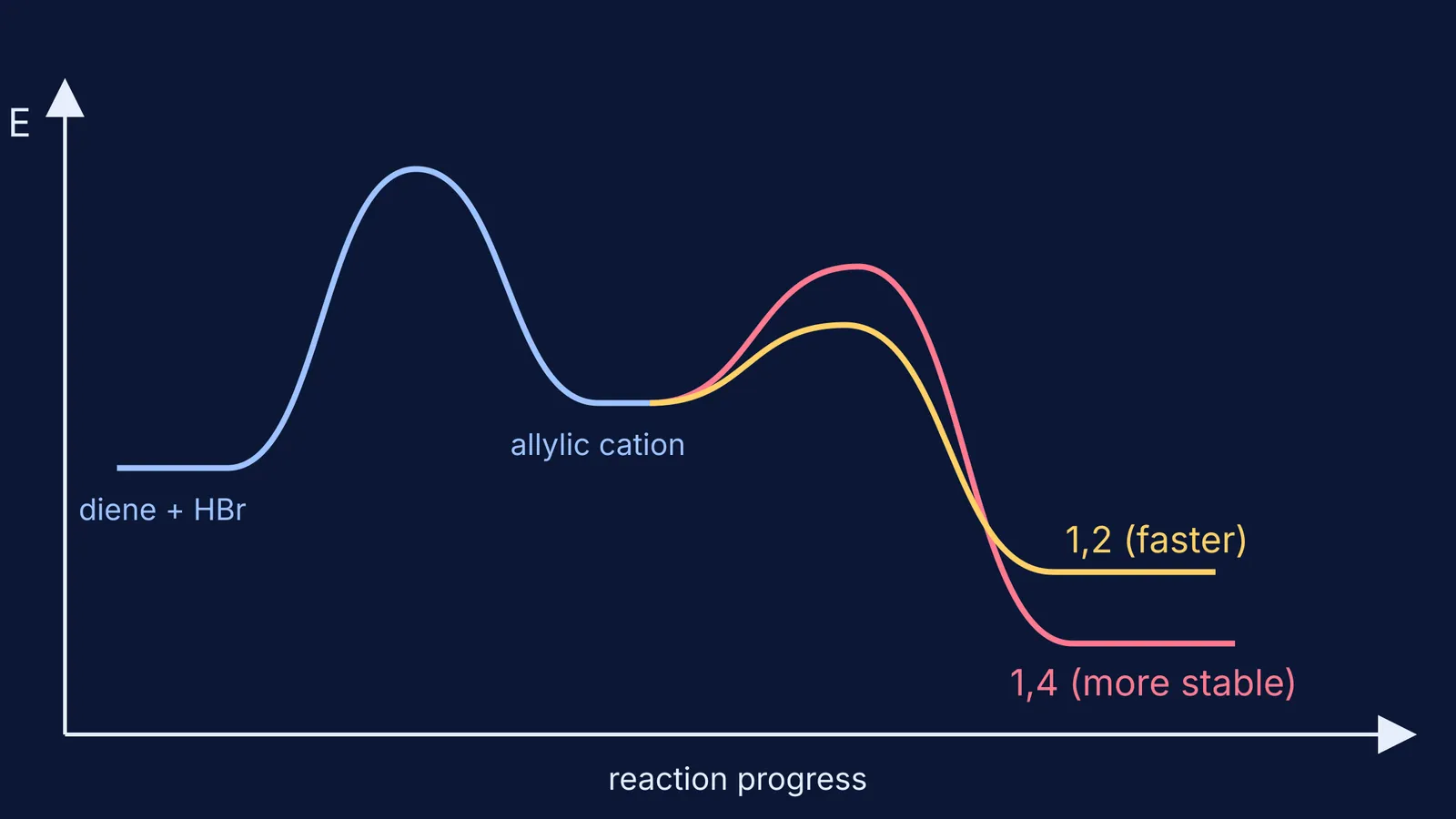
The 1,4 product is more stable because its double bond is internal and disubstituted, while the 1,2 product keeps a terminal, monosubstituted double bond, the same source explains. More substituted alkenes are more stable.
Picture it as two paths out of one valley. The 1,2 path has the lower hill; the 1,4 path has a taller hill but ends in a deeper valley. At 0 °C molecules rarely climb back, so they stay where they first landed. At 40 °C they can climb back and settle in the deeper valley.
How do you answer a 1,2 vs 1,4 question in an exam?
Use this four-step check for a conjugated diene with HX.
Protonate the end carbon that gives an allylic carbocation.
Draw both resonance forms and mark the two carbons that carry the positive charge.
Write both products: X on the near positive carbon (1,2), or X on the far one with the double bond shifted to the middle (1,4).
Read the conditions. Low temperature means the faster 1,2 product. Higher temperature or longer time with HX present means the more stable product, the one with the more substituted double bond.
Worked example. 1,3-Butadiene reacts with one equivalent of HBr at 40 °C. Name the major product.
Step 1: H+ adds to C-1, giving a cation at C-2.
Step 2: resonance spreads the positive charge to C-4.
Step 3: the candidates are 3-bromo-1-butene (1,2) and 1-bromo-2-butene (1,4).
Step 4: 40 °C means thermodynamic control, so 1-bromo-2-butene is major, 85% of the mixture per OpenStax section 14.3.
The common trap is to think "Markovnikov, so 1,2" and stop. Markovnikov's rule tells you where the H goes. It does not choose between the two ends of the allylic cation; the temperature does.
If carbocation stability itself is the gap, the Fermi Concept Library gives each chemistry concept its own lesson and its place in the map, so you can step back before tackling dienes. To practise the four steps on fresh questions, the Fermi Problem Library has worked problems with a step-by-step solver that explains the reasoning rather than printing an answer.


