

On this page
Location-of-roots questions turn up all through JEE quadratics: "find m so that 2 lies between the roots" or "find m so that the roots have opposite signs". A common approach is to write several conditions (discriminant, sum, product) and solve them all, which leaves room for algebra slips. For this question one condition is enough.
What is the condition for k to lie between the roots of a quadratic?
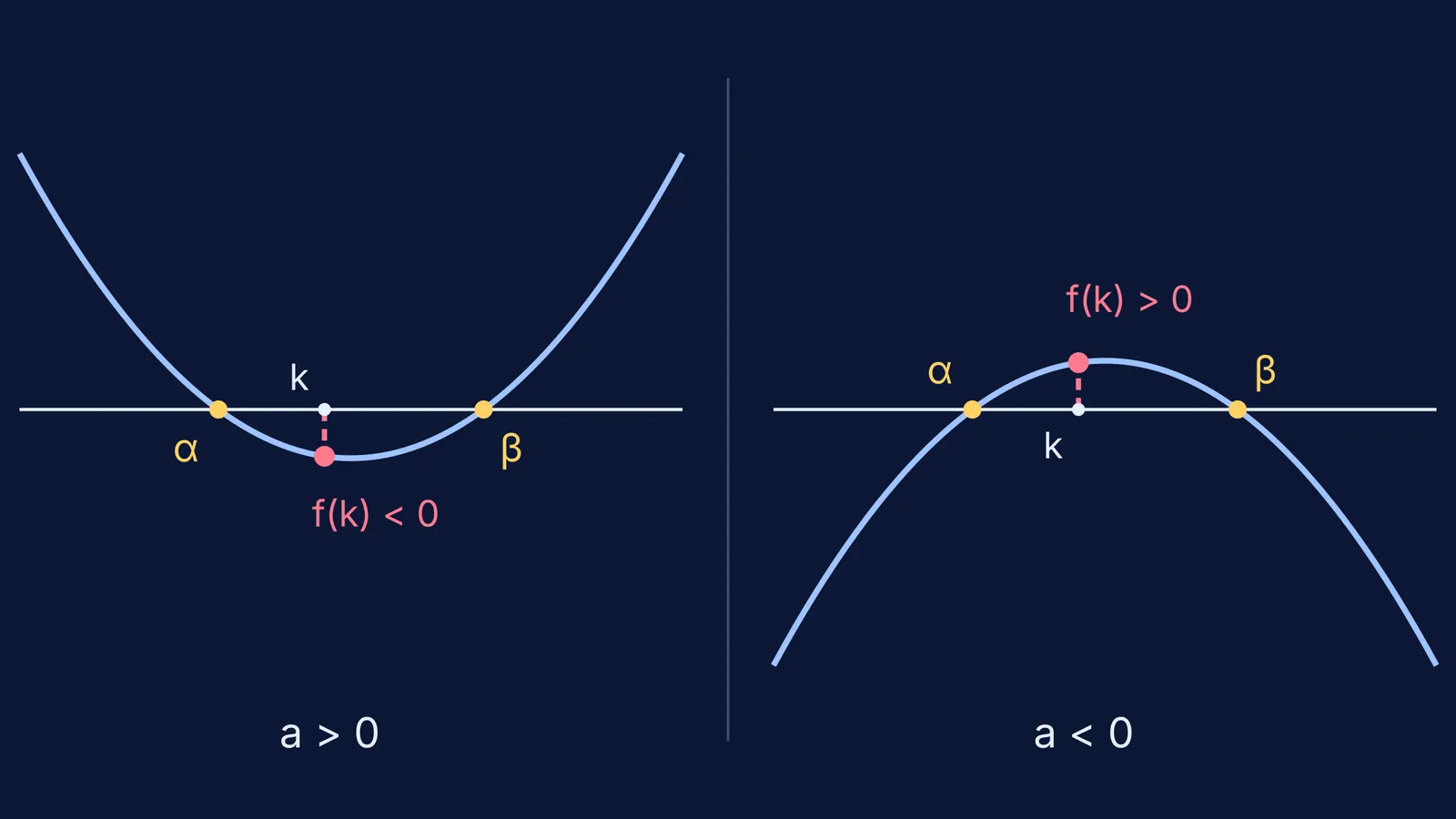
For f(x) = ax² + bx + c, a real number k lies strictly between the roots exactly when a·f(k) < 0. This chapter on location of roots states the same condition and notes that no discriminant condition is needed.
In words: f(k) must have the opposite sign to a. If the parabola opens upwards (a > 0), k sits between the roots when the curve is below the x-axis at k. If it opens downwards (a < 0), k sits between them when the curve is above the axis at k. The diagram above shows both cases.
Why does a·f(k) < 0 alone decide it?
Any quadratic with roots α and β can be written in factored form, f(x) = a(x − α)(x − β), as the Wikipedia article on quadratic functions sets out. Multiply by a:
a·f(k) = a²(k − α)(k − β)
Since a² is always positive, a·f(k) has the same sign as (k − α)(k − β). That product is negative only when k is bigger than one root and smaller than the other. Check the three cases:
Two distinct real roots: (k − α)(k − β) < 0 exactly when k is strictly between them.
Equal roots (α = β): the product is (k − α)², which is never negative. The test fails, as it should, because nothing lies between a root and itself.
Complex roots: α and β are conjugates, so (k − α)(k − β) = |k − α|², a positive real number. The test fails again.
So whenever a·f(k) < 0 holds, the roots are automatically real and distinct. You don't need to add D > 0, because the sign test already includes it.
Worked example 1: when does 2 lie between the roots?
Find all m for which 2 lies between the roots of x² − (m − 3)x + m = 0.
Here a = 1, so the condition is simply f(2) < 0.
f(2) = 4 − 2(m − 3) + m = 10 − m.
10 − m < 0 gives m > 10.
Check one value: m = 11 gives x² − 8x + 11 = 0, with roots 4 ± √5, roughly 1.76 and 6.24. The number 2 is between them. At the boundary, m = 10 gives (x − 2)(x − 5) = 0, so 2 is a root, not between the roots. That is why the inequality is strict.
How do you show one root is positive and one is negative?
Put k = 0. Since f(0) = c, the condition becomes a·c < 0. This agrees with Vieta's formulas, which give the product of the roots as c/a: a negative product means opposite signs.
Worked example 2. Find m so that (m − 2)x² + 3x + (m + 4) = 0 has one positive and one negative root.
a·f(0) = (m − 2)(m + 4) < 0.
The product of two factors is negative between their zeros: −4 < m < 2.
Check m = 0: −2x² + 3x + 4 = 0 has discriminant 9 + 32 = 41 > 0 and product of roots 4/(−2) = −2, so the signs are opposite. The strict inequality already leaves out m = 2, where the equation would stop being quadratic.
The trap here is the sign of a. For every m in the answer, a = m − 2 is negative, so f(0) must be positive. A student who writes "f(0) < 0" out of habit gets m < −4, which is wrong. Multiplying by a avoids splitting into cases.
Which mistakes cost marks on these questions?
Writing f(k) < 0 when a could be negative. Always multiply by a, especially when a contains the parameter.
Adding D > 0 and then making a slip solving it. The condition is redundant here.
Using ≤ instead of <. At equality, k is a root.
Forgetting to exclude values of the parameter that make a = 0.
The same idea extends: both k₁ and k₂ lie between the roots when a·f(k₁) < 0 and a·f(k₂) < 0 both hold. If the factored form still feels slippery, our earlier post on reading the signs of a, b and c from a parabola builds the picture. Two more posts cover the discriminant side: proving the roots are real for all k and watching a parabola cut, touch or miss the axis.
For more practice, the Fermi Problem Library has worked problems with a step-by-step solver that explains the reasoning rather than printing an answer. If the factored form itself is the gap, the Fermi Concept Library has a lesson for each concept in mathematics.


