

On this page
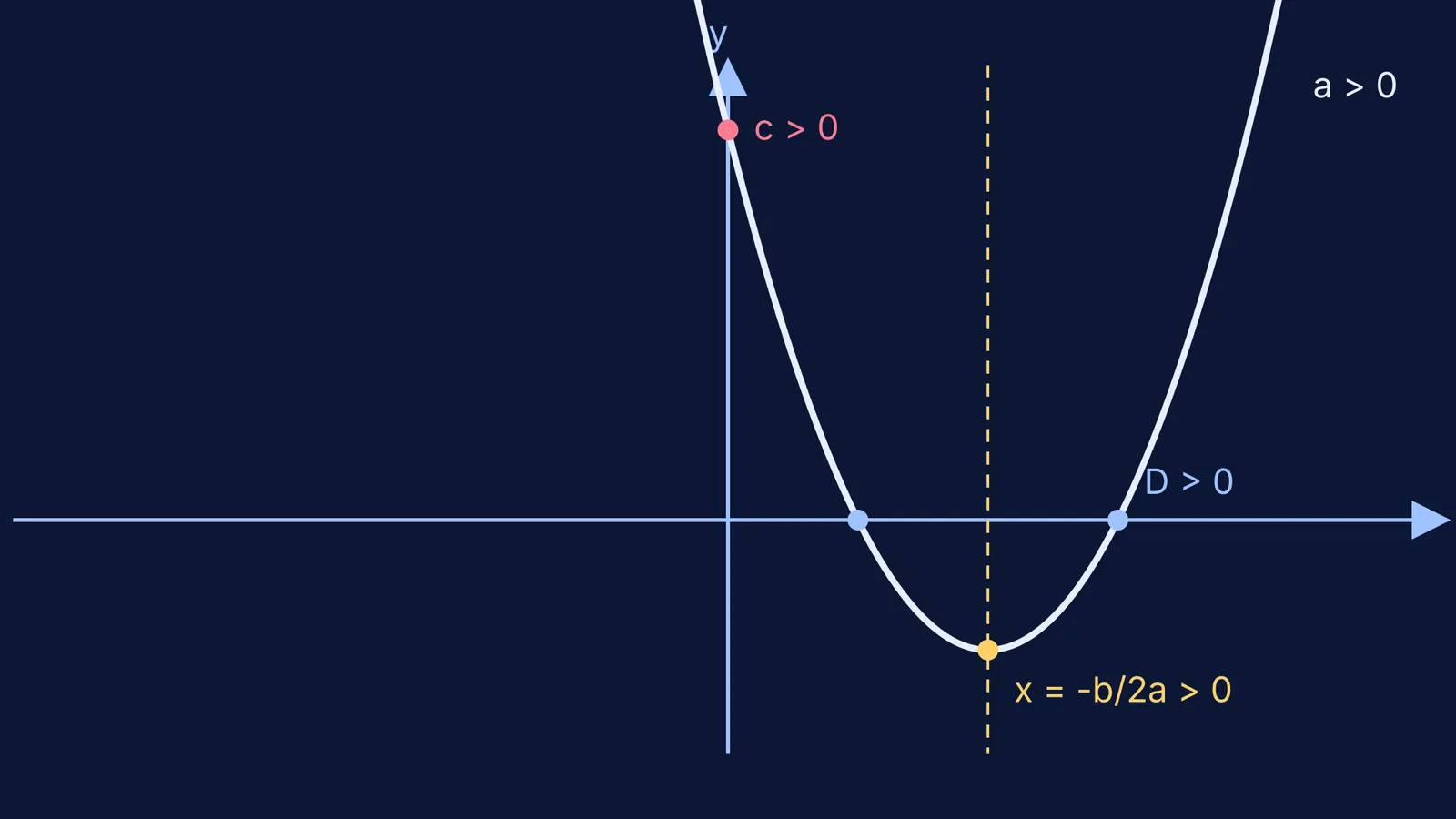
When you look at the graph of a quadratic equation y = ax² + bx + c, you are looking at a parabola. You do not need to solve the full equation to know whether its coefficients are positive or negative. Every feature of the curve — which way it opens, where it crosses the axes, and where it turns — corresponds directly to the signs of a, b, c and the discriminant D.
This visual check is one of the fastest ways to eliminate wrong options in JEE Main or school exams. By translating the geometry back into algebra without writing down any numbers, you save valuable time.
How to find the sign of a from the graph of a parabola?
The coefficient a determines the direction in which the parabola opens. According to the standard geometric properties of a parabola, the curve opens upward if a is positive and downward if a is negative.
If a > 0: The parabola looks like a "U" and has a minimum point at its vertex.
If a < 0: The parabola looks like an upside-down "U" and has a maximum point.
If you struggle to recall this, remember that y = x² (where a is 1) is positive for any non-zero value of x, so the arms of the curve must point upwards towards positive infinity.
How to find the sign of c from the y-intercept?
The coefficient c is the easiest to read from the graph. It represents the y-intercept, which is the point where the parabola crosses the vertical y-axis. This occurs exactly at x = 0. If you substitute x = 0 into y = ax² + bx + c, the first two terms vanish, leaving y = c.
If c > 0: The graph crosses the y-axis above the origin.
If c < 0: The graph crosses the y-axis below the origin.
If c = 0: The graph passes exactly through the origin (0, 0).
How to find the sign of b from the vertex?
The sign of b is linked to both a and the horizontal position of the vertex. The vertex is the point where the parabola intersects its axis of symmetry, with its x-coordinate located at x = -b/2a. This formula means the sign of b depends on the side of the y-axis where the vertex lies, combined with the sign of a.
Vertex is to the left of the y-axis (x < 0): For -b/2a to be negative, b/2a must be positive. This means a and b must have the same sign.
Vertex is to the right of the y-axis (x > 0): For -b/2a to be positive, b/2a must be negative. This means a and b must have opposite signs.
Vertex is exactly on the y-axis (x = 0): The value of b is zero.
An alternative way to find the sign of b is to look at the slope of the parabola exactly where it crosses the y-axis. The derivative of y = ax² + bx + c is dy/dx = 2ax + b. If we evaluate this slope at the y-intercept (where x = 0), the slope is simply b. Therefore, if the curve is heading upwards as it crosses the y-axis, b is positive. If the curve is heading downwards, b is negative.
If visualising these shifts is difficult, the Fermi Concept Library can help you build the intuition behind the vertex formula instead of just memorising cases.
What does the discriminant D tell you?
The discriminant is the expression D = b² - 4ac. While it is hidden inside the quadratic formula, its sign is clearly visible from the number of times the parabola intersects the horizontal x-axis.
If D > 0: The parabola crosses the x-axis at two distinct points, meaning the equation has two real roots.
If D = 0: The vertex of the parabola touches the x-axis at exactly one point.
If D < 0: The parabola never touches the x-axis, meaning the roots are complex numbers.
A worked example: reading the signs
Imagine a parabola that opens downward, crosses the y-axis below the origin, and has its vertex in the third quadrant (bottom left). Let us find the signs of a, b, c and D without writing a single equation.
It opens downward, so a < 0.
It crosses the y-axis below the origin, so c < 0.
The vertex is in the third quadrant, which is to the left of the y-axis. This means a and b must have the same sign. Since we already know a < 0, it follows that b < 0.
The vertex is below the x-axis and the parabola opens downward, so the curve will never rise up to cross the x-axis. Therefore, D < 0.
Summary checklist: Reading the signs
Opening direction: Opens upward means a > 0; opens downward means a < 0.
y-intercept: Crosses above the origin means c > 0; crosses below means c < 0.
Vertex position: Left of the y-axis means a and b have the same sign; right of the y-axis means they have opposite signs.
x-intercepts: Two distinct intercepts mean D > 0; no intercepts mean D < 0.
By breaking down the graph into these four visual checks, you can reliably deduce the signs of a quadratic's coefficients. If you keep making sign errors, a step-by-step solver like the Fermi Problem Library explains the reasoning behind each algebra step.
Read more:


