

On this page
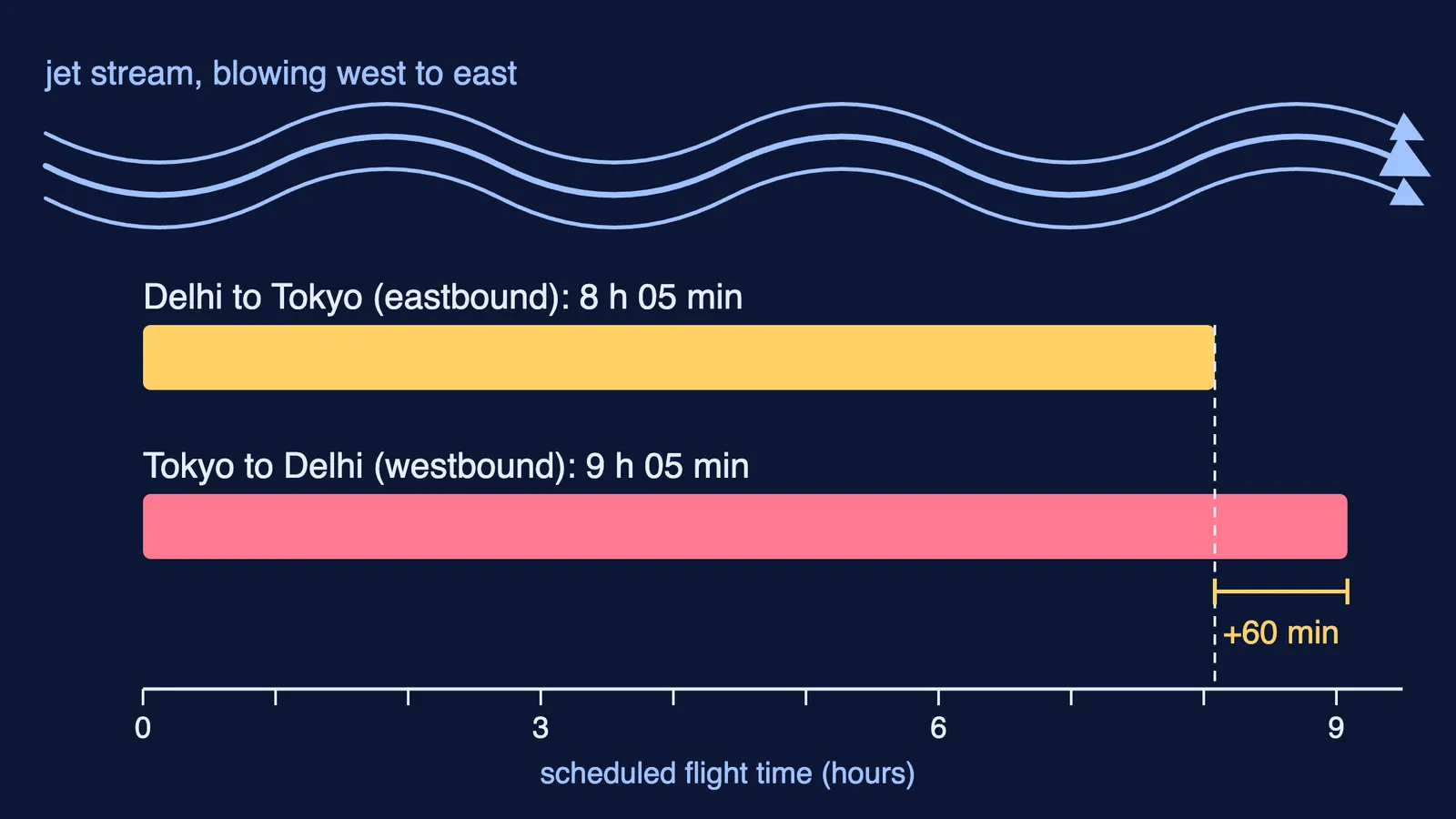
Air India's timetable for its daily Delhi–Tokyo Haneda flights doesn't match in the two directions. AI358 leaves Delhi at 20:20 and lands at Haneda at 07:55 next morning; AI357 leaves Haneda at 11:50 and lands in Delhi at 17:25, according to a report on the daily schedule announced from 15 June 2025. Those are local times. Convert them and the scheduled flight to Tokyo turns out an hour shorter than the flight home. The reason is a river of wind high above Asia.
Why are flights faster going east?
Jet streams are relatively narrow bands of strong wind in the upper atmosphere, typically around 30,000 feet up, according to NOAA's guide to the jet stream. They blow from west to east and can reach more than 275 mph (442 km/h), NOAA says. They follow the boundaries between hot and cold air, and Earth's rotation is part of why they exist.
That is close to where airliners cruise, as we explain in why planes fly at 35,000 feet. A plane flies through the air, so its speed over the ground is its airspeed plus the wind, added as vectors. Heading east, the jet stream pushes from behind; heading west, it pushes against you. The Met Office puts it simply: flying with the jet stream is quicker and saves fuel, and flying against it costs fuel and makes you late.
How much faster is the flight east from Delhi to Tokyo?
This is a Class 11 relative-velocity problem with real data from the published schedule.
Put both clocks on one zone. India uses UTC+5:30 (Indian Standard Time) and Japan uses UTC+9 (Japan Standard Time), and neither has daylight saving. Japan is 3 h 30 min ahead.
Eastbound: 20:20 in Delhi is 23:50 in Tokyo. Landing at 07:55 means 8 h 05 min, or 485 minutes.
Westbound: 11:50 in Tokyo is 08:20 in Delhi. Landing at 17:25 means 9 h 05 min, or 545 minutes.
Let the distance be D, the airspeed v and the average wind along the route w. Then D = (v + w) × 485 = (v − w) × 545.
Divide: (v + w)/(v − w) = 545/485, which gives w/v = 60/1030, about 0.058.
So the timetable implies an average wind of about 6% of the plane's airspeed. At an illustrative airspeed of 850 km/h (a round number, not a quoted figure), that is about 50 km/h, well below the jet stream's peak. One likely reason is that the plane is not in the fastest core for the whole trip.
The wind never fully pays you back, either: over a round trip in steady wind, the total time is always longer than in still air, as we show in why a round trip in wind takes longer.
If you get stuck on “which velocity is relative to what”, the Fermi Problem Library has worked problems with a step-by-step solver that explains the reasoning rather than printing an answer.
What does the jet stream have to do with the Indian monsoon?
The westerly jet moves with the seasons, and its movement is linked to the monsoon. Using weather data from 1958 to 2001, Schiemann, Lüthi and Schär reported in the Journal of Climate that the jet sits south of the Tibetan Plateau in winter and north of it in summer. The median dates of the two switches were 28 April and 12 October, and the spring date varies a lot from year to year, while the autumn switch usually falls within a three-week window. They also found a statistical link between the strength of the summer jet and all-India rainfall.
In summer, with the westerly jet north of the plateau, a different jet blows above India. A 2013 study in Geophysical Research Letters describes the Tropical Easterly Jet as generally found between 100 and 150 hPa (pressure levels high in the atmosphere) over India from June to September, with a strength directly related to monsoon rainfall. As its name says, it blows from east to west, the opposite way to the westerly jet. For another driver of good and bad monsoon years, read how El Niño affects the Indian monsoon.
How do you solve any wind and travel-time question?
Fix the frame: airspeed is relative to the air, wind is relative to the ground.
Write ground velocity = air velocity + wind velocity, with signs for direction.
Convert every time to one zone before subtracting.
For the same distance both ways, the ratio of times is the inverse ratio of ground speeds.
Sanity check: the wind you find should be smaller than the airspeed.
If vector addition is easier to see than to read, the Fermi Simulation Lab has interactive simulations for it. If you don't know where your gaps are, Fermi's AI tutor can work out what you already know and build a plan for the session.
Next time you fly east, watch the ground speed on the seat-back map: that is vector addition at work.


