

On this page
A Class 9 test asks: is air a mixture or a compound? The answer is a mixture, but the marks come from the reasons. Here are the four reasons, with real numbers, a model answer, and a quick test that works on any substance.
What is air made of?
Dry air is 78.08% nitrogen and 20.95% oxygen by volume, according to NASA's Earth fact sheet. The same sheet lists argon at 9,340 parts per million (about 0.93%) and carbon dioxide at about 420 ppm. Water vapour comes on top, roughly 1% of the atmosphere, and NASA notes that it varies a lot.
These gases are not joined to one another. Air is a crowd of separate N₂, O₂ and Ar particles, with some CO₂ and H₂O, sharing the same space. That is why air has no chemical formula: there is no fixed recipe to write one for.
Why is air a mixture and not a compound?
Each reason below compares air with a real compound, water.
First, its composition changes, and a compound's cannot. A LibreTexts chemistry text states the law of definite proportions: a compound always contains the same elements in the same proportions by mass, so every sample of pure water is 11.19% hydrogen and 88.81% oxygen by mass.
Air fails this test. Its water vapour rises and falls with the weather, and its carbon dioxide drifts from year to year: NOAA's Mauna Loa record shows a monthly mean of 424.37 ppm in September 2025 and 426.07 ppm in September 2026. A compound cannot change its proportions and stay the same compound.
The main gases stay close to their usual shares because air is constantly stirred, which is why it looks uniform. For an early test of this, read how Gay-Lussac tested air composition from a balloon in 1804.
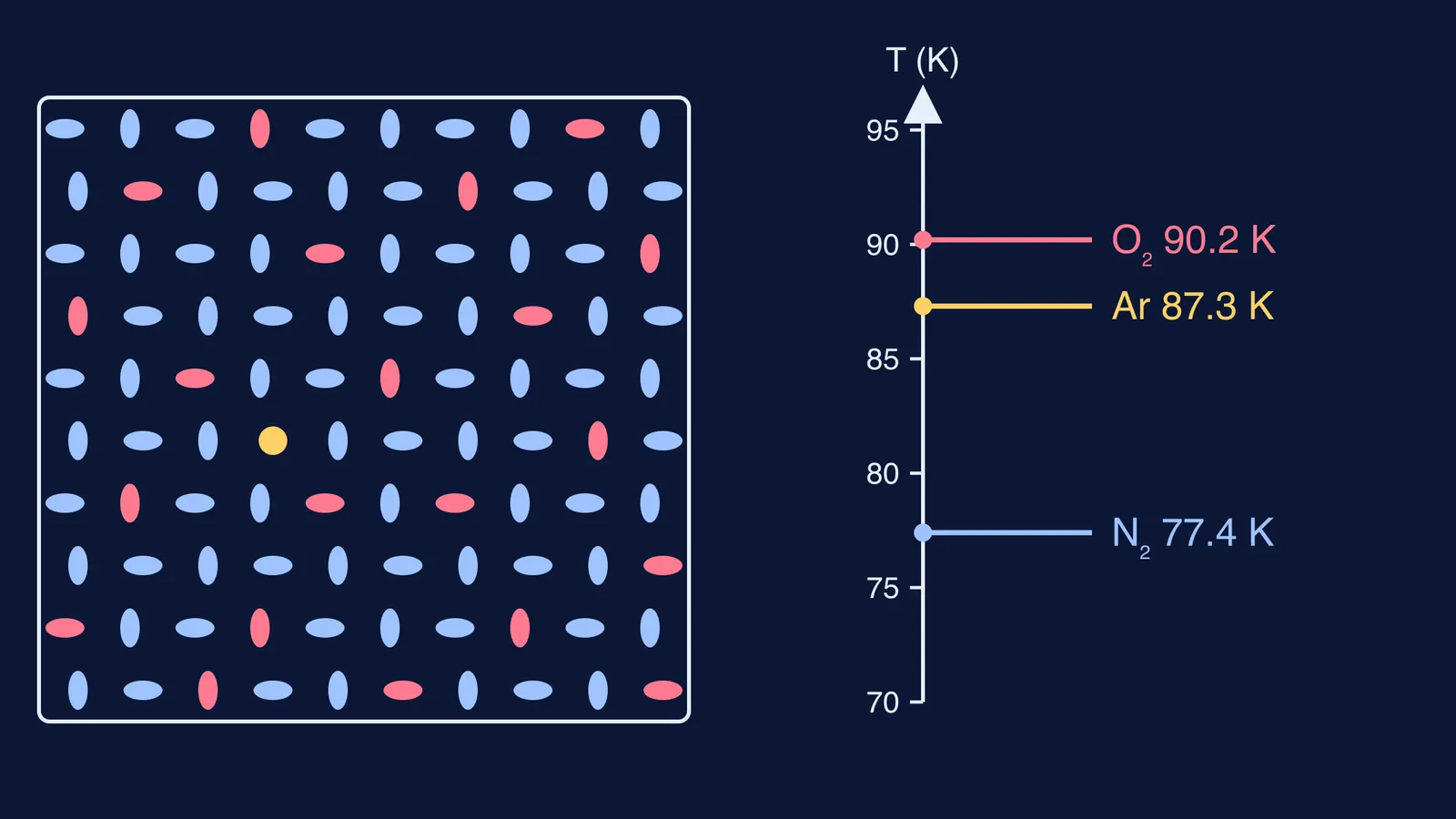
Second, its gases can be separated by physical means, with no chemical reaction. Cool and compress air until it turns liquid, then distil it. Each gas has its own boiling point (normal boiling points from the NIST Chemistry WebBook):
Nitrogen: 77.4 K, about −196 °C (NIST nitrogen data)
Argon: 87.3 K, about −186 °C (NIST argon data)
Oxygen: 90.2 K, about −183 °C (NIST oxygen data)
Nitrogen boils lowest, so it comes off first and the liquid left behind grows richer in oxygen; in an industrial column, argon is drawn off between the two. This is fractional distillation, a physical method. Boiling water, by contrast, only gives steam; splitting it into hydrogen and oxygen needs a chemical change such as electrolysis.
Third, each gas keeps its own properties. In air, oxygen still supports burning and still boils at its own temperature, which is why distillation works. Nothing new has formed. Compare water: hydrogen burns and oxygen helps things burn, yet water puts fires out. A compound has new properties of its own.
Fourth, mixing involves no reaction. At room temperature you can mix nitrogen and oxygen in any ratio and nothing happens: no flame, no new substance. Making a compound is a chemical reaction, as when hydrogen burns in oxygen to form water.
How do you write this answer in an exam?
For a three-mark question, write four short lines:
"Air is a mixture."
"Its composition is not fixed; the amounts of water vapour and carbon dioxide vary."
"Its components can be separated by a physical method, fractional distillation of liquid air, because they have different boiling points."
"Each component keeps its own properties; for example, oxygen in air still supports burning."
For five marks, add the no-reaction reason and one contrast with water.
How can you tell any mixture from a compound?
Ask four questions. A yes to any of them points to a mixture.
Can the proportions change while it keeps the same name?
Can a physical method (filtering, evaporation, distillation, a magnet) separate the parts?
Does each part behave as it did on its own?
Was it made without a chemical reaction?
Air: yes to all four, so a mixture. Water: no to all four, so a compound. Carbon dioxide: also no to all four, so a compound, even though it is one of the gases in air. That is the usual trap. Air contains elements (N₂, O₂, Ar) and compounds (CO₂, H₂O), and the whole is still a mixture. For the related mix-up, see why not every molecule is a compound.
Another slip: "air looks the same everywhere, so it must be a compound." Uniform is not the same as fixed. Salt water looks uniform too, and it is a mixture. To practise picking separation methods, try asking AI which method separates each mixture, then checking it.
If elements, compounds and mixtures still blur together, the Fermi Concept Library gives each chemistry concept its own lesson and shows its place in the map. For practice, the Fermi Problem Library has worked problems with a step-by-step solver that explains the reasoning rather than printing an answer.
Next time the question comes up, write the answer first, then the reasons.


