

On this page
Every molecule is a group of bonded atoms, but only some molecules are compounds, and some compounds are not made of molecules at all. Mixing up the two words costs marks in Class 9 chemistry and in later true-or-false questions. The fix is to see that they answer two different questions.
What is the difference between a molecule and a compound?
A molecule is a group of two or more atoms held together by chemical bonds, as the Wikipedia article on molecules defines it. The word says nothing about which elements those atoms belong to.
A compound is a substance made of atoms from more than one element held together by chemical bonds, according to the Wikipedia article on chemical compounds. The same article spells out what follows: a molecule made of atoms of only one element is not a compound.
So "molecule" is about structure (are the atoms joined into separate units?), and "compound" is about composition (how many elements?). Keep those two apart and the rest falls into place.
Which molecules are elements and which are compounds?
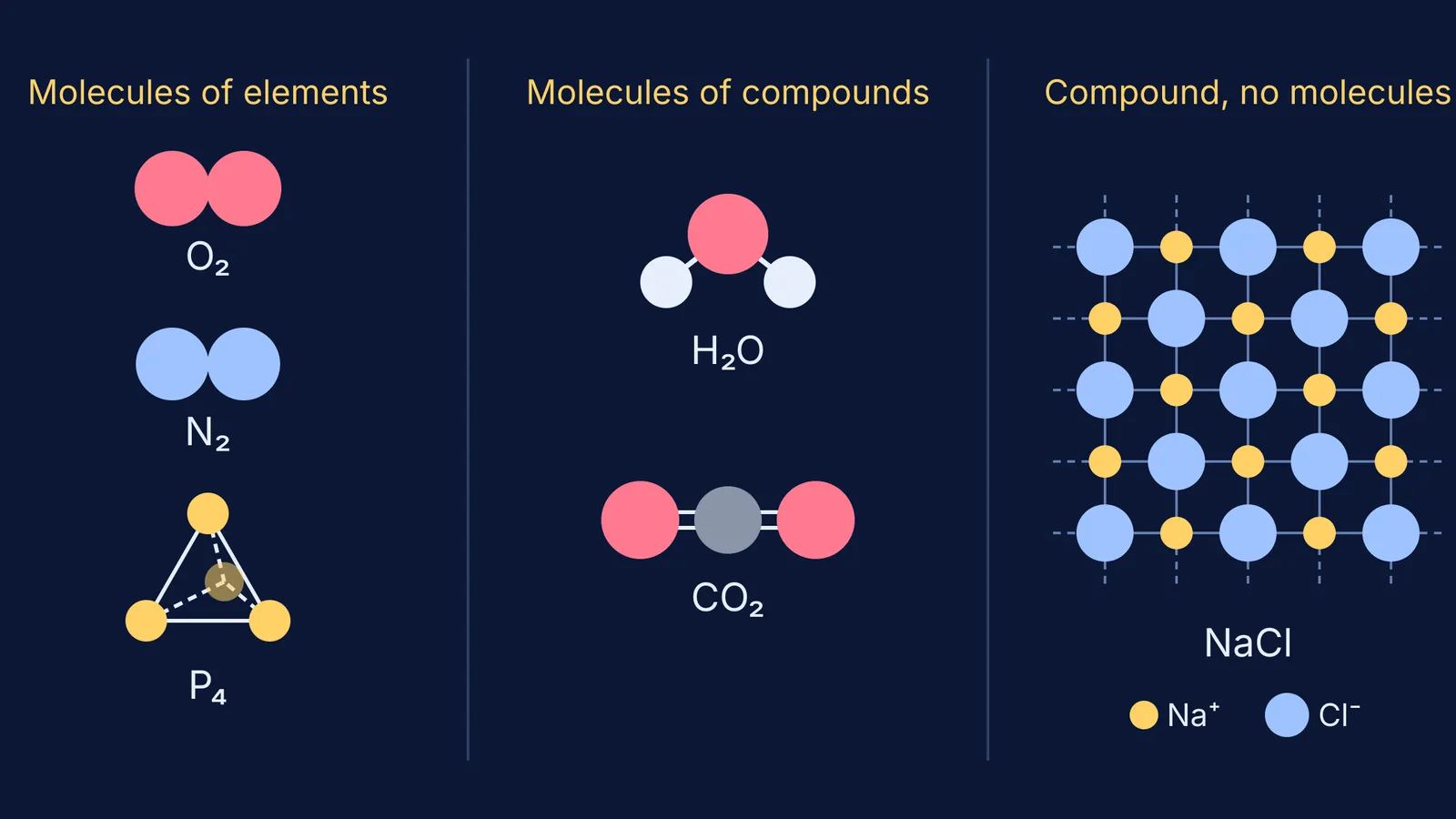
Molecules of elements contain only one kind of atom:
O₂: two oxygen atoms, the oxygen you breathe.
N₂: two nitrogen atoms.
P₄: white phosphorus is made of molecules of four phosphorus atoms arranged in a tetrahedron, with six P–P bonds in each one (white phosphorus).
Molecules of compounds contain two or more kinds of atom:
H₂O: two hydrogen atoms and one oxygen atom, the example the molecule article uses for a molecule of a compound.
CO₂: one carbon atom and two oxygen atoms.
The number of atoms in a molecule is called its atomicity. Our post on atomicity of elements with examples works through monatomic, diatomic and polyatomic elements if you want more practice.
Why do ionic compounds have no molecules?
Sodium chloride is a compound, because it contains two elements. But it is not made of molecules. Ionic compounds do not exist as discrete molecular units; an ionic compound is a large three-dimensional array of alternating cations and anions, as LibreTexts' chapter on ionic compounds/02%3A_Elements_and_Ions/2.06%3A_Ionic_Compounds) explains.
Ions in an ionic compound usually have several nearest neighbours, so they are part of a continuous three-dimensional network rather than part of molecules (chemical compound). There is no single pair you could pull out and call "one NaCl molecule".
That is why the formula NaCl only tells you a ratio: equal numbers of sodium ions and chloride ions in the crystal (LibreTexts/02%3A_Elements_and_Ions/2.06%3A_Ionic_Compounds)). For substances like this, chemists use the term formula unit, defined as the smallest unit of a non-molecular substance such as an ionic compound, a covalent network solid or a metal (formula unit).
If the line between ionic and covalent still feels blurry, read how ionic and covalent compounds differ.
How do you classify any substance in under a minute?
Run this three-step sort on any formula:
Count the elements in the formula. One element means it is an element; two or more means it is a compound.
Ask whether it forms separate bonded units. If yes, it is made of molecules.
If the formula pairs a metal with a non-metal (NaCl, MgCl₂), expect ions in a lattice: a compound described by formula units, not molecules.
Here is the sort applied to seven substances:
N₂: one element, separate units. A molecule of an element.
P₄: one element, separate tetrahedral units. A molecule of an element.
H₂O: two elements, separate units. A molecule of a compound.
CO₂: two elements, separate units. A molecule of a compound.
NaCl: two elements, ionic lattice. A compound with no molecules.
Diamond (C): one element, a covalent network solid with no discrete molecules (formula unit). An element with no molecules.
Argon (Ar): one element that exists as individual atoms, like the other noble gases (molecule). An element with no molecules in the strict sense.
So being an element does not guarantee molecules either. One caution: in the kinetic theory of gases, "molecule" is often used for any gas particle, argon included, so follow the convention of the chapter you are answering from.
Which exam statements are traps?
"Every molecule is a compound." False: O₂ and P₄ are molecules of elements.
"Every compound is made of molecules." False: NaCl is a compound with no molecules.
"All elements exist as molecules." False: argon exists as single atoms and diamond is a network.
If you cannot tell whether your gap is in the definitions or in using them, the Fermi Concept Library gives every chemistry concept its own lesson and shows its place in the map, so you can see how atoms, molecules, ions and compounds connect. When you want practice, the Fermi Problem Library has worked problems with a step-by-step solver that explains the reasoning rather than printing an answer.
For the building blocks themselves, our post on the difference between an atom, a molecule and an ion is a good next read. The next time a question says "molecule", ask the two questions before you answer.


