

On this page
Ask Class 9 students how much one mole of oxygen weighs and you may hear two different answers. Both can be right. The difference is atomicity, and once you see it, a whole family of mole-concept mistakes goes away.
What is atomicity of an element?
Atomicity is the total number of atoms present in one molecule of an element (Wikipedia: Atomicity)). An element with atomicity 1 is monoatomic, 2 is diatomic and 3 is triatomic; elements with more atoms per molecule are called polyatomic, and you may also see P4 described as tetratomic.
Atomicity belongs to the molecule, not to the element's name. Hydrogen, nitrogen, oxygen and the halogens occur naturally as the two-atom molecules H2, N2, O2, F2, Cl2, Br2 and I2, while phosphorus and sulphur occur as P4 and S8 (Chemistry LibreTexts, adapted from Brown et al./02:_Atoms_Molecules_and_Ions/2.06:_Molecules_and_Molecular_Compounds)).
Which elements are monoatomic, diatomic, triatomic and polyatomic?
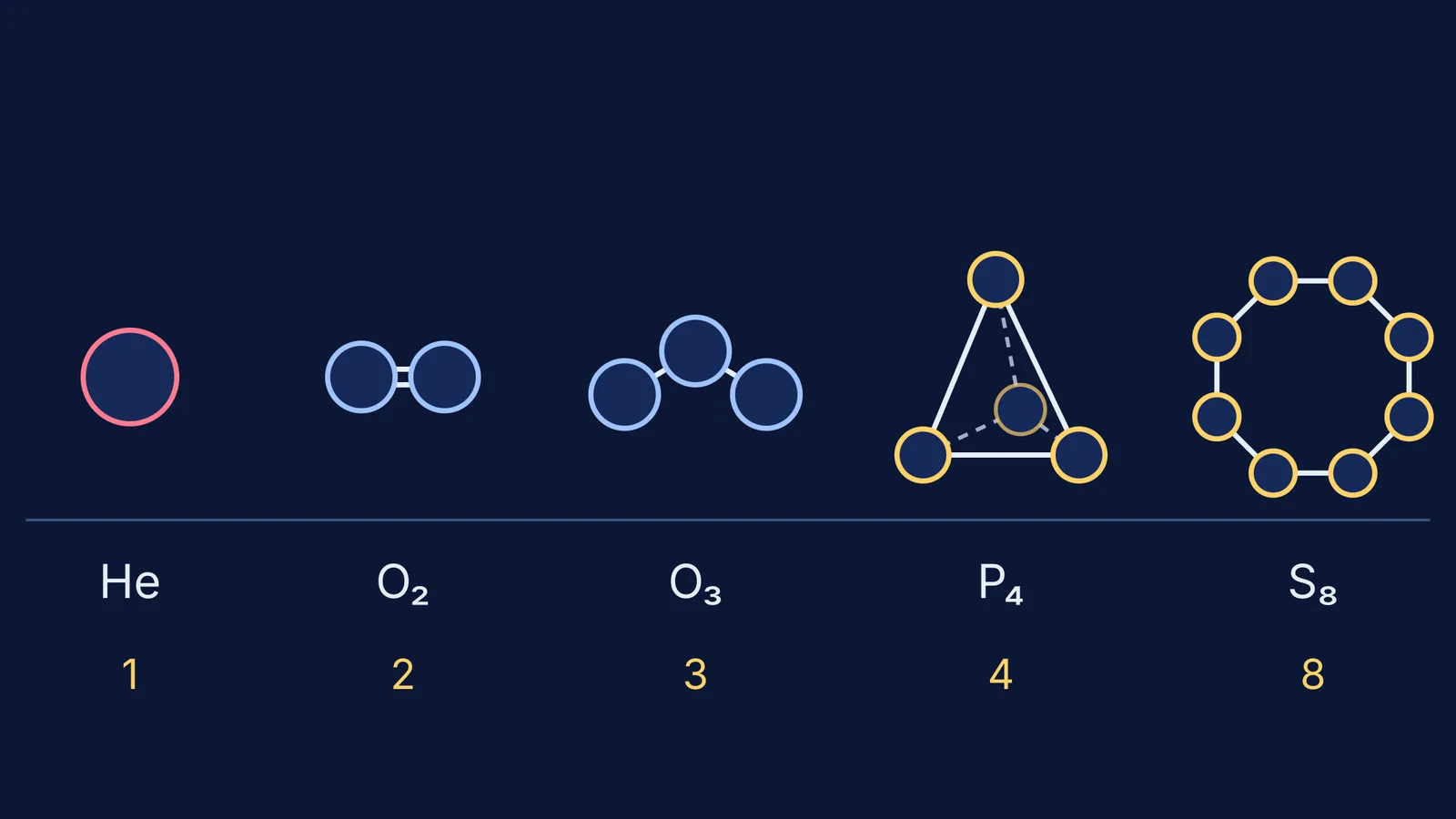
Monoatomic (1): helium, He. The noble gases are monoatomic gases at room temperature (Chemistry LibreTexts: group trends for nonmetals/07:_Periodic_Properties_of_the_Elements/7.08:_Group_Trends_for_Selected_Nonmetals)). We explain the reason in why noble gases exist as single atoms instead of molecules.
Diatomic (2): oxygen gas, O2. The two atoms are joined by a double bond, O=O (Royal Society of Chemistry: oxygen).
Triatomic (3): ozone, O3. Oxygen exists in two molecular forms, O2 and O3, which are allotropes of each other (LibreTexts/07:_Periodic_Properties_of_the_Elements/7.08:_Group_Trends_for_Selected_Nonmetals)).
Polyatomic (4): white phosphorus, P4. It has a tetrahedral shape, with one phosphorus atom at each corner (Royal Society of Chemistry: phosphorus).
Polyatomic (8): sulphur, S8. The most common stable form of sulphur is the yellow solid S8, an eight-member ring of sulphur atoms (LibreTexts/07:_Periodic_Properties_of_the_Elements/7.08:_Group_Trends_for_Selected_Nonmetals)). Both rhombic and monoclinic sulphur are built from these rings; see rhombic and monoclinic sulphur: difference and transition temperature.
How does atomicity change molar mass?
The rule is one line: molar mass of the molecule = atomicity x atomic mass. The 2024 abridged table of standard atomic weights from the IUPAC commission (CIAAW) gives He 4.0026, O 15.999, P 30.974 and S 32.06 (CIAAW abridged standard atomic weights). So:
He: 1 x 4.0026 = 4.0026 g/mol
O2: 2 x 15.999 = 31.998 g/mol
O3: 3 x 15.999 = 47.997 g/mol
P4: 4 x 30.974 = 123.896 g/mol
S8: 8 x 32.06 = 256.48 g/mol
School papers usually give rounded values (He 4, O 16, P 31, S 32), which makes these 4, 32, 48, 124 and 256 g/mol. Always use the atomic masses printed in the question.
How do you use atomicity in mole calculations?
You need one more number: the Avogadro constant, exactly 6.02214076 x 10^23 per mole (NIST CODATA value). Schools round it to 6.022 x 10^23. The examples below use the rounded atomic masses from the CIAAW table.
Example 1: 64 g of oxygen gas. Oxygen gas is O2, molar mass 32 g/mol. Moles of O2 = 64 / 32 = 2 mol. Each molecule has 2 atoms, so moles of O atoms = 2 x 2 = 4 mol.
Example 2: 31 g of white phosphorus. P4 has molar mass 4 x 31 = 124 g/mol. Moles of P4 = 31 / 124 = 0.25 mol. Molecules = 0.25 x 6.022 x 10^23 = 1.51 x 10^23. Atoms = 4 x 0.25 = 1 mol, which is 6.022 x 10^23 atoms.
Example 3: 1 g of sulphur. S8 has molar mass 8 x 32 = 256 g/mol. Molecules = (1 / 256) x 6.022 x 10^23 = 2.35 x 10^21. Atoms = 8 x 2.35 x 10^21 = 1.88 x 10^22. Check: 1 g divided by 32 g/mol for single S atoms gives the same 1.88 x 10^22 atoms.
That is why 1 g of oxygen and 1 g of ozone hold the same number of atoms, which we work through in which has more atoms: 1 g of oxygen or 1 g of ozone?
Which mistakes cost marks in atomicity questions?
Use this checklist before you hand in any mole-concept answer:
Write the formula first: He, O2, O3, P4 or S8, before any number.
Read the noun: "oxygen gas" is O2, "oxygen atoms" is O, "ozone" is O3.
Write molar mass as atomicity x atomic mass, so the examiner sees the step.
Label every mole answer: "mol O2" or "mol O", never just "mol".
To get atoms, multiply the number of molecules by atomicity at the end.
Use the atomic masses and Avogadro value the paper gives.
If you keep landing on the wrong molar mass, try a few mole-concept problems in the Fermi Problem Library, where a step-by-step solver explains the reasoning rather than printing an answer, so you can see the exact line where atomicity should have gone in. If allotropes such as O2 and O3 still feel fuzzy, the Fermi Concept Library gives each chemistry concept its own lesson and shows its place in the map.
Next time a question says "oxygen", pause and write O or O2 before you calculate. That one symbol decides the answer.


