

On this page
When you first encounter stoichiometry in chemistry, exam questions often test your understanding of mass, moles, and particles. A classic trap question asks you to compare the number of atoms in 1 gram of oxygen gas (O₂) and 1 gram of ozone gas (O₃). At first glance, because ozone molecules contain more atoms, you might assume a gram of ozone has more atoms overall. However, the opposite logic applies: because each ozone molecule is heavier, a 1-gram sample contains fewer molecules.
Which has more atoms: 1 g of oxygen or 1 g of ozone?
Both 1 g of oxygen gas and 1 g of ozone gas contain exactly the same number of atoms.
Because oxygen and ozone are both composed entirely of oxygen atoms, comparing their atomic counts by mass is straightforward. Oxygen gas exists as diatomic molecules (O₂), while ozone is triatomic (O₃). The molar mass of a substance—defined as the mass in grams of one mole of that substance—is approximately 31.999 g/mol for O₂ and 47.997 g/mol for O₃.
If you are struggling to keep molecular mass and atomic mass straight while revising, Fermi's AI tutor can work out what you already know and build a plan for the session, teaching through the calculations step by step rather than just giving you the answer.
How do you calculate the number of atoms in a mass?
To prove that the number of atoms is identical, you can trace the calculation from grams to moles to atoms.
Find the number of moles of molecules by dividing the given mass by the molar mass.
Multiply by Avogadro's constant (6.022 × 10²³) to find the total number of molecules.
Multiply by the number of atoms per molecule to find the total number of atoms.
For 1 g of oxygen gas (O₂):
Moles of molecules ≈ 1 / 32
Number of molecules ≈ (1 / 32) × (6.022 × 10²³)
Number of atoms = 2 × (1 / 32) × (6.022 × 10²³) = (1 / 16) × (6.022 × 10²³) ≈ 3.76 × 10²² atoms.
For 1 g of ozone gas (O₃):
Moles of molecules ≈ 1 / 48
Number of molecules ≈ (1 / 48) × (6.022 × 10²³)
Number of atoms = 3 × (1 / 48) × (6.022 × 10²³) = (1 / 16) × (6.022 × 10²³) ≈ 3.76 × 10²² atoms.
Why do equal masses of oxygen and ozone have the same number of atoms?
The math reveals a simple physical reality. An oxygen molecule (O₂) has a mass of roughly 32 atomic mass units (u), and an ozone molecule (O₃) has a mass of roughly 48 u.
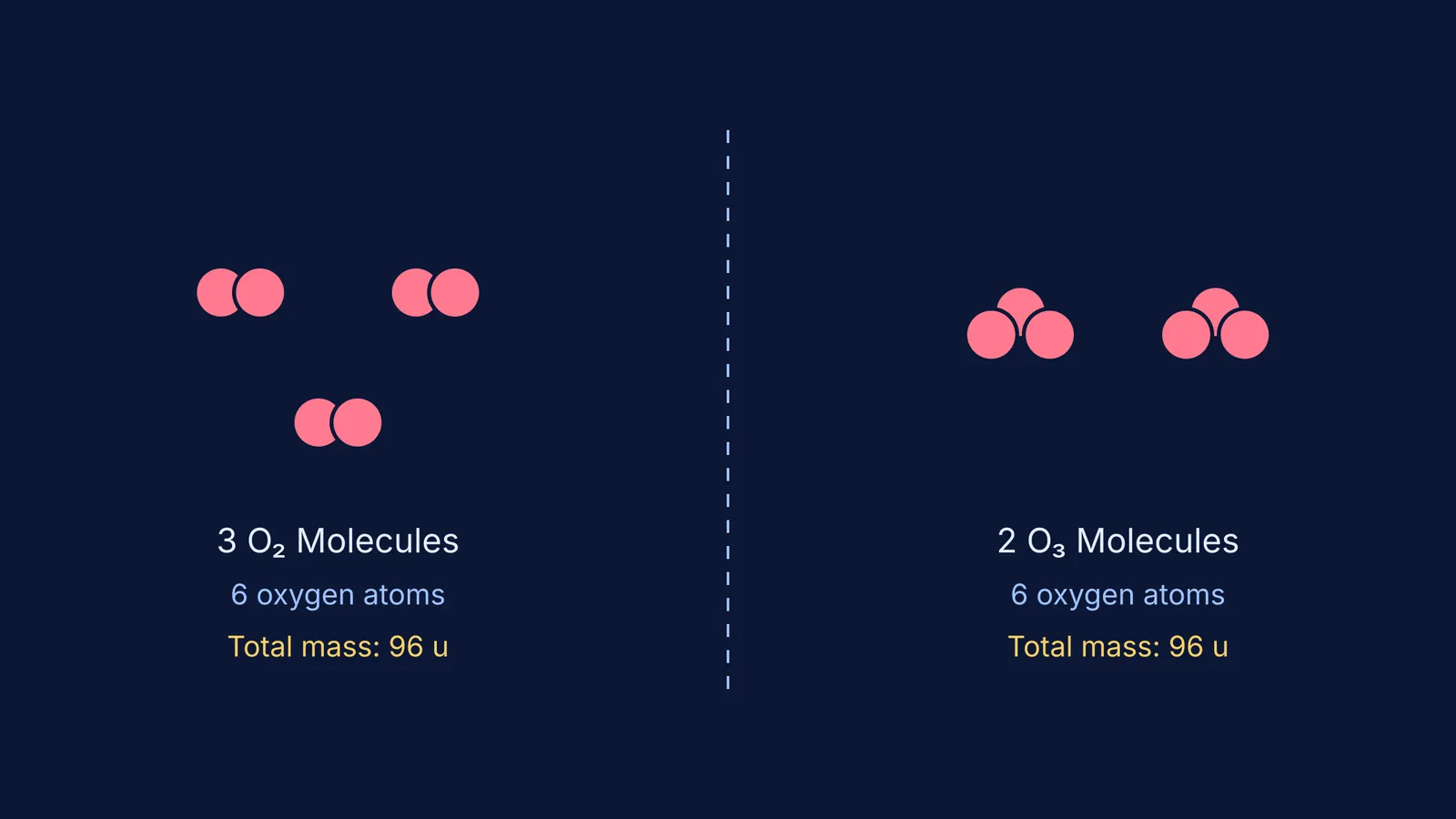
Imagine a sample weighing 96 u. This mass would perfectly hold either 3 molecules of O₂ (3 × 32 = 96) or 2 molecules of O₃ (2 × 48 = 96). Three O₂ molecules contain 6 atoms (3 × 2), and two O₃ molecules also contain 6 atoms (2 × 3). No matter how you scale the mass up to 1 gram or 100 grams, the ratio remains perfectly balanced. The historical quest to count these discrete particles, highlighted by the work of Jean Perrin and Avogadro's number, proved that atomic properties scale up to macroscopic masses predictably.
When solving multiple-choice questions for exams like JEE Main or NEET-UG, recognising this pattern saves valuable minutes. The Fermi Problem Library has worked problems with a step-by-step solver that explains this reasoning, helping you learn to spot the shortcut instead of doing the long multiplication every time.
Does this rule apply to other gases like CO₂ and N₂O?
This concept extends to mixtures and different compounds, provided their molar masses and atom counts align. A common variation of the question asks you to compare 1 g of carbon dioxide (CO₂) and 1 g of nitrous oxide (N₂O).
Carbon dioxide (CO₂) has a molar mass of 44.009 g/mol, consisting of one carbon and two oxygen atoms. Nitrous oxide (N₂O) has a molar mass of 44.013 g/mol, consisting of two nitrogen and one oxygen atoms. Because their molar masses are nearly identical and both are triatomic molecules (3 atoms per molecule), equal masses of CO₂ and N₂O will contain the same number of molecules and the same total number of atoms.
For instance, when calculating reaction yields in industrial processes or laboratory experiments, you frequently rely on molar mass to bridge the gap between measurable mass and the unseen molecular count. This fundamental property ensures that chemical equations can be reliably scaled from microscopic molecules to kilograms or tonnes of bulk material. You can see similar mass dependencies when finding the average molar mass of a gas mixture, where identifying the number of moles is the first step. Whenever two substances have the same molar mass and the same number of atoms per formula unit, equal masses will always hold an equal number of atoms.
What if you compare equal moles instead of equal masses?
Sometimes, an exam question will twist the phrasing and ask you to compare equal moles of oxygen and ozone, or equal volumes of these gases at identical temperature and pressure.
In this scenario, the rules change entirely. According to the definition of a mole, 1 mole of any substance contains exactly 6.022 × 10²³ molecules. Therefore, 1 mole of O₂ and 1 mole of O₃ contain the exact same number of molecules.
However, because they contain the same number of molecules, the number of atoms will differ:
1 mole of O₂ contains 2 moles of oxygen atoms.
1 mole of O₃ contains 3 moles of oxygen atoms.
So, when comparing equal moles (or equal volumes of gas), ozone will always contain more atoms. Reading the question carefully to see whether it specifies equal mass or equal moles is the crucial step that prevents you from losing marks on a straightforward concept.


