

On this page
If you look at oxygen or nitrogen in the air, they always travel in pairs (O₂ and N₂). But helium, neon, and argon float around as isolated, individual atoms. These elements are known as noble gases, and they are monatomic (existing as single atoms) because they are already perfectly stable on their own.
Most atoms are restless. They form molecules by sharing or transferring electrons until they reach a stable arrangement. But the noble gases sit at the far right of the periodic table, already possessing the configuration that every other element is trying to achieve.
Why do noble gases not form molecules?
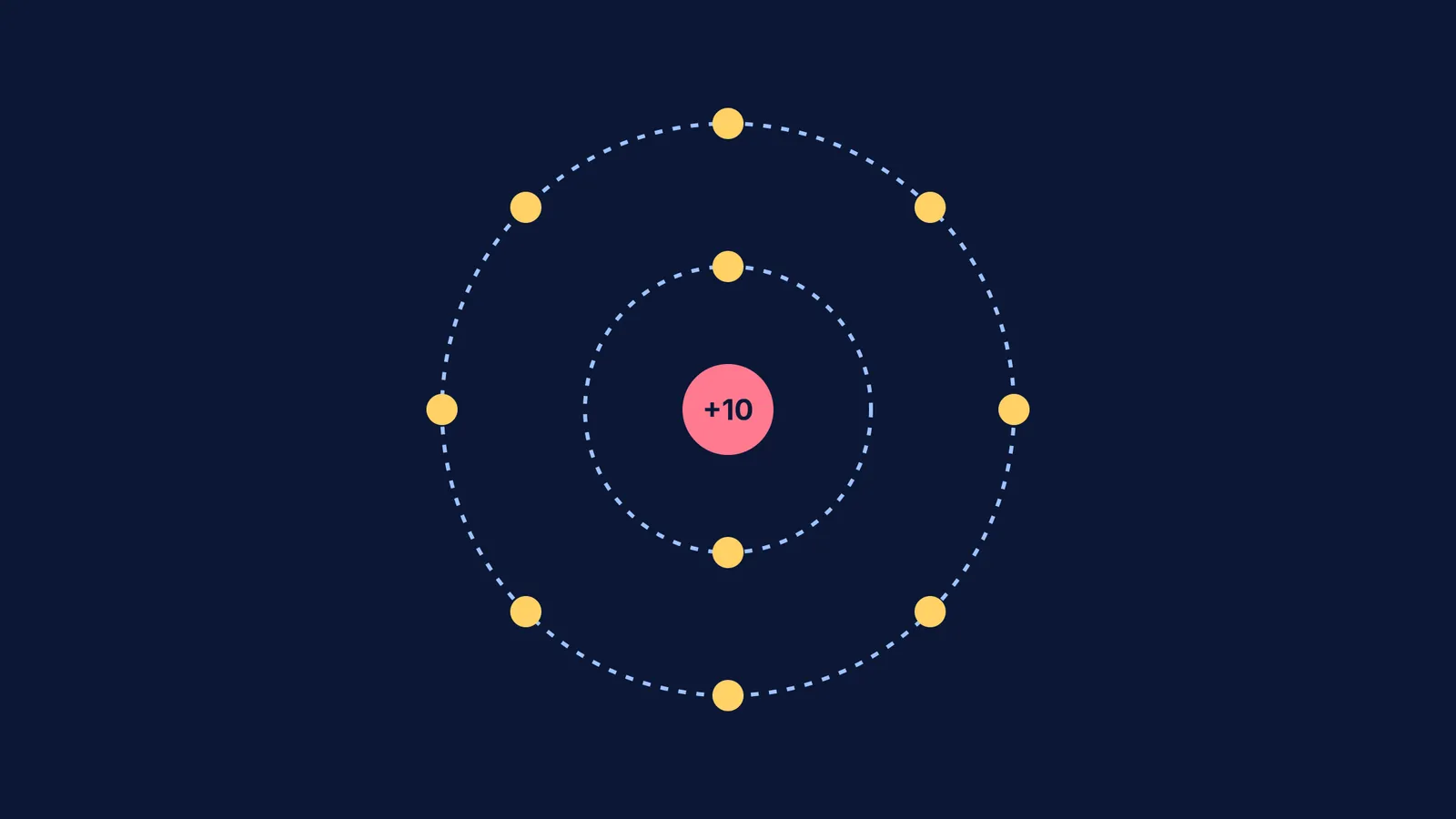
The simple answer comes down to the octet rule. For an atom to be chemically stable, it typically needs eight electrons in its outermost shell (its valence shell).
Helium (He) is stable with just two electrons (a duplet) because its single shell only holds two.
Neon (Ne), Argon (Ar), Krypton (Kr), Xenon (Xe), and Radon (Rn) all have exactly eight electrons in their outer shell.
Because their valence shells are full, there is no empty space to accept new electrons, and no weakly held electrons to give away. The Royal Society of Chemistry notes that this full shell leaves noble gases with no energetic incentive to react, so they do not form covalent or ionic bonds under normal conditions (Periodic Table: Helium).
If you are revising for exams and struggling to keep these rules straight, the Concept Library breaks down the octet rule and chemical bonding into visual, step-by-step lessons.
What keeps single atoms together in a gas?
Since noble gases do not form bonds, you might wonder how they ever condense into liquids. The answer is London dispersion forces. These are very weak, temporary attractive forces that occur when the electrons around an atom briefly shift to one side, creating a momentary dipole.
Because these forces are so weak, it takes very little heat to break the atoms apart. This is why noble gases have very low boiling points. Helium, the lightest noble gas, boils at just 4.22 K (Royal Society of Chemistry), remaining a gas at almost any temperature.
To understand how this differs from elements that do bond, you can review the difference between an atom, molecule, and ion in Class 9.
How does their stability appear in exam questions?
In board exams and competitive tests like JEE and NEET, the stability of noble gases is often tested through ionisation energy. Ionisation energy is the energy required to remove an electron from an atom.
Because noble gases have a full, stable shell, they hold onto their electrons very tightly. Helium has a first ionisation energy of 2372.3 kJ/mol, the highest of any element on the periodic table (Royal Society of Chemistry).
When tackling questions about electron configurations, remember that other elements react specifically to reach this noble gas state. For instance, when sodium and chlorine react, they transfer an electron so that both end up with a full octet, acting according to the Bohr-Bury rules for the distribution of electrons in shells.
If you get stuck on an ionisation energy trend, Fermi's AI tutor works out what you already know and builds a plan for the session, teaching through the reasoning rather than just printing an answer.
A checklist for exam questions on noble gases
When you see a question about group 18 elements in a chemistry paper, run through this mental checklist before writing your answer:
Check the octet: State clearly that the atom has a completely filled valence shell (ns² np⁶, or 1s² for helium).
Mention stability: Connect the full shell to the atom's lack of tendency to gain, lose, or share electrons.
Name the force: If asked about boiling points or states of matter, explicitly name "London dispersion forces" as the only force acting between the atoms.
Compare ionisation energy: Note that because the shell is full, removing an electron requires a massive amount of energy, leading to high first ionisation enthalpies.
Remember to follow this logic to secure full marks.


