

On this page
Every material you encounter in science class breaks down into microscopic particles, yet exam questions frequently test whether you can tell atoms, molecules, and ions apart. While textbooks often introduce these terms together, they represent distinct physical entities defined by their atomic composition, bonding behavior, and electrical charge.
What is the difference between an atom, a molecule, and an ion?
An atom is the smallest unit of an element that retains its characteristic chemical properties and carries zero net electrical charge (IUPAC Compendium of Chemical Terminology). In an isolated neutral atom, positively charged protons in the nucleus exactly balance negatively charged electrons in surrounding shells. Individual atoms of most elements have incomplete valence shells and cannot remain unbonded under normal conditions, which is why your syllabus introduces combination rules in Class 9 laws of combination and chemical formulae.
A molecule is an electrically neutral entity composed of two or more atoms held together by covalent chemical bonds (IUPAC Compendium of Chemical Terminology). Unlike single reactive atoms, a molecule is the smallest particle of an element or compound capable of stable, independent existence while retaining its chemical properties. Molecules can contain identical atoms, such as diatomic oxygen (O₂), or different elements bonded together, such as water (H₂O).
An ion is an atom or bonded group of atoms that carries a net positive or negative electrical charge (IUPAC Compendium of Chemical Terminology). Ions form when atoms transfer electrons during chemical reactions rather than sharing them. Losing one or more valence electrons creates a positively charged cation, whereas gaining electrons produces a negatively charged anion.
For students building foundational particle models, the Fermi Concept Library covers every concept in chemistry, each with its own lesson and its place in the map.
How do sodium, chlorine, and table salt illustrate each particle type?
Tracing sodium and chlorine demonstrates how shifting valence electrons alters a particle's identity, reactivity, and charge:
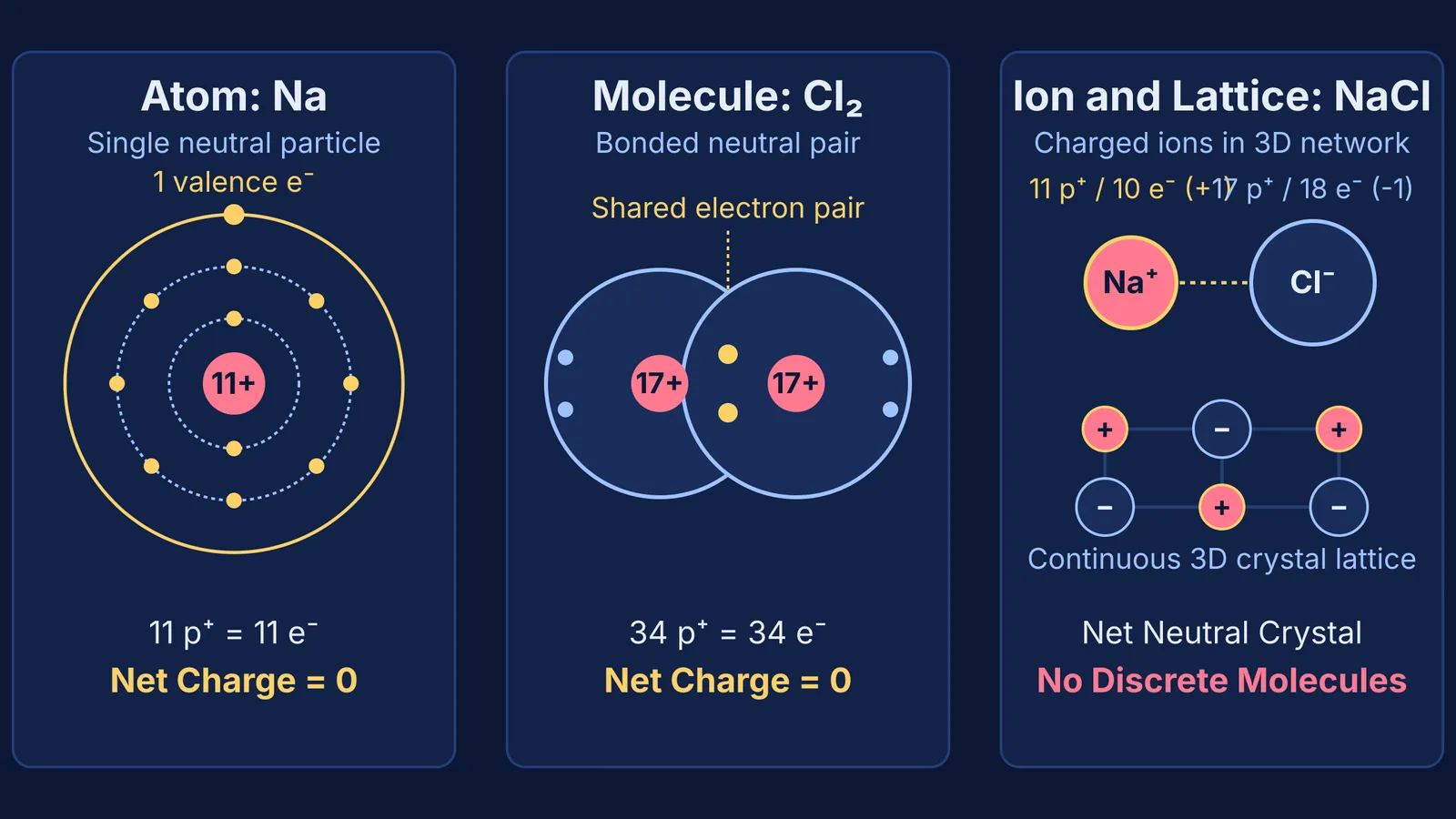
Sodium atom (Na): A single neutral atom containing 11 protons and 11 electrons. With an electron configuration of (2, 8, 1), it has one valence electron. Because it readily loses this electron, pure sodium metal is highly reactive and cannot exist as isolated free atoms in air or water.
Chlorine molecule (Cl₂): A diatomic molecule formed when two chlorine atoms each share one valence electron in a single covalent bond. The resulting molecule contains 34 protons balanced by 34 electrons, giving it zero net charge and stable independent existence as a gas. You can see how shared pairs complete octets in covalent electron dot structures.
Sodium cation (Na⁺): A monoatomic ion formed when a neutral sodium atom loses its outer valence electron. With 11 protons and only 10 electrons, it carries a net charge of +1 and attains the stable neon electron configuration of (2, 8).
Sodium chloride (NaCl): An ionic compound containing equal numbers of Na⁺ cations and Cl⁻ anions held together by electrostatic forces. Crucially, solid NaCl does not contain discrete two-atom molecules, but an extended three-dimensional crystal lattice.
Why is NaCl a crystal lattice rather than a molecule?
The distinction between an ionic solid and a molecule trips up students on examinations. In a study of 30 Grade-12 students, researchers Alan K. Griffiths and Kirk R. Preston identified 52 distinct student misconceptions about atomic and molecular structures, including confusion over particle bonding (Journal of Research in Science Teaching).
This issue was examined by Keith S. Taber, Georgios Tsaparlis, and Canan Nakiboğlu across secondary students in 3 European contexts (International Journal of Science Education). The authors found that students routinely adopt an incorrect "molecular framework" for ionic compounds, assuming a sodium ion is bonded only to the single chloride partner that accepted its electron to form an isolated "NaCl molecule."
In crystalline sodium chloride, there are no isolated pairs. Each Na⁺ ion is surrounded symmetrically by 6 equidistant Cl⁻ ions, and each Cl⁻ ion is surrounded by 6 equidistant Na⁺ ions. Non-directional electrostatic attraction acts equally across the lattice. Calling NaCl a molecule obscures this geometry and fails to explain why ionic compounds have high melting points and shatter along crystal cleavage planes. To understand how electron arrangements determine these charges, review Bohr models and atomic structure in Class 9.
How do you identify whether a chemical species is an atom, molecule, or ion?
When analyzing a chemical formula on a worksheet or examination, use this three-step diagnostic sequence:
Check for an explicit charge: Look at the top-right superscript. If you see a positive or negative sign (such as Na⁺, Mg²⁺, Cl⁻, or polyatomic ions like SO₄²⁻ and NH₄⁺), the species is an ion. If no superscript appears, the particle is electrically neutral.
Check the number of atoms: If the formula is neutral and contains a single element symbol without a subscript (such as Na, He, or Fe), you have an atom.
Check the bonding structure: If the neutral formula contains two or more non-metal atoms bonded covalently (such as Cl₂, O₂, CO₂, or CH₄), it is a molecule. If it pairs a metal with a non-metal (such as NaCl or MgO), it represents an ionic crystal structure written as a formula unit.
Testing four common examples confirms the classification: Ar is a neutral noble gas atom; O₂ is a neutral diatomic molecule; NH₄⁺ is a polyatomic cation; and KBr is an ionic compound composed of K⁺ and Br⁻ ions in a crystal lattice.
When working through chemical formula exercises, the Fermi Problem Library provides worked problems with a step-by-step solver that explains the reasoning rather than printing an answer. Practising with this step-by-step diagnostic prevents particle mix-ups and builds confidence for your upcoming chemistry exams.


