

On this page
In the early 19th century, scientists understood that air was a mixture of gases, primarily nitrogen and oxygen. Because oxygen is denser than nitrogen, many suspected that the atmosphere sorted itself out by weight. If true, the air near the ground would be rich in oxygen, while the upper atmosphere would be mostly nitrogen, making it unbreathable not just because it was thin, but because it chemically lacked life-sustaining oxygen.
To test this, Joseph Louis Gay-Lussac took to the sky. He first flew in August 1804 alongside his colleague Jean-Baptiste Biot. They were commissioned by the French Academy of Sciences to study the Earth's magnetic field and the atmosphere. Reaching about 4,000 metres, they found that magnetic intensity did not weaken. However, the combined weight of two men and their scientific equipment prevented the balloon from ascending further. To reach the extreme altitudes needed to truly test the air composition, Gay-Lussac knew he had to fly alone.
Does the composition of air change with altitude?
No. On September 16, 1804, Gay-Lussac flew a hydrogen balloon alone to a record-breaking altitude of 7,016 metres above sea level.
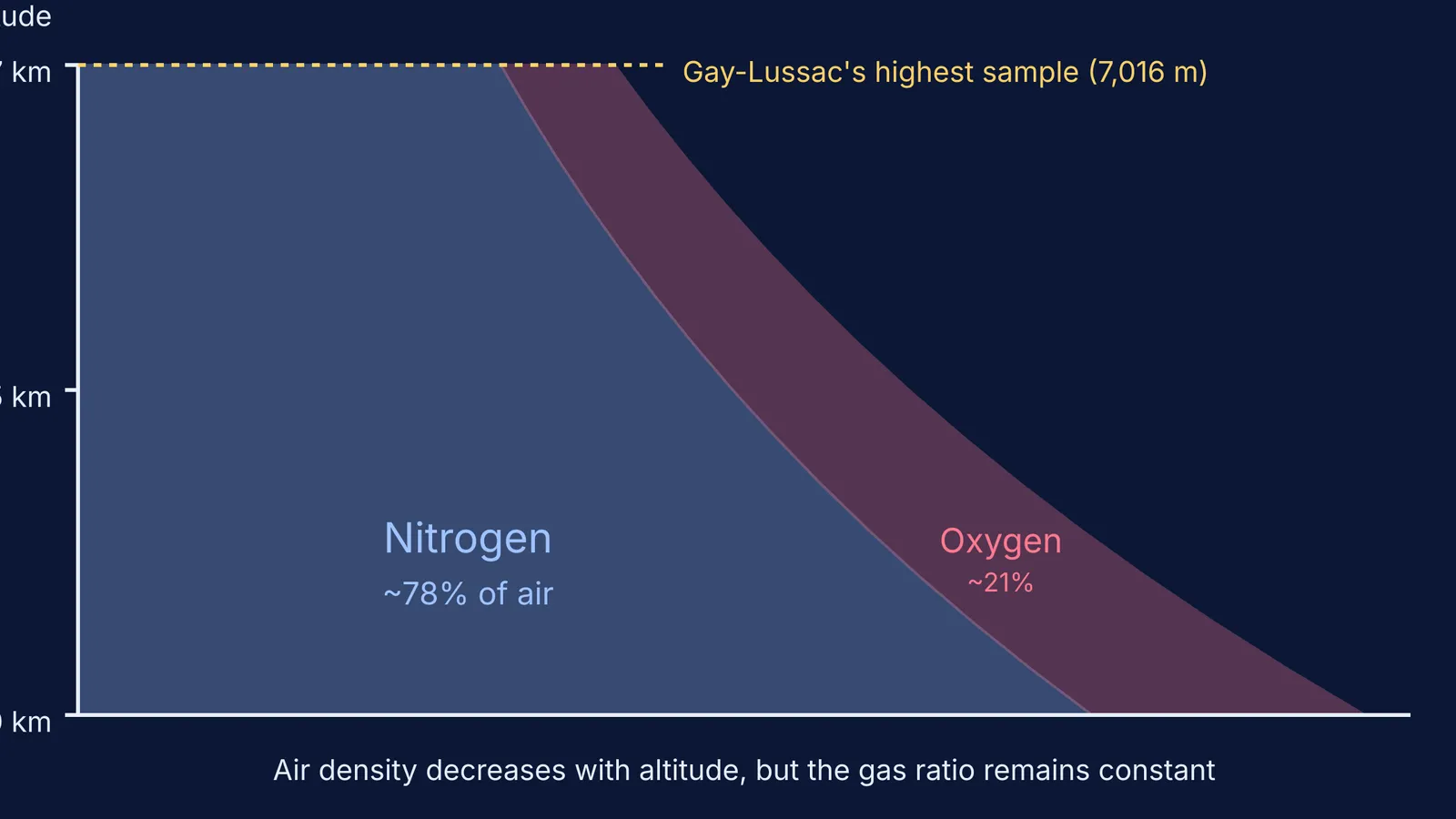
He brought two evacuated flasks with him, opening them at his maximum altitude to pull in the thin, freezing air. Upon returning to the ground, he analysed the samples and found that the air at 7,000 metres contained exactly the same proportion of oxygen (about 21%) as ordinary air at ground level.
This proved that the atmosphere is a well-mixed fluid. While the total density and pressure drop dramatically as you climb, the chemical ratio of the gases remains constant.
How did Gay-Lussac measure the composition of air?
Gay-Lussac used an instrument called a eudiometer, which measures the change in volume of a gas mixture after a chemical reaction.
To measure the oxygen, he mixed his high-altitude air sample with a known volume of pure hydrogen gas. He then passed an electric spark through the mixture, causing the hydrogen and oxygen to combust and form liquid water.
Because liquid water takes up vastly less volume than the gases that form it, the total volume of gas in the eudiometer shrank. By measuring this shrinkage, and knowing that hydrogen and oxygen combine in a strict 2:1 volume ratio, Gay-Lussac calculated exactly how much oxygen had been in his original sample.
Why do gases not settle into layers?
If oxygen is heavier than nitrogen, why does it not sink to the bottom of the atmosphere? The answer lies in the constant motion of gas molecules.
Thermal energy keeps the molecules moving rapidly in random directions. This process, called diffusion, mixes the gases far faster than gravity can separate them. Large-scale weather patterns and wind (convection) also stir the atmosphere continuously, ensuring that the 21% oxygen and 78% nitrogen blend stays uniform from the surface up to roughly 100 kilometres.
What this means for your studies
When you study the kinetic theory of gases or stoichiometry for JEE Main or NEET-UG, the equations can feel abstract. The barometric formula P = P₀ e^(-mgh/kT) tells you that pressure drops with height, but it does not tell you the story of a scientist shivering in a balloon to prove it.
Connecting the maths to real physical experiments makes it stick. If you struggle to picture how gas mixtures behave under pressure, the Concept Library has every concept in physics, chemistry, biology, mathematics and computing, each with its own lesson and its place in the map.
When you move on to solving eudiometry problems — predicting volume contractions after combustion — you can use the Problem Library. It features worked problems with a step-by-step solver that explains the reasoning rather than printing an answer, helping you master the ratios Gay-Lussac used.
If you are curious about other properties of gases, you might enjoy exploring Which Gas Balloons Float: Helium or Carbon Dioxide? or calculating how pressure changes depth in Air bubble doubles in volume as it rises: how deep is the lake?. You can also discover more about how to learn physics from first principles, not formulas.


