

On this page
Whether a brightly coloured party balloon drifts lazily to the ceiling or drops instantly to the floor comes down to one fundamental chemical property: density. While almost everyone knows that helium makes objects rise, predicting how other common household or industrial gases behave requires comparing their molecular masses directly to the surrounding atmosphere. Understanding this basic physical principle allows you to know exactly which balloons will take flight and which will remain firmly planted on the ground.
Which gas balloons float: helium or carbon dioxide?
To know if a gas will float, you must compare it to the air around it. According to the NASA Earth Fact Sheet, the average molar mass of Earth's dry air is 28.97 g/mol. This number is a weighted average of the gases in our atmosphere, primarily nitrogen (78.08%) and oxygen (20.95%).
For a balloon to float, the gas inside it must be less dense than the air it displaces. Because density is directly proportional to molar mass under standard conditions, any gas with a molar mass significantly lower than 28.97 g/mol will float. Any gas heavier than that will sink.
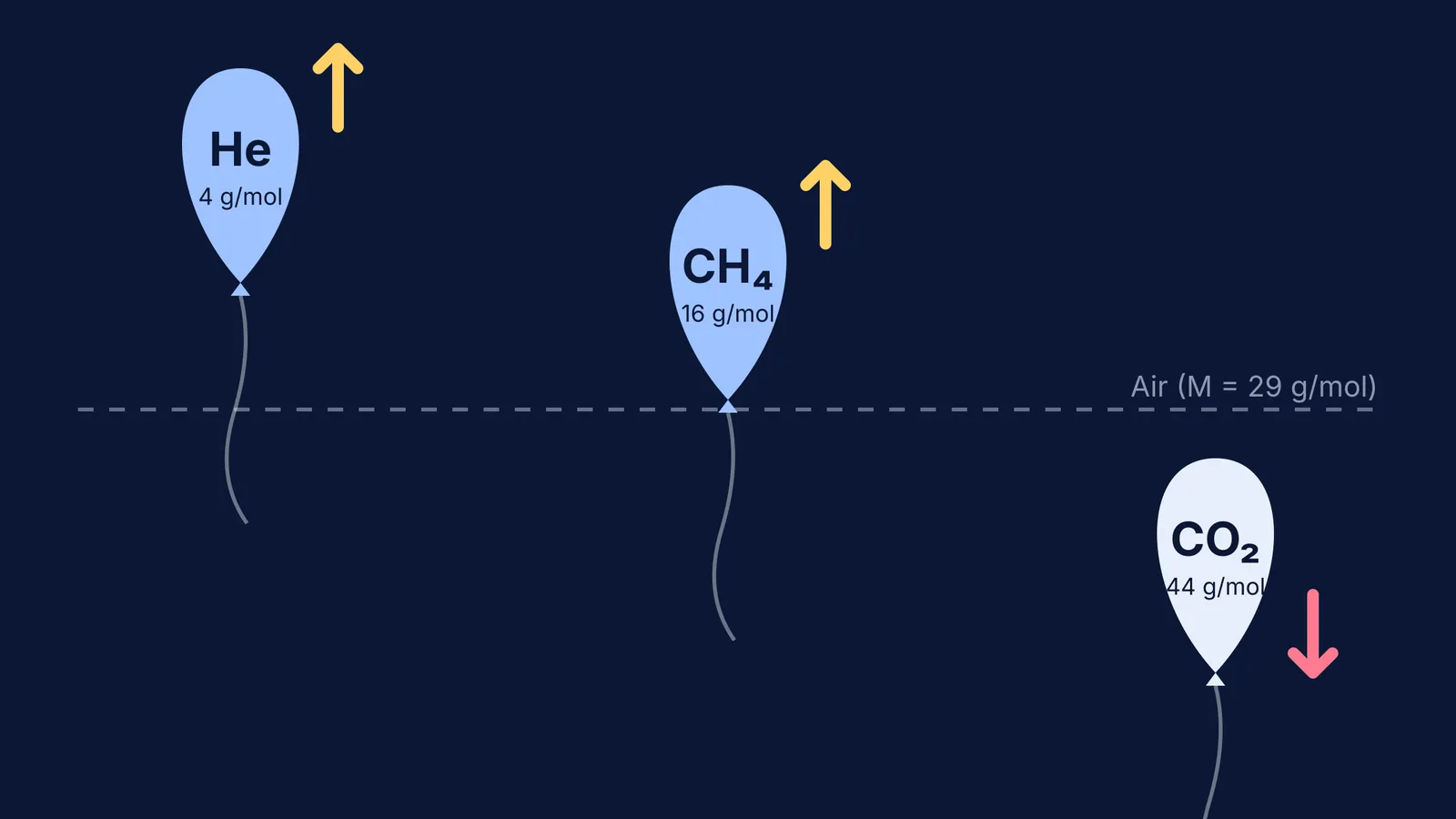
This means helium floats effortlessly, while carbon dioxide sinks.
Why do helium and methane balloons rise?
The ideal gas law tells us how pressure, volume, temperature, and mass interact. As derived in the OpenStax Chemistry textbook, the formula for gas density is d = PM / RT, where P is pressure, M is molar mass, R is the gas constant, and T is temperature. If the temperature and pressure are the same inside and outside the balloon, the density depends entirely on the molar mass (M).
Helium (He): With a molar mass of 4.00 g/mol (PubChem), helium is roughly seven times lighter than air. This creates a massive upward buoyant force, easily overcoming the weight of a rubber balloon.
Methane (CH₄): Methane consists of one carbon atom and four hydrogen atoms, giving it a molar mass of 16.04 g/mol (PubChem). Because 16.04 is much less than 28.97, methane is less dense than air, and a methane-filled balloon will also rise.
If you are working on advanced thermodynamics, you might also look at the free expansion of an ideal gas to understand how gases behave when not constrained by a balloon's skin.
Does a carbon dioxide balloon float or sink?
A carbon dioxide (CO₂) balloon will sink rapidly. Carbon dioxide contains one carbon atom and two oxygen atoms, giving it a combined molar mass of 44.01 g/mol (PubChem).
Because 44.01 g/mol is much higher than air's 28.97 g/mol threshold, the gas itself is fundamentally heavier than the air it pushes out of the way. This is also why balloons you inflate with your own breath do not float. Human breath contains carbon dioxide and moisture, making it denser than the surrounding room air.
When studying mixtures of atmospheric gases, meteorologists often calculate the average molar mass of a gas mixture to see exactly how moisture and CO₂ levels shift the local air density.
A checklist for predicting balloon buoyancy
You do not need an experiment to test if a gas will float. You can predict the outcome mathematically with this framework:
Find the chemical formula: Identify the exact molecule (e.g., CO₂ for carbon dioxide).
Calculate molar mass (M): Add up the atomic weights from the periodic table.
Compare against the air threshold: Check if your total is lighter or heavier than 28.97 g/mol.
Account for the casing: A gas must be sufficiently lighter than air (ideally with a molar mass under 25 g/mol) to provide enough upward lift to overcome the dead weight of the latex, rubber, or mylar foil casing. For instance, a balloon filled with pure nitrogen gas (which has a molar mass of 28.02 g/mol, according to PubChem) is technically lighter than the surrounding air mixture, but it will still sink. The minor difference in density simply cannot generate enough buoyant force to lift the mass of the balloon's rubber skin.
Visualising these invisible buoyant forces and the interactions between gas particles can make the underlying mathematics much more intuitive for students. If you want to explore how these principles work in practice, the Fermi Simulation Lab provides interactive simulations for the ideas that are easier to see than to read.


