

On this page
If a Class 12 or JEE question tells you A² = I, it has handed you the inverse for free. Here is why, and how mirrors help you picture it.
What is an involutory matrix?
An involutory matrix is a square matrix A such that A² = I, where I is the identity matrix, as defined on Wolfram MathWorld. It is the matrix version of functions where f(f(x)) = x.
Why is a matrix with A² = I its own inverse?
The NCERT Class 12 textbook (Chapter 3, Matrices) defines the inverse of a square matrix A as a matrix B of the same order with AB = BA = I. The same chapter proves, as Theorem 3, that the inverse of a square matrix, if it exists, is unique.
The proof that A⁻¹ = A takes two lines:
Put B = A. Then AB = BA = A² = I.
So A passes the definition of the inverse of A, and since the inverse is unique, A⁻¹ = A.
Three more facts follow from A² = I:
Taking determinants gives (det A)² = 1, so det A = 1 or −1.
Powers alternate: Aⁿ = A for odd n and Aⁿ = I for even n, so A¹⁰¹ = A and A⁵⁰ = I.
Every eigenvalue is +1 or −1, as the Wikipedia article on involutory matrices notes.
What are some examples of matrices with A² = I?
The identity I and its negative −I.
The swap matrix with rows (0, 1) and (1, 0). It exchanges x and y, which is reflection in the line y = x.
The matrix with rows (1, 0) and (0, −1). It flips the sign of y, which is reflection in the x-axis.
Any 2×2 matrix of the form with rows (a, b) and (c, −a) where a² + bc = 1, a family listed on the Wikipedia involutory matrix page.
Any permutation matrix that swaps two rows of the identity, such as the 3×3 matrix that swaps rows 1 and 2.
Worked example: take A with rows (3, −4) and (2, −3). Here a² + bc = 9 − 8 = 1. Multiplying, the top row of A² is (9 − 8, −12 + 12) = (1, 0) and the bottom row is (6 − 6, −8 + 9) = (0, 1). So A² = I and A⁻¹ = A, with no adjoint needed. If a step like this goes wrong in your own work, the Fermi Problem Library has worked matrix problems with a step-by-step solver that explains the reasoning rather than printing an answer.
How are involutory matrices linked to reflections?
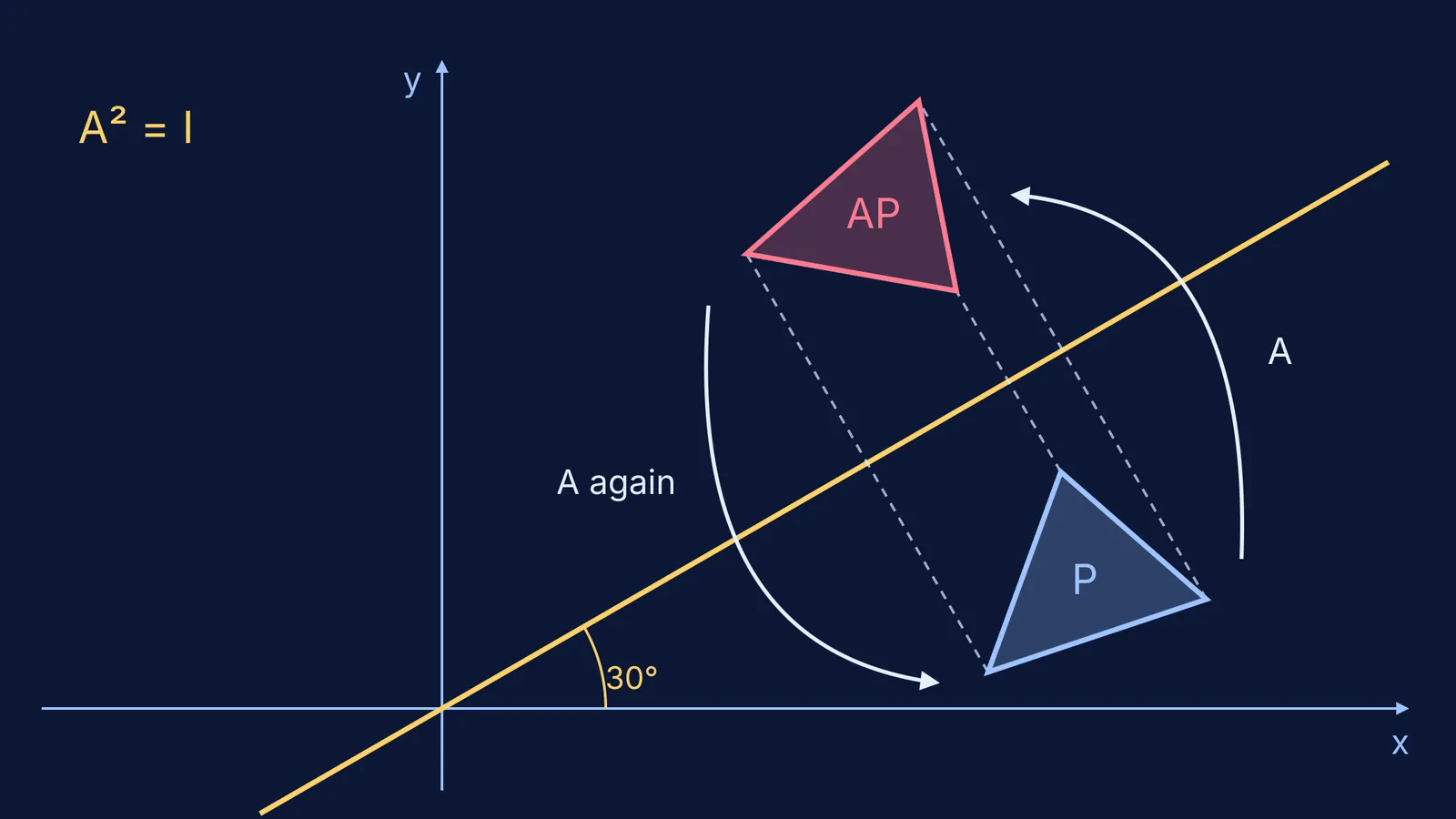
Reflect a shape in a mirror, then reflect the image, and it lands exactly where it began. Doing it twice is doing nothing: A² = I in picture form.
The matrix that reflects the plane in a line through the origin at angle θ to the x-axis has rows (cos 2θ, sin 2θ) and (sin 2θ, −cos 2θ), and every such reflection is its own inverse, according to Wikipedia's page on rotations and reflections in two dimensions. You can check it: the diagonal entries of its square are cos² 2θ + sin² 2θ = 1, and the off-diagonal entries cancel to 0.
For θ = 30°, the rows are (1/2, √3/2) and (√3/2, −1/2): the family above, with a² + bc = 1/4 + 3/4 = 1. A reflection matrix is orthogonal with determinant −1, as Wikipedia's article on reflection states.
Two different mirrors give a rotation instead, as shown in why two reflections make a rotation.
In any dimension, the Householder matrix P = I − 2vvᵀ, with v a unit vector, reflects space in the hyperplane through the origin perpendicular to v and is involutory, according to the Wikipedia article on the Householder transformation. Alston Householder used it in a 1958 Journal of the ACM paper.
How do you check A² = I quickly in an exam?
Is A equal to I or −I? Then you are done.
For any other 2×2 matrix, check for trace 0 and determinant −1. By the Cayley-Hamilton theorem, A² − (trace A)A + (det A)I = 0, so those two values give A² = I. See using Cayley-Hamilton to find A⁻¹ and A⁵⁰ for the method.
Is A a swap of two coordinates, or diagonal with only 1s and −1s? Then A² = I.
Once you know A² = I, replace A⁻¹ with A, even powers with I and odd powers with A.
If the gap is earlier, with inverses or determinants themselves, the Fermi Concept Library gives each concept in mathematics its own lesson and shows its place in the map.


