

On this page
Square 3 and you get 9; square again and you get 81. Some functions behave differently: apply one twice and you are back where you started. They turn up in Class 12 and JEE questions on composition, inverses and graph sketching.
What is a function with f(f(x)) = x called?
It is called an involution. An involution is a function that is its own inverse, so f(f(x)) = x for every x in its domain (Wikipedia: Involution)). The same article notes that every involution is a bijection, which makes sense: a function you can undo must be one-one and onto.
Three examples you already know:
f(x) = −x. Then f(f(x)) = −(−x) = x.
f(x) = 1/x, for x ≠ 0. Then f(f(x)) = 1/(1/x) = x.
f(x) = a − x, for any constant a. Then f(f(x)) = a − (a − x) = x.
The identity f(x) = x is the trivial case.
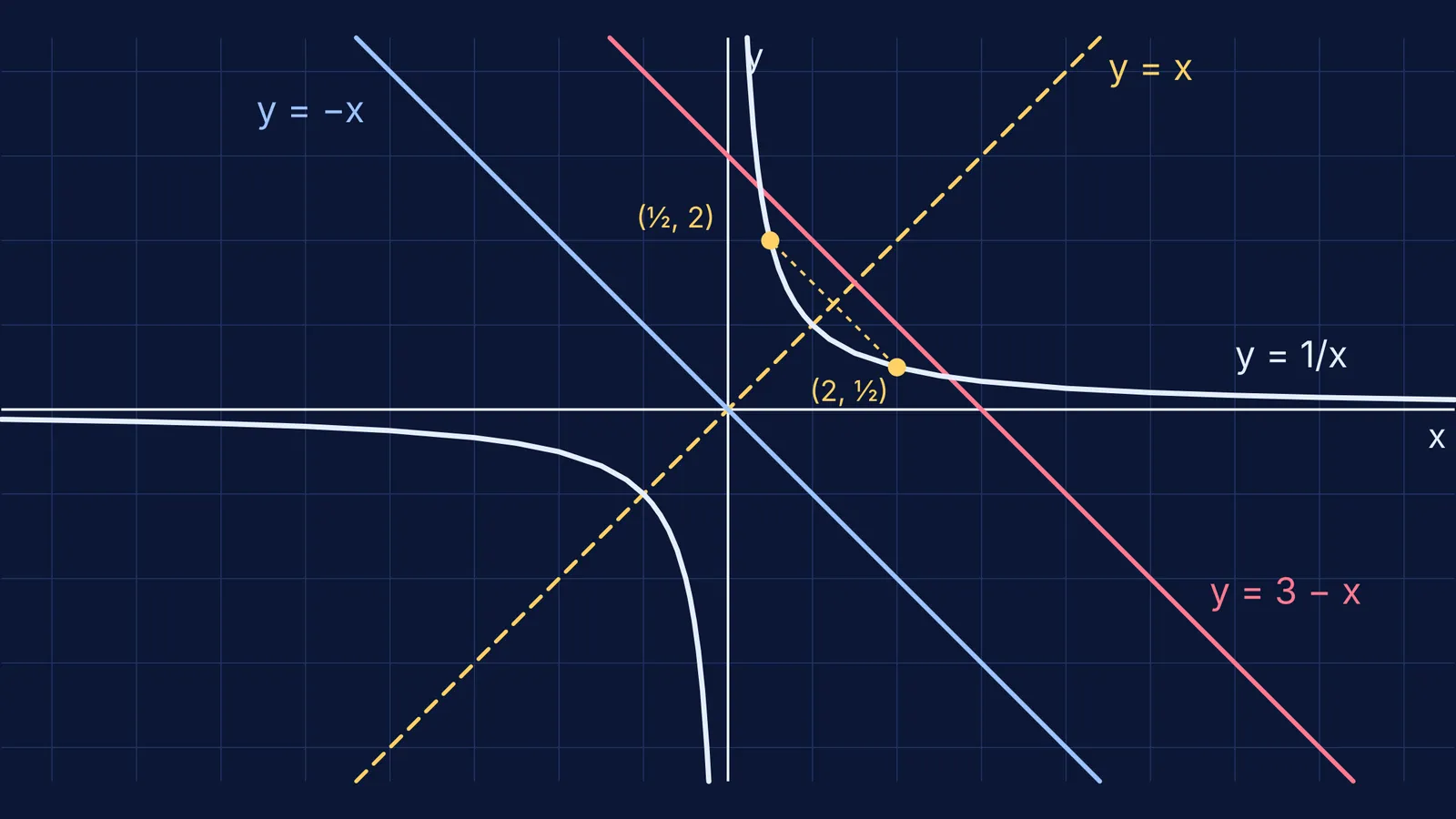
Why is the graph of an involution symmetric about y = x?
The graph of f⁻¹ is the graph of f reflected in the line y = x, because finding an inverse swaps the roles of x and y (Wikipedia: Inverse function). If f is its own inverse, reflecting its graph in y = x must give the same graph back. For the full reflection method, see how to graph an inverse function by reflecting in y = x.
The point (2, ½) lies on y = 1/x, and so does its mirror image (½, 2). The lines y = −x and y = 3 − x cross y = x at right angles, so reflection maps each onto itself.
A quick test: swap x and y in the equation. If it is unchanged, the graph is symmetric about y = x. xy = 1 and x + y = 3 survive the swap. y = x² becomes x = y², a different curve, so squaring is not an involution.
How do you check whether f(f(x)) = x? A worked example
Take f(x) = (4x + 3)/(6x − 4), with x ≠ 2/3.
Write f(f(x)) = (4f(x) + 3)/(6f(x) − 4).
Numerator: 4f(x) + 3 = (16x + 12 + 18x − 12)/(6x − 4) = 34x/(6x − 4).
Denominator: 6f(x) − 4 = (24x + 18 − 24x + 16)/(6x − 4) = 34/(6x − 4).
Divide: f(f(x)) = 34x/34 = x.
So f is its own inverse, and f⁻¹(x) = (4x + 3)/(6x − 4) with no further work. (For how composition behaves in general, see composite functions visualised.)
The shortcut: for f(x) = (ax + b)/(cx + d), composing f with itself matches squaring the matrix with rows (a, b) and (c, d). The square has b(a + d) and c(a + d) off the diagonal and a² + bc, d² + bc on it, so f(f(x)) = x when a + d = 0 and ad − bc ≠ 0 (apart from the trivial f(x) = x). Here a = 4 and d = −4. Both 1/x (a = d = 0) and a − x, written (−x + a)/1, pass too.
For more composition and inverse practice, the Fermi Problem Library has worked problems with a step-by-step solver that explains the reasoning rather than printing an answer.
Which functions can be involutions?
A two-line proof: a strictly increasing involution must be f(x) = x. If f(p) = q with q > p, applying the increasing f gives f(q) > f(p), so p > q, a contradiction; q < p fails the same way. So apart from x itself, no involution is strictly increasing; −x, a − x and each branch of 1/x are all decreasing.
Try these yourself:
f(x) = √(1 − x²) on [0, 1]. Then f(f(x)) = √(x²) = x. Its graph is a quarter circle, symmetric about y = x.
f(x) = (x + 1)/(x − 1), x ≠ 1. Here a = 1 and d = −1, so it passes.
A three-step check for exam questions
Look at the shape. Is it a constant minus x, k/x, or (ax + b)/(cx + d) with a + d = 0 and ad − bc ≠ 0? Then expect an involution.
Test one number. Pick a value in the domain, apply f twice, and see if you get it back. If not, stop: it is not an involution.
Prove it for all x and state the domain. For (ax + b)/(cx + d) with a + d = 0, the excluded input −d/c is also the one value f never takes.
If the ideas underneath feel shaky, inverses, bijections and composition each have their own lesson in the Fermi Concept Library, so you can revise them as one connected topic.


