
On this page
In the CBSE Business Studies curriculum for 2026-27, Internal Trade is Unit 9 of Class 11, in Part B (Finance and Trade), and it shares 20 theory marks with Unit 10, International Business.
The textbook chapter is Chapter 10 of the NCERT Business Studies Class 11 book, reprint 2026-27.
What is internal trade in Class 11?
In NCERT's terms, internal trade is trade in goods and services that takes place inside one country's borders (NCERT Chapter 10).
It has two types:
Wholesale trade: buying and selling in large quantities for resale or for use in further business.
Retail trade: buying and selling in relatively small quantities, mostly to the final consumer.
For how trade fits into business as a whole, see our notes on the nature and purpose of business.
What services do wholesalers and retailers provide?
NCERT groups these services by who receives the service, so learn four short lists.
Wholesalers to manufacturers: large-scale production (pooling small retail orders into bulk orders), bearing risk, financial help (prompt cash payment), expert advice about the market, help with marketing, continuity of production, and storage.
Wholesalers to retailers: ready availability of goods, marketing support, credit, specialised knowledge, and risk sharing.
Retailers to manufacturers and wholesalers: distribution to scattered buyers, personal selling, enabling large-scale operations, collecting market information, and help in promotion.
Retailers to consumers: regular availability, information about new products, convenience in buying, a wide selection, after-sales services, and credit for regular buyers.
What are the types of retail outlets?
NCERT splits retailers into two groups (NCERT Chapter 10).
Itinerant retailers have no fixed place of business and move to find customers: peddlers and hawkers, market traders, street traders (pavement vendors) and cheap jacks.
Fixed shop retailers sell from a permanent shop. Small ones are general stores, speciality shops, street stall holders and second-hand goods shops. Large ones include departmental stores and chain stores (multiple shops).
The syllabus names three large-scale formats in its learning outcomes: departmental stores, chain stores and mail order business (CBSE curriculum). How they differ, in NCERT's terms:
Departmental store: one large store, centrally located, with separate departments meeting almost every need under one roof; many services; may give credit to regular customers.
Chain store: many similar-looking branches in busy localities, run from a head office that buys centrally; a narrow range of standard branded goods; fixed prices; cash sales.
Mail order house: sells by post with no face-to-face contact; customers order from advertisements or catalogues.
A quick test: if the question stresses "one roof" and "central location", it is a departmental store; if it stresses "uniform prices" and "branches near customers", it is a chain store.
What is GST and how does it work?
India brought in the Goods and Services Tax on 1 July 2017 (PIB, September 2025). NCERT explains GST as one destination-based tax on the supply of goods and services that took the place of many separate Central and State indirect taxes (NCERT Chapter 10). It has a Central part (CGST) and a State part (SGST).
The key feature is input tax credit: each seller subtracts the GST already paid on its purchases, so tax is never charged on tax, and the final consumer bears the whole tax.
One update the textbook does not show: NCERT still lists four slabs (5%, 12%, 18% and 28%), but the GST Council recommended a two-slab structure of 5% and 18%, with a 40% rate for a small group of luxury and sin goods, and the new rates took effect from 22 September 2025 (a few tobacco products excepted) (PIB, September 2025). For the earlier GST maths you met in school, see our Class 8 guide to calculating GST on a bill.
Worked example: GST along the chain
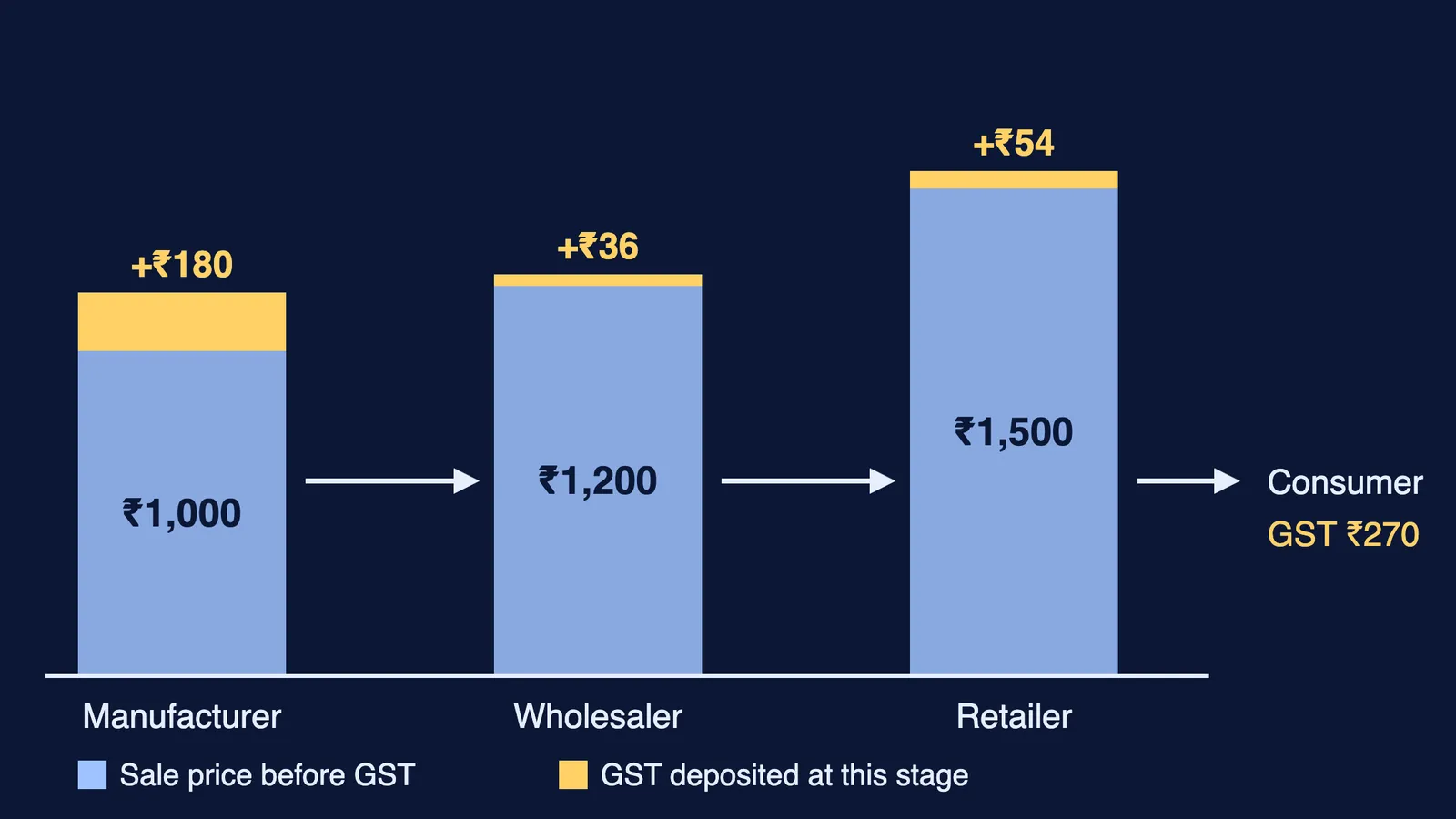
Suppose an item is taxed at 18% and moves from manufacturer to wholesaler to retailer to you.
The manufacturer sells for ₹1,000 plus ₹180 GST. It deposits ₹180.
The wholesaler sells for ₹1,200 plus ₹216 GST. It claims credit for the ₹180 it paid and deposits ₹36.
The retailer sells for ₹1,500 plus ₹270 GST. It claims credit for ₹216 and deposits ₹54.
You pay ₹1,770. The government receives ₹180 + ₹36 + ₹54 = ₹270, which is exactly 18% of the ₹1,500 final price before tax.
Without the credit, each stage would tax a price that already included tax: the "cascading effect" (tax on tax) that NCERT says input tax credit helps avoid.
If percentages trip you up, the Fermi Concept Library has every concept in mathematics, each with its own lesson.
How should you revise internal trade?
Day 1: write the definitions and four service lists from memory; check against NCERT.
Day 2: draw a two-branch tree of retail types with one example you have seen for each.
Day 3: answer one comparison question (departmental store vs chain store) using the seven points of difference NCERT gives.
Day 4: redo the GST example with your own numbers and explain input tax credit in three sentences.
Next, see who owns these shops in our guide to forms of business organisation.