On this page
A row of charges that never ends sounds like it should give an infinite answer. It doesn't. Each charge alone is a one-line calculation; the skill is spotting that those lines form a geometric progression and summing it with the right ratio and signs.
How do you find the electric field of charges at x = 1, 2, 4, 8 … ?
You need two facts. The field of a point charge has magnitude E = kq/r², where k = 1/(4πε₀) ≈ 8.99 × 10⁹ N m²/C² (OpenStax University Physics, Coulomb's law). When several charges are present, the total field is the vector sum of the separate fields (OpenStax, electric field).
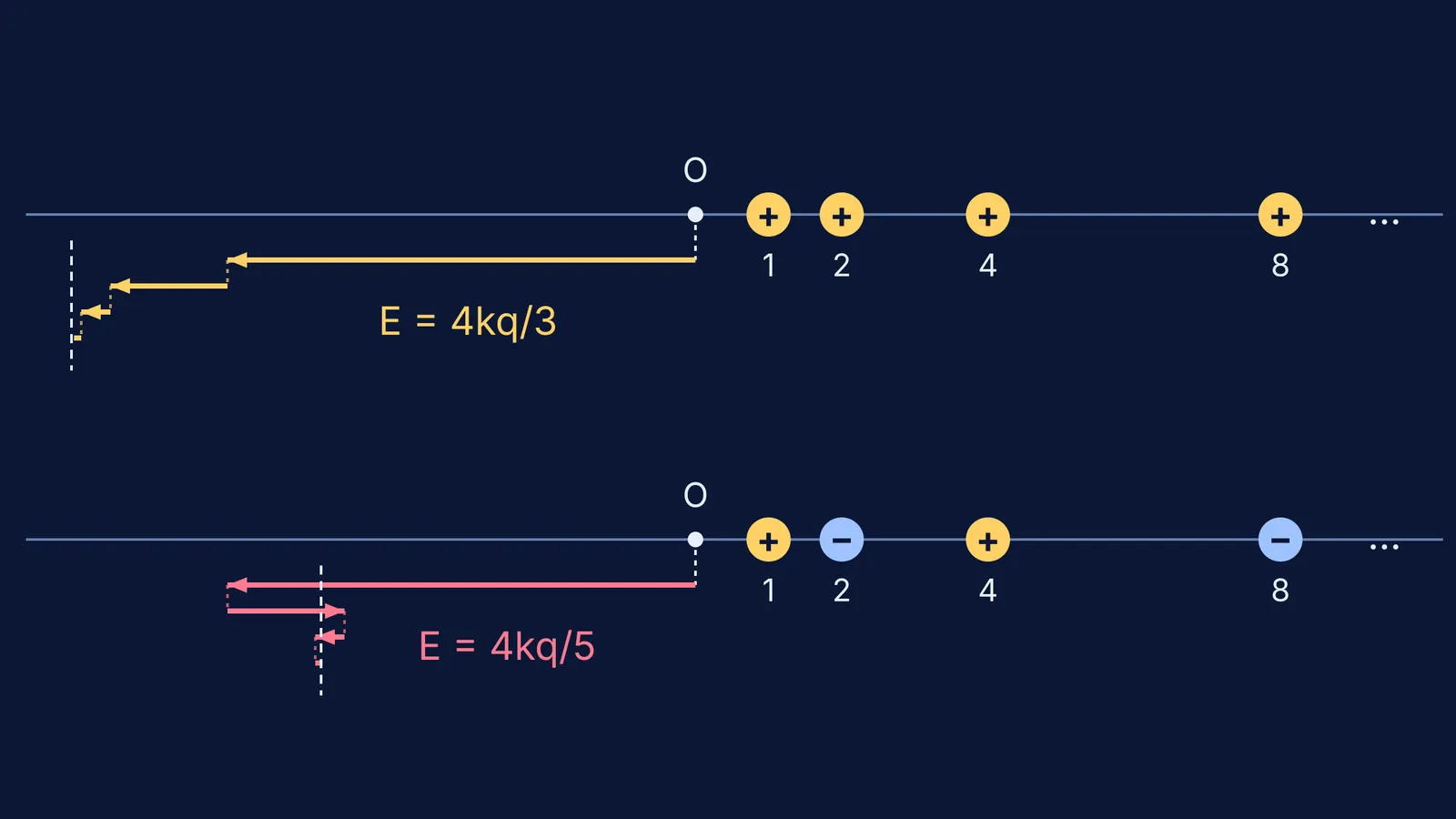
Every charge sits on the positive x-axis, so for positive q each field at the origin points along −x. On one line, the vector sum becomes a plain sum of magnitudes:
E = kq(1/1² + 1/2² + 1/4² + 1/8² + …) = kq(1 + 1/4 + 1/16 + 1/64 + …)
The first term is a = 1 and the common ratio is r = 1/4. An infinite geometric series a + ar + ar² + … converges to a/(1 − r) when |r| < 1 and diverges otherwise (OpenStax Calculus Volume 2). So E = kq × 1/(1 − 1/4) = 4kq/3, pointing along −x, away from the charges. For more on the |r| < 1 condition, see when an infinite GP has a finite sum.
What is the potential at the origin?
The potential of a point charge is V = kq/r, and potentials from several charges add as ordinary numbers, not vectors (OpenStax, calculations of electric potential). That makes this half easier:
V = kq(1 + 1/2 + 1/4 + 1/8 + …) = kq × 1/(1 − 1/2) = 2kq
What changes when the charges alternate in sign?
Now put +q at x = 1, −q at x = 2, +q at x = 4, and so on. A negative charge's field points towards it, so the −q at x = 2 contributes along +x. The terms alternate:
E = kq(1 − 1/4 + 1/16 − 1/64 + …), ratio r = −1/4, so E = kq × 1/(1 + 1/4) = 4kq/5, along −x
V = kq(1 − 1/2 + 1/4 − 1/8 + …), ratio r = −1/2, so V = kq × 1/(1 + 1/2) = 2kq/3
Check: the partial sums of the field series go 1, 0.75, 0.8125, 0.797… and settle at 0.8.
Worked example: what are the numbers for q = 1 μC?
Take k ≈ 9 × 10⁹ N m²/C² (OpenStax's 8.99 × 10⁹, rounded) and distances in metres. Then kq = 9 × 10⁹ × 10⁻⁶ = 9 × 10³ N m²/C.
Same signs: E = (4/3) × 9 × 10³ = 1.2 × 10⁴ N/C along −x, and V = 2 × 9 × 10³ = 1.8 × 10⁴ V.
Alternating signs: E = (4/5) × 9 × 10³ = 7.2 × 10³ N/C along −x, and V = (2/3) × 9 × 10³ = 6.0 × 10³ V.
The general version: for charges at x = d, db, db², … with b > 1, the field is (kq/d²) × b²/(b² − 1) and the potential is (kq/d) × b/(b − 1). With alternating signs, the minus signs in the denominators become plus signs. For b = 3 (charges at 1, 3, 9, 27 m) you get 9kq/8 and 3kq/2.
Which mistakes cost marks on this problem?
Field ratio is 1/b², potential ratio is 1/b. Never use the same ratio for both.
The field is a vector. State the direction (−x here), not just 4kq/3. Our post on Coulomb's law in vector form shows how to let the signs set the direction.
In the alternating case, the charge's sign already flips each term. Don't flip it again by hand.
Check the first term. If the row starts at x = 2, then a = kq/4 for the field and kq/2 for the potential.
Check that the positions form a GP. With charges at x = 1, 2, 3, 4 …, the potential series is 1 + 1/2 + 1/3 + …, the harmonic series, which diverges (OpenStax Calculus Volume 2). For a refresher, see AP vs GP: how to identify them.
If you want to practise more superposition sums like this one, the Fermi Problem Library has worked problems with a step-by-step solver that explains the reasoning rather than printing an answer. If the gap is in the idea, the Fermi Concept Library gives each concept, including superposition and electric potential, its own lesson.
Try it now: cover the answers, set b = 3 with alternating signs, and check that you get 9kq/10 for the field and 3kq/4 for the potential.